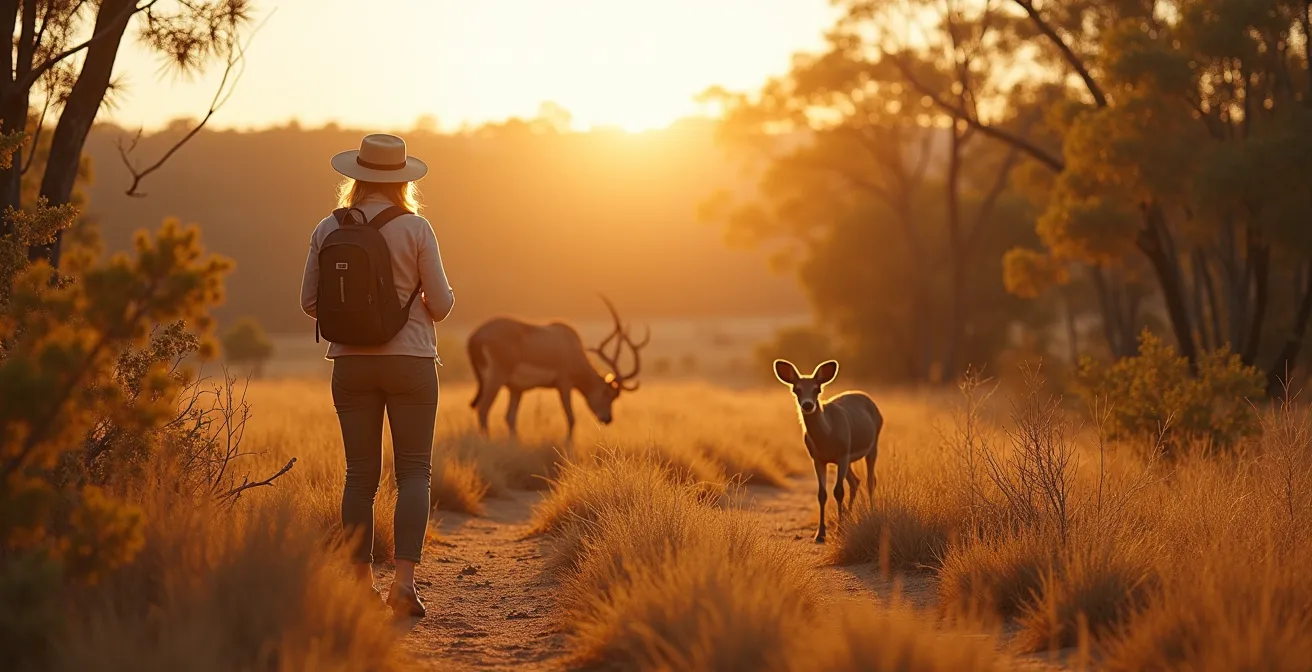
The key to safely experiencing Australia’s wildlife isn’t avoiding it, but understanding its language.
- Recognize an animal’s warning signs instead of provoking an instinctive reaction.
- Back away slowly and sideways to signal you are not a threat; never turn and run.
- Turn simple checks of your shoes, clothing, and car into preventative safety rituals.
Recommendation: Adopt these preventative habits to ensure every encounter is respectful and safe for both you and the animals.
The desire to get that perfect photo of a kangaroo or a koala is a powerful one for many visitors to Australia. It’s a chance to connect with a unique and iconic natural world. But this enthusiasm, when not guided by knowledge, can lead to dangerous situations. The common advice you’ll hear is to “keep your distance” or “don’t feed the animals.” While true, this advice is incomplete. It tells you *what* to do, but not *why* you’re doing it. It treats wildlife as an unpredictable threat to be avoided rather than a complex system to be understood.
As a ranger, I’ve seen countless interactions go wrong not because of malice, but because of a simple misunderstanding. The truth is that most negative encounters are preventable. They happen when we, as humans, unintentionally send the wrong signals. We misinterpret an animal’s body language, trigger a defensive instinct, or inadvertently cause long-term harm through a moment of misguided kindness. The real secret to safety isn’t about fear or avoidance; it’s about behavioral decoding. It’s about learning to read the signs, understand the instincts, and respect the unspoken rules of the bush.
This guide moves beyond the generic warnings. We’re not just going to list rules; we’re going to translate the language of the wild. By understanding why a kangaroo stands tall or why you should never run from a dingo, you transform from a potential threat into a respectful observer. This shift in perspective is what truly keeps you—and our precious wildlife—safe.
This article will walk you through the essential principles of wildlife safety, from decoding animal warnings and understanding the fatal consequences of feeding them, to mastering preventative rituals and reacting correctly in a close encounter. Let’s begin your training as a responsible wildlife observer.
Summary: An Australian Ranger’s Guide to Wildlife Encounters
- Why a kangaroo standing tall is a warning signal you should never ignore?
- The “lumpy jaw” disease: how feeding bread to wallabies sentences them to death?
- The shoe shake routine: preventing spider bites in rural accommodation
- The “swerving for wildlife” mistake that causes most rural car accidents
- Stand still or run: the correct reaction when you encounter a snake on the path?
- Back away slowly: why turning and running triggers the chase instinct?
- Joint pain and fatigue: how to tell Ross River apart from the flu?
- How to Spot Nocturnal Marsupials in the Wild Without Disturbing Them?
Why a kangaroo standing tall is a warning signal you should never ignore?
A large male kangaroo standing up on its hind legs, puffing out its chest, might look like a classic “Aussie” photo opportunity. In the animal’s language, however, it’s anything but a friendly pose. This posture is a clear challenge signal. He is assessing you as a potential rival. Continuing to approach, or even holding direct eye contact, confirms his suspicion that you are a threat to his dominance or his mob (family group). This is a classic example of behavioral decoding: you’re not seeing a cute animal, you’re seeing a clear warning.
While fatal kangaroo attacks are incredibly rare—with only 2 documented deaths from kangaroo attacks since 1936—getting too close can provoke a defensive reaction. A male kangaroo can use its powerful hind legs to kick or its sharp claws to grapple, causing serious injury. The goal is never to get to this point. Your first response to a tall stance should be de-escalation. Avert your gaze, turn your body side-on to appear smaller, and begin to back away slowly and calmly. This signals submission and shows you are not a challenger.
Understanding this interaction is the first step to safer encounters. It’s not about the kangaroo being “aggressive”; it’s about you inadvertently speaking the language of a challenger. By learning to recognize these instinctive triggers, you can stop a confrontation before it even begins. This principle of reading and respecting an animal’s personal space and signals is the foundation of all safe wildlife interactions in Australia. It’s a quiet, respectful conversation, not a one-sided photo-op.
The “lumpy jaw” disease: how feeding bread to wallabies sentences them to death?
Tossing a piece of bread or a chip to a cute wallaby seems harmless, even kind. But this single act can be a death sentence. Native macropods like kangaroos and wallabies have highly specialized digestive systems designed for tough, fibrous native grasses. A diet high in processed carbohydrates, like bread, disrupts their gut flora and leads to a horrific condition called “lumpy jaw” (Actinomycosis). This bacterial infection causes painful abscesses in the jaw, leading to swelling, an inability to eat, and eventual starvation. Your act of kindness becomes an ecological consequence of the most tragic kind.
The Queensland Government is clear that providing food causes animals to become dependent and can lead to health problems and unnatural concentrations of wildlife. When animals get used to being fed, they lose their natural fear of humans and can become demanding or aggressive when food isn’t offered. This creates a dangerous cycle for both the animal and the next person who encounters it. Instead of offering food, the most ethical action is to support the organizations dedicated to their care and to appreciate them from a distance.
The image below symbolises the ethical alternatives. Focusing on observation with tools like binoculars and supporting conservation efforts protects these animals, rather than harming them with misplaced generosity.
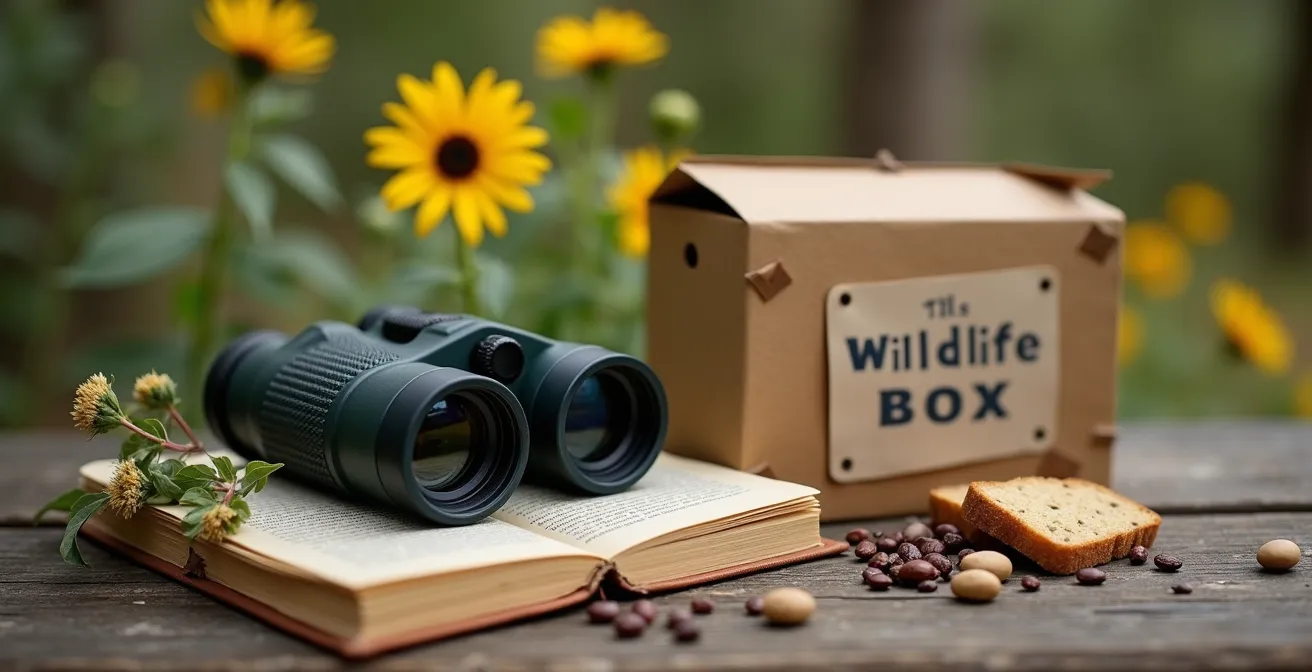
Ultimately, the rule is absolute: never feed native wildlife. It alters their behaviour, destroys their health, and sentences many to a slow, painful death. True kindness is respecting their wild nature and allowing them to thrive on the diet that millennia of evolution have perfected for them. Your respect is a far greater gift than a piece of bread.
The shoe shake routine: preventing spider bites in rural accommodation
The fear of Australia’s spiders is often greater than the reality. Sensationalized stories have created a myth that every corner hides a deadly threat. While caution is necessary, panic is not. In 2022, there were only 5 deaths from venomous animals in Australia, and with the development of antivenom for species like the funnel-web, fatalities from spider bites are now virtually zero when treated. The key isn’t to live in fear, but to adopt simple, effective preventative rituals that become second nature.
Spiders and other creatures often seek dark, quiet places to shelter. A shoe left on the floor, a helmet on a table, or clothes in a pile are perfect hiding spots. The most common way bites occur is when a person accidentally traps or presses a spider against their skin. This is not an “attack” but a last-ditch defensive reaction from a terrified animal. The “shoe shake routine” is your first line of defense: always pick up and shake out your footwear before putting it on. This single habit can prevent the vast majority of potential bites.
This same logic applies to all your belongings in rural or bush settings. By turning these checks into a consistent routine, you systematically eliminate the risk. It’s a far more effective and calming approach than constantly worrying about what might be lurking. It puts you in control of your own safety through mindful, repeatable actions.
Your Accommodation Safety Checklist: Points to Verify
- Footwear Inspection: Vigorously check and shake out all shoes, boots, and any footwear before wearing.
- Toilet Seat Check: Always inspect under the toilet seat, a classic hiding spot for redback spiders.
- Headwear & Clothing: Examine the inside of helmets and hats, and shake out any clothing left on the floor or furniture.
- Vehicle Inspection: Look behind sun visors in your car before driving, especially if parked outdoors.
- Tent & Bag Discipline: Keep tent zippers and bags fully closed at all times to prevent unwanted entry.
The “swerving for wildlife” mistake that causes most rural car accidents
When driving on a rural Australian road, especially at dawn or dusk, an animal suddenly appearing in your headlights is a very real possibility. The instinctive human reaction is to swerve violently to avoid hitting it. This is often the most dangerous mistake you can make. More serious accidents are caused by drivers losing control and hitting a tree, rolling the vehicle, or swerving into oncoming traffic than by the initial impact with the animal itself. The latest data from Australian insurance reports shows thousands of wildlife collision claims annually, many of which are complicated by these secondary accidents.
The correct, albeit counter-intuitive, response is to brake firmly and in a straight line. Maintain control of your vehicle above all else. While the thought of hitting an animal is distressing, your own safety and that of your passengers must be the priority. This is particularly true during droughts or hot summers, when wildlife is more likely to wander into towns and onto roads in search of food and water.
If a collision is unavoidable and you have safely stopped, the next step is to act ethically. Pull over, turn on your hazard lights, and assess the situation. If the animal is a marsupial like a kangaroo or wombat, it is crucial to check its pouch for a surviving joey, even if the mother is deceased. A joey can survive for days in the pouch, and your call can be its only chance. Do not try to be a hero; contact a local wildlife rescue organization immediately. They have the training and equipment to handle the situation safely and humanely. Saving the WIRES number (1300 094 737) in your phone before a road trip is a vital preparation step.
Stand still or run: the correct reaction when you encounter a snake on the path?
There are few things that stop a hiker in their tracks faster than a snake on the path ahead. In this moment of high-adrenaline surprise, your next move is critical. The instinct for many is to scream, jump back, or run. These sudden movements are precisely the wrong thing to do. A snake’s primary senses are vibration and vision. It has poor hearing but is highly attuned to ground vibrations and rapid movement, which it interprets as a threat from a large predator.
The correct hierarchy of response is simple: first, freeze. Stand completely still. You are no longer registering as a fast-moving threat. The snake, which was likely just passing through on its way to find food or sun itself, will often not even perceive you as a living thing. Its main desire is to be left alone and it does not want a confrontation with something as large as a human. As experts from the Australian National University advise, you should calmly back away and give it a wide berth.
Once the initial shock has passed and you are frozen in place, you can slowly and deliberately back away, giving the snake a very wide path to continue on its way. The best encounter is one that never happens. You can greatly reduce the chances of a surprise meeting by making noise as you walk—stomping your feet occasionally creates vibrations that warn snakes of your approach long before you see them. Always wear enclosed shoes and long pants in the bush, and never step over a log without first checking what’s on the other side. Snakes are a vital part of the ecosystem; give them space, and they will give you yours.
Back away slowly: why turning and running triggers the chase instinct?
The urge to turn and run from a potentially dangerous animal like a dingo or a large kangaroo is a primal one. However, in the language of the animal kingdom, this is the most dangerous signal you can send. It is an action that unequivocally identifies you as prey. This single act can flip a switch in the animal’s brain, activating a powerful, hard-wired predatory response.
As wildlife experts from the Australian National University explain, this isn’t a malicious or aggressive decision on the animal’s part; it’s pure instinct.
Running identifies you as ‘prey’, activating an innate and powerful chase response. It’s not malicious; it’s instinct.
– Australian National University Wildlife Safety Guide, Wildlife at ANU Safety Information
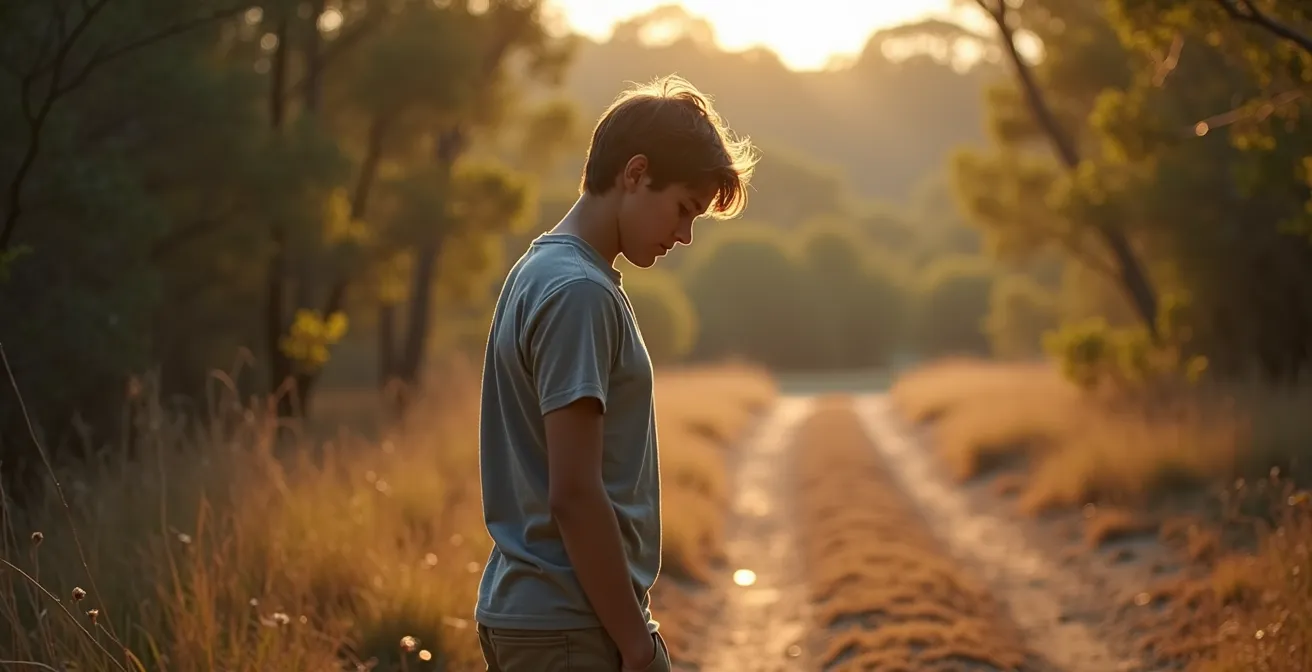
This chase instinct is a fundamental predator-prey dynamic. The correct protocol, which applies to almost all wildlife encounters, is to back away slowly and deliberately. Never turn your back. By keeping your front towards the animal and increasing the distance calmly, you communicate that you are not a threat, nor are you frightened prey. You are simply a large, uninteresting object that is leaving its space. For added effect, turning your body slightly side-on makes you appear smaller and less confrontational, as demonstrated in the posture below.
This principle is adapted for different species. When encountering a cassowary, for example, experts recommend backing away slowly while holding a bag or backpack between you and the bird to act as a shield. If camping in dingo habitats, such as on K’gari (Fraser Island), it’s vital to secure all food, as the scent can attract them to your campsite and create situations of conflict. In every case, the core lesson is the same: control your fear, suppress the urge to run, and move in a way that signals calm confidence, not panicked prey.
Joint pain and fatigue: how to tell Ross River apart from the flu?
Not all wildlife dangers are large and toothy. Some of the most debilitating come from one of Australia’s smallest creatures: the mosquito. Ross River fever is a viral illness transmitted by mosquitoes that can cause debilitating symptoms. The initial signs—fever, fatigue, and aches—are often mistaken for a bad case of the flu. However, knowing the key differences is crucial for getting the right diagnosis and managing expectations for recovery, which can be a much longer process than with influenza.
The defining symptom of Ross River fever is severe and often migrating joint pain (polyarthralgia), typically in the wrists, knees, and ankles. This is distinct from the generalized muscle aches (myalgia) of the flu. Furthermore, while the flu usually resolves within a week or two, the joint pain and fatigue from Ross River can persist for months, sometimes even longer. Your geographic location is also a major clue. The risk is highest near wetlands and river systems, particularly after heavy rains which trigger mosquito breeding cycles. The peak season is typically during the wet season in northern Australia, whereas the flu is more common in the winter months.
The following table, based on information for travellers, breaks down the key distinctions to help you and your doctor make an informed assessment.
| Symptom | Ross River Fever | Flu |
|---|---|---|
| Pain Type | Severe joint pain (polyarthralgia) in wrists, knees, ankles | Generalized muscle aches (myalgia) |
| Duration | Can persist for months | Usually resolves in 7-10 days |
| Geographic Risk | Near wetlands and river systems, especially after rain | Universal, no specific geographic pattern |
| Peak Season | Wet season in northern Australia | Winter months typically |
Prevention is your best defense. This includes using a strong insect repellent containing DEET or Picaridin, wearing long, loose-fitting, and light-colored clothing (dark colors attract mosquitoes), and avoiding outdoor activity during peak mosquito hours at dawn and dusk. This is confirmed by analysis from health bodies like World Nomads’ travel safety guide which synthesises this advice for visitors.
Key takeaways
- Understand that animal body language, like a kangaroo standing tall, is a form of communication you must respect.
- Never feed wildlife; it leads to disease, dependency, and aggressive behaviour.
- Adopt preventative rituals like checking shoes and clothing to mitigate risks from smaller creatures like spiders.
- The chase instinct is real: never turn and run from a potentially dangerous animal. Back away slowly.
How to Spot Nocturnal Marsupials in the Wild Without Disturbing Them?
After a day spent practicing safe interactions, the Australian bush transforms at night, offering a chance to see a completely different cast of characters. Possums, gliders, wombats, and bandicoots emerge from their daytime slumber. However, spotting these nocturnal marsupials requires a shift from safety-focused observation to ethical, low-impact viewing. The biggest mistake is to blast the darkness with a bright white torch or a camera flash. This is incredibly stressful for nocturnal animals, whose sensitive eyes are adapted to low light. A bright flash can temporarily blind them, cause distress, and make them vulnerable to predators.
The professional technique, used by guides and researchers, is to use a torch with a red filter. Most nocturnal animals do not see well in the red spectrum, so a red light illuminates them for you without disturbing them. You get the magical experience of watching them forage, climb, or groom, and they remain completely unaware of your presence. This is the pinnacle of respectful wildlife observation: to see without being seen, to witness without interfering.
Another powerful tool is your own hearing. Find a quiet spot, stand still for five minutes, and just listen. The bush is alive with sound. You might hear the distinctive low grunt of a koala, the shuffling of a bandicoot in the undergrowth, or the chattering calls of sugar gliders high in the canopy. Once you’ve identified a sound, you can use your red-light torch to gently scan the area for the tell-tale sign of eyeshine. This patient, multi-sensory approach is far more rewarding and effective than crashing through the bush with a bright light. It transforms you from an intruder into a part of the nocturnal landscape.
By learning to decode behaviour, respect boundaries, and use the right techniques, you ensure that your memories of Australian wildlife are filled with wonder, not regret. The next step is to take these principles and apply them with awareness and respect on every journey into the wild.