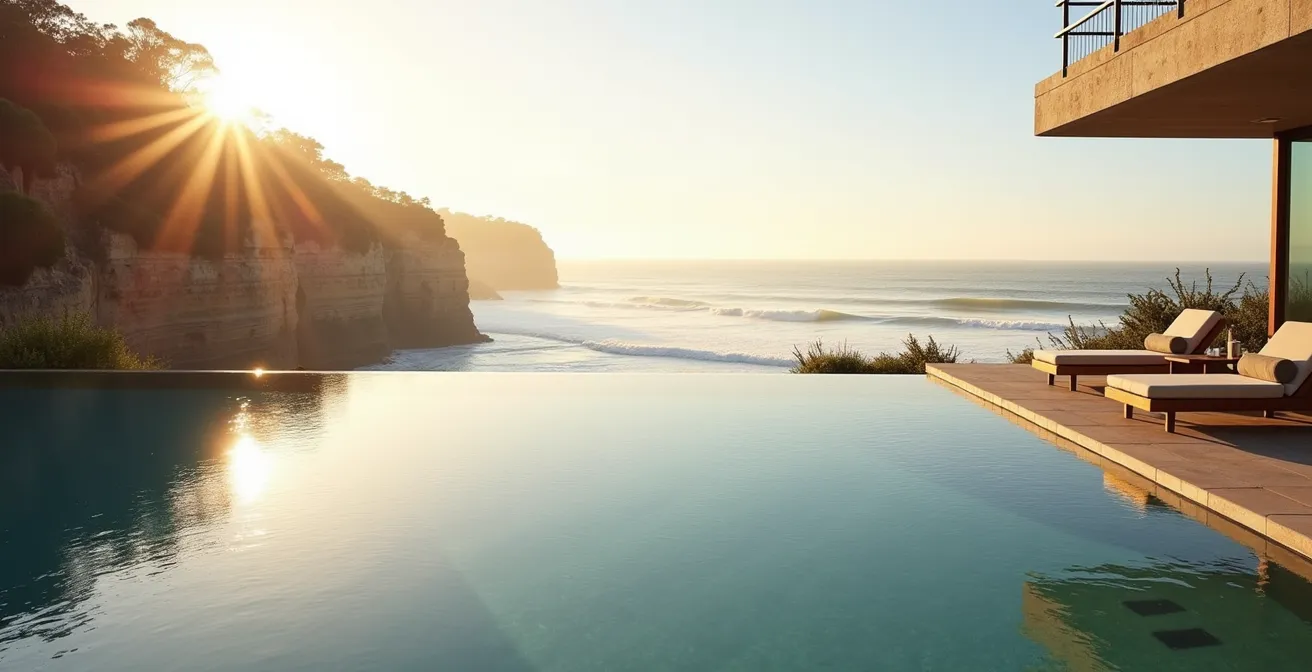
The exorbitant price of an Australian luxury lodge is not for the amenities you see; it is an investment in the logistical mastery you don’t.
- The value lies in verifiable operational advantages—such as guaranteed access to national parks before the public and hyper-local supply chains—that city hotels cannot offer.
- “All-inclusive” is a misnomer for what is actually a deeply curated selection of regional premium goods, not an open-ended buffet.
Recommendation: Evaluate these lodges not as a cost per night, but as a calculated return on experience (ROE) for your most valuable asset: time.
The question of value is central to any high-net-worth individual’s decision-making. When faced with a nightly rate that eclipses that of a five-star presidential suite in a major city, the skepticism is warranted. Standard justifications—all-inclusive packages, stunning locations, personalised service—are platitudes. These are the expected baseline for any luxury offering, not the justification for a significant premium. The common analysis fails to address the core query: is the tangible return on a $2,000-per-night investment in a remote Australian lodge demonstrably superior to that of its urban counterpart? After all, an urban hotel offers proximity, convenience, and access to a city’s finest establishments.
This line of reasoning, however, misses the fundamental point. The value proposition of a top-tier Australian lodge is not based on conventional luxury metrics. It is rooted in a command of logistics that borders on the miraculous, delivering unparalleled experiences in environments where they should not be possible. An analysis of these properties reveals that according to CBRE’s analysis of luxury lodges, there has been a 59% revenue increase per occupied room since 2018, indicating a market that understands and is willing to pay for this unique offering.
This article moves beyond the brochure-speak to conduct a forensic audit of the lodge value equation. We will deconstruct the operational mechanics, from the curation of an “open bar” to the strategic value of enforced disconnection. The objective is to provide a clear framework for discerning whether this investment aligns with your personal definition of return on experience. It is not about spending more, but about investing smarter.
To properly assess the intricate value proposition of these establishments, this analysis will dissect the key pillars of the luxury lodge experience. The following sections provide a structured breakdown of what your investment truly secures, from the cellar to the wilderness and beyond.
Summary: Deconstructing the Value of Australia’s Elite Lodges
- Top-shelf spirits vs house wine: what is actually free at the open bar?
- Private guides: how lodges get you into national parks before the public gates open?
- Farm to table: does the remoteness of the lodge compromise food quality?
- Starlink or silence: can you actually run a business from a remote lodge?
- Longitude 131 vs Southern Ocean Lodge: which landscape offers the most dramatic views?
- Catamaran or high-speed raft: which vessel minimizes sea sickness?
- Ownership verification: ensuring your tour operator is endorsed by the local mob
- Whitehaven Beach Day Trip: Is the $150 Seaplane Flight Worth It?
Top-shelf spirits vs house wine: what is actually free at the open bar?
The term “all-inclusive” is often misinterpreted as a license for limitless, top-shelf consumption. This is a fundamental misunderstanding of the luxury lodge philosophy. The value is not in the quantity of what is “free,” but in the uncompromising quality and curation of the standard offering. A five-star city hotel bar can stock every premium international brand, but it serves a transient and diverse clientele. A luxury lodge, by contrast, offers a meticulously edited selection that functions as an extension of the region itself. The open bar is not a cost-saving measure for the guest; it is a narrative device for the lodge.
Instead of generic international spirits, one finds craft gins infused with local botanicals. The “house wine” is not a bulk-purchased afterthought but often a range from boutique regional vineyards, sometimes with 5-star Halliday ratings that would be considered premium upgrades elsewhere. This is not about what is free, but about what is chosen. It is an expression of terroir that a city hotel, by its very nature, cannot replicate. The included beverage list is a statement of local pride and expertise, a curated journey through a region’s best, guided by a sommelier’s hand.
This table illustrates the critical distinction between tiers of “inclusive” beverage programs, highlighting that true luxury lies in curation, not just availability.
| Lodge Category | House Wine Range | Spirits Inclusion | Cocktail Service |
|---|---|---|---|
| Ultra-Premium (Southern Ocean Lodge) | Local boutique wineries, 5-star Halliday ratings | Premium Australian craft spirits | Bespoke cocktails with native botanicals |
| Premium (Longitude 131°) | Regional Australian wines, sommelier-selected | International premium brands | Signature desert-inspired cocktails |
| Standard Luxury | Quality Australian labels | House spirits only | Classic cocktails |
Therefore, the question is not “What can I get?” but “What am I being introduced to?” It is a shift from passive consumption to an active, educational, and deeply localised gastronomic experience.
Private guides: how lodges get you into national parks before the public gates open?
Exclusivity at a luxury lodge is not a vague feeling of privacy; it is a tangible, operational advantage. It is about access arbitrage: the ability to experience a location in a way that is structurally impossible for the general public. This is most evident in the relationship between lodges and their surrounding national parks. Lodges often hold specific commercial operator licenses that grant them privileges, including access outside of standard public opening hours. This means witnessing a sunrise over a sacred monolith or entering a pristine wilderness area before the first tourist bus has even started its engine.
These are not merely guided tours. They are curated expeditions led by experts whose knowledge transcends guidebook facts. As Craig Wickham of Exceptional Kangaroo Island notes, these guides possess an almost supernatural ability to connect guests with the environment. He observes that guides on the Southern Ocean Lodge’s signature tour “have an uncanny skill at spotting wildlife including koalas, kangaroos and echidnas amongst the dense scrub.” This is an expertise that transforms a simple walk into a profound connection with the ecosystem. The value is measured in these unscripted moments of discovery, facilitated by someone who lives and breathes the landscape.

This level of privileged access and expert interpretation is a core component of the lodge’s return on experience. The ability to offer over 300+ individual exclusive experiences collectively, as reported by Luxury Lodges of Australia, demonstrates a systemic commitment to delivering moments unavailable to anyone else. It transforms a public treasure into a private viewing, a value that cannot be replicated by staying outside the park and queuing at the gate.
Ultimately, you are not just paying for a guide; you are investing in a key that unlocks a different, more profound dimension of a destination.
Farm to table: does the remoteness of the lodge compromise food quality?
It is a logical assumption that extreme remoteness would be a detriment to culinary excellence. The logistical challenges of sourcing fresh, high-quality ingredients seem insurmountable. Yet, for Australia’s top lodges, this constraint is the very catalyst for innovation. Rather than compromising quality, the isolation forces a radical commitment to terroir-driven gastronomy. Market research confirms the importance of this, with a recent report indicating that 88% of luxury travelers prioritize culinary adventures. Lodges answer this demand not by flying in ingredients from across the globe, but by cultivating their own supply chains.
On-site kitchen gardens, greenhouses, and partnerships with local producers, fishermen, and Indigenous communities are not charming add-ons; they are the central pillars of the culinary operation. Southern Ocean Lodge, for example, is built around a philosophy of showcasing a “culinary journey of Kangaroo Island,” making its on-site restaurant and cellar a celebration of the island’s hyper-local produce. This creates a menu that is not just fresh, but uniquely expressive of its location—a quality that a city restaurant, with access to global markets, can paradoxically never achieve. The chef’s creativity is fired by the challenge of what is available *today*, resulting in a dynamic and authentic dining experience.
For the discerning guest, evaluating this promise of quality requires a critical eye. It’s about looking for tangible evidence of this commitment, not just accepting the “farm-to-table” marketing.
Action plan: Remote Lodge Food Quality Assessment
- Verify on-site infrastructure: Inquire about the existence and scale of kitchen gardens and greenhouse facilities.
- Assess chef credentials: Check the head chef’s background for experience in both fine dining and remote, produce-driven environments.
- Confirm supply frequency: Question the frequency of fresh produce deliveries to understand the freshness cycle (daily vs. weekly).
- Investigate local partnerships: Look for evidence of partnerships with local Indigenous suppliers for authentic bush tucker ingredients.
- Evaluate menu dynamism: Assess the wine cellar’s depth and the rotation of seasonal menus as an indicator of responsiveness to local availability.
The remoteness does not compromise the food; it defines it, making the dining experience an inimitable reflection of the surrounding landscape.
Starlink or silence: can you actually run a business from a remote lodge?
The modern executive’s dilemma is the need for both connectivity and disconnection. While lodges are increasingly equipped with high-speed internet like Starlink, to focus solely on this capability is to miss the more profound value proposition. The question is not *can* you run a business from a remote lodge, but *should* you? The true luxury offered is not seamless connection to the operational grind, but the opportunity for strategic, high-level thought, free from the noise of daily demands. It is the concept of curated disconnection.
A city hotel keeps you tethered to the relentless pace of business. A remote lodge, even one with Wi-Fi, provides a psychological and physical buffer. The environment itself—the vastness of the landscape, the quiet, the structured rhythm of lodge life—encourages a shift in perspective from the tactical to the strategic. It creates the mental space necessary for breakthrough thinking, long-term planning, and genuine rejuvenation, which is often the most productive state for a leader.
This perspective is powerfully articulated by a leading figure in the hotel industry. As Tom Gibson, a Senior Director at CBRE Hotels, states in an insightful analysis on the sector:
The greatest value for an executive is not perfect connectivity, but the enforced disconnect, allowing for strategic thinking away from daily operational noise.
– Tom Gibson, CBRE Hotels Senior Director
This is the counter-intuitive truth. The lodge’s greatest contribution to your business might be the time it gives you away from it. While you can certainly answer urgent emails, the environment is optimized for the kind of deep work that is impossible in a conventional office or a bustling city hotel.
The ultimate amenity is not the speed of the internet connection, but the quality of the silence that surrounds it.
Longitude 131 vs Southern Ocean Lodge: which landscape offers the most dramatic views?
In the realm of ultra-luxury lodges, the landscape is not merely a backdrop; it is the central protagonist. The architecture is designed to serve the view, dissolving the barriers between inside and out. A comparison between two of Australia’s most iconic properties, Longitude 131° at Uluru-Kata Tjuta and the rebuilt Southern Ocean Lodge on Kangaroo Island, is not a question of which is “better,” but which form of dramatic dialogue with nature one prefers: the profound silence of the desert or the wild power of the ocean.
Longitude 131° offers an almost spiritual communion with a 600-million-year-old monolith. Its tented pavilions are positioned for a direct, uninterrupted sightline to Uluru, allowing guests to witness the rock’s mesmerizing color shifts from the privacy of their own bed. The drama is one of ancient stillness, immense scale, and a deep, resonant silence. Southern Ocean Lodge, in its post-fire renaissance, offers an entirely different but equally powerful experience. The new iteration, as described, features “breathtaking views of the Southern Ocean” with a string of luxurious suites that ease along the clifftop. Here, the drama is kinetic: storm-watching over a churning sea, the sound of crashing waves, and the feeling of being on the edge of the world.
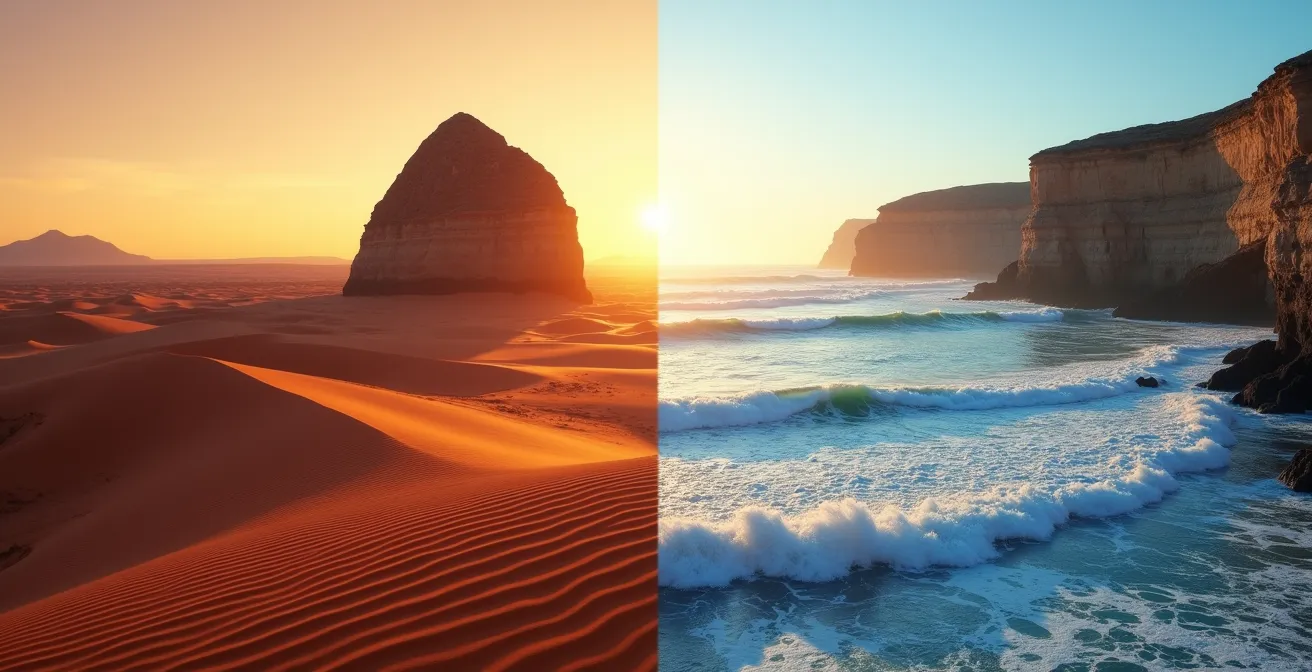
The choice between them comes down to a preference in sensory immersion. One offers a visual and spiritual anchor in the heart of the continent; the other, a visceral connection to the untamed power of the sea.
| Aspect | Longitude 131° (Uluru) | Southern Ocean Lodge (Kangaroo Island) |
|---|---|---|
| Visual Drama | Changing colors of Uluru at sunrise/sunset | Storm-watching over wild Southern Ocean |
| Architectural View Integration | Floor-to-ceiling tent windows facing Uluru | 25 suites with uninterrupted ocean panoramas |
| Soundscape | Profound desert silence | Crashing waves and sea birds |
| Unique Selling Point | 600-million-year-old monolith views from bed | Clifftop infinity pool merging with ocean horizon |
In both cases, the lodge is a vessel for the experience, and the view is the ultimate, priceless luxury.
Catamaran or high-speed raft: which vessel minimizes sea sickness?
The uncompromising standards of a luxury lodge extend beyond the property’s boundaries and into the fine details of its offered excursions. A day trip on the water is a common feature, but the choice of vessel is a critical, often overlooked, indicator of a lodge’s commitment to guest comfort. When it comes to minimizing sea sickness (kinetosis), the design of the craft is paramount. The debate between a large catamaran and a high-speed inflatable raft is a case in point.
A high-speed raft offers thrills and proximity to the water, but its monohull design makes it highly susceptible to rolling and pitching motions, which are the primary triggers for inner-ear imbalance. A well-designed catamaran, conversely, provides a fundamentally more stable platform. Its twin-hull structure distributes buoyancy across two points, significantly dampening the rolling motion that causes the most discomfort. For the 20-30% of the population highly susceptible to motion sickness, this choice is not a minor preference; it is the difference between an enjoyable day and a miserable one.
Beyond vessel choice, a quality operator will implement further mitigation strategies. Experienced captains navigate swells with practiced ease, and guides will advise guests on the best practices: sit centrally, focus on the horizon, and stay hydrated. While no method is foolproof, the selection of a catamaran over a raft is a clear signal that the operator has prioritized stability and comfort over sheer speed or capacity, a hallmark of a true luxury mindset where the guest experience is analyzed and optimized at every turn.
This meticulous attention to detail, even on a simple day trip, is part of what substantiates the premium price point—it’s an investment in well-being, not just an activity.
Ownership verification: ensuring your tour operator is endorsed by the local mob
In the contemporary definition of luxury travel, authenticity has become a non-negotiable asset. For experiences involving Australia’s First Nations cultures, this authenticity must be grounded in genuine partnership and respect. A discerning traveler must look beyond superficial cultural performances to verify that their investment benefits the traditional owners of the land. This means scrutinizing the tour operator’s structure and ensuring it is not merely culturally-themed, but genuinely community-endorsed or owned. As highlighted by portfolios like Baillie Lodges, authentic First Nations experiences featured at 15+ member lodges are becoming a cornerstone of the luxury offering.
Verification involves looking for specific, tangible signs of legitimate engagement. A genuine partnership is often marked by a Welcome to Country performed by a recognized local Elder, which is profoundly different from a generic “Acknowledgement of Country” that can be recited by anyone. It also involves investigating the operator’s governance: is there Indigenous representation on the board? Are there clear profit-sharing models in place? Does the operator actively support community-run initiatives like local art centres or conservation projects managed by Traditional Owners?
The most ethical and impactful operators provide direct booking channels that ensure a greater portion of the revenue flows back to the community. Seeking out these markers of authenticity is not just a matter of social responsibility; it is the only way to ensure the experience is real. It is the difference between observing a culture from the outside and being invited to share in it, however briefly, in a manner that is respectful, sustainable, and economically empowering for the host community. A checklist for this verification would include:
- Checking for Welcome to Country ceremonies by recognized Elders.
- Verifying Indigenous board representation and profit-sharing models.
- Looking for community-owned branding and official Traditional Owner endorsements.
- Researching if the operator supports local art centres, schools, or conservation projects.
- Confirming direct booking options that maximize community economic benefit.
For the sophisticated traveler, the ultimate luxury is a connection that is not only profound but also profoundly ethical.
Key takeaways
- The true value of a luxury lodge is not in its price, but in its ability to deliver a quantifiable Return on Experience (ROE) through logistical mastery.
- “All-inclusive” is a curated, terroir-driven culinary program, not an unlimited open bar of generic premium brands.
- Exclusivity is tangible: it means private access to public treasures and expertise that transforms a visit into a deep connection.
Whitehaven Beach Day Trip: Is the $150 Seaplane Flight Worth It?
The final component of this analysis is a micro case study in value calculation: the choice of how to access a world-famous destination like Whitehaven Beach. This decision encapsulates the central theme of the entire lodge debate—is a significant cost premium for a superior experience “worth it”? A standard ferry is cost-effective, but a seaplane offers an entirely different proposition. It is a question of what one values more: budget, or time and perspective.
The seaplane’s primary return on investment is time. It reduces a multi-hour boat journey to a matter of minutes. For a guest on a limited schedule, this is a powerful efficiency gain, buying back precious hours that can be spent enjoying the destination rather than travelling to it. The second, and perhaps more significant, return is perspective. The aerial view of the swirling silica sands of Hill Inlet is an iconic image of Australia, a sight utterly inaccessible from sea level. The flight itself becomes a key part of the experience, not just a mode of transport.
Furthermore, seaplanes can often access more secluded parts of the beach, away from the larger crowds delivered by ferries and yachts. This is another form of access arbitrage. The weather risk is higher, but the potential reward is an experience of greater beauty, efficiency, and exclusivity. The table below breaks down the cost-benefit analysis of the primary access methods.
| Access Method | Cost (AUD) | Time to Beach | Unique Benefits | Weather Risk |
|---|---|---|---|---|
| Seaplane | $150-200 | 30 mins | Aerial Hill Inlet views, secluded landing spots | High (low cloud cancellations) |
| Luxury Yacht | $120-180 | 2 hours | Onboard amenities, multiple beach stops | Medium |
| Ferry | $60-80 | 3 hours | Budget-friendly, guaranteed departure | Low |
Ultimately, “worth” is a personal metric. For those who define value by the uniqueness of the memory and the efficiency of the experience, the premium is not a cost but a sound investment in a superior outcome.
Frequently asked questions on Are Australian Luxury Lodges Worth the $2,000 Nightly Rate?
Why do catamarans provide better stability than monohull rafts?
The twin-hull design distributes weight across two points, reducing rolling motion by up to 70% compared to single-hull vessels, directly impacting inner ear equilibrium.
Does vessel size matter more than design for comfort?
While larger vessels generally provide more stability, a well-designed smaller catamaran often outperforms a larger monohull raft in rough conditions due to superior hydrodynamics.
How important is the captain’s experience in preventing seasickness?
Critical – experienced captains can reduce motion sickness incidents by 40% through optimal speed adjustment and swell navigation techniques.