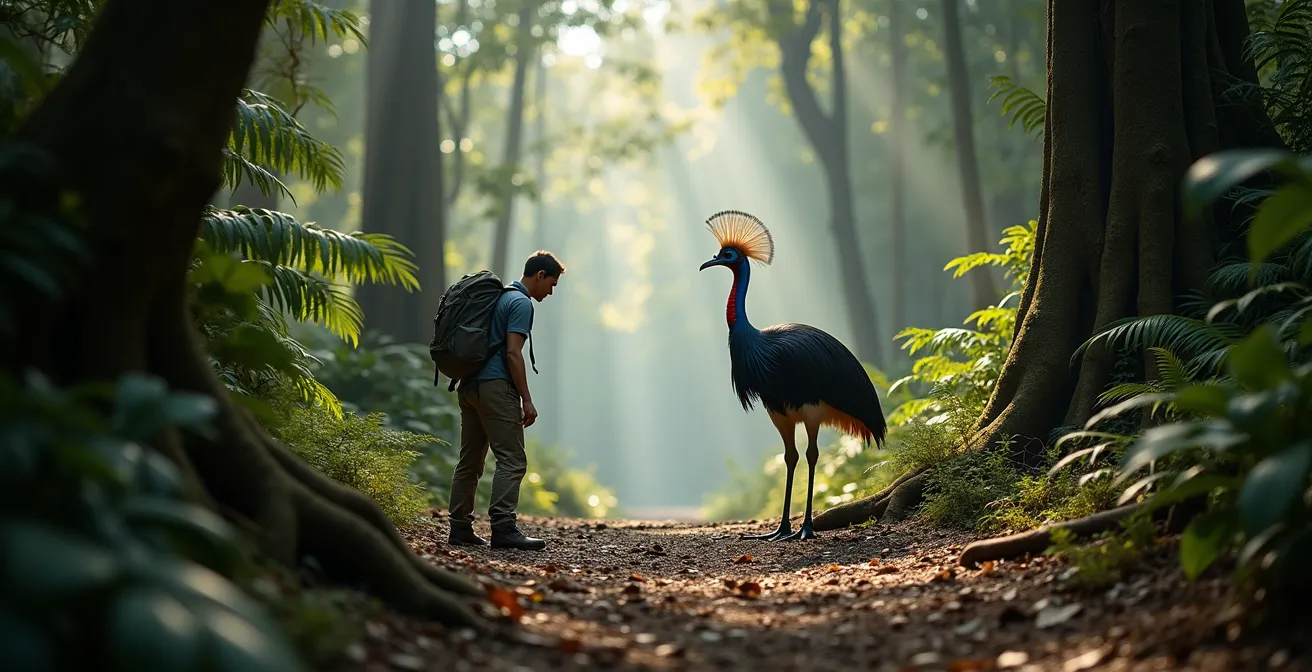
In summary:
- Identify cassowary presence early by spotting their distinctive, large-seeded droppings on the trail.
- If you encounter a cassowary, your primary survival tactic is to never turn your back or run. Back away slowly and calmly.
- Use a bag or object as a shield between you and the bird, and never feed them, as this directly causes aggressive behavior.
The first time you hear it, you won’t forget it. A deep, vibrating rumble that seems to come from the very ground of the North Queensland rainforest. This is often the first sign that a Southern Cassowary is near. For hikers, the bird’s reputation as the ‘world’s most dangerous’ precedes it, creating a mix of awe and legitimate fear. Most advice focuses on simple, often repeated rules: don’t approach, don’t feed them. While correct, this advice lacks the critical context that transforms a rule into a survival instinct.
The truth is that cassowaries are not malicious predators; they are powerful, territorial animals operating on a clear and predictable logic. They are wary of humans and attacks are rare, but when they occur, it’s almost always because a human has inadvertently triggered a specific defensive or food-soliciting behavior. The key to safety isn’t about being prepared for a fight, but about developing a deep understanding of the bird’s triggers and its fundamental role in the ecosystem you are visiting.
This guide moves beyond generic warnings. It is a de-escalation protocol. We will detail how to develop predictive awareness by reading the signs on the trail, what specific actions to take—and avoid—during a close encounter to prevent triggering a chase, and why understanding the cassowary’s ecological importance is part of respecting its space. This is not about conquering the rainforest; it’s about coexisting safely within it.
To navigate this topic, we will break down the essential knowledge needed for any hiker in cassowary country. The following sections provide a clear, step-by-step framework for awareness, reaction, and prevention.
Summary: A Hiker’s De-escalation Protocol for Cassowary Encounters
- Piles of fruit seeds: how to identify fresh cassowary scat on the trail?
- Back away slowly: why turning and running triggers the chase instinct?
- The “slow down” zones: avoiding vehicle strikes in Mission Beach
- Aggressive begging: what to do if a cassowary approaches your picnic table?
- The rainforest gardener: why the forest dies without the cassowary spreading seeds?
- Camouflage masters: how to spot the reptiles blending into the tree trunks?
- Stand still or run: the correct reaction when you encounter a snake on the path?
- Surviving a Multi-Day Rainforest Trek: What Gear Fails in High Humidity?
Piles of fruit seeds: how to identify fresh cassowary scat on the trail?
Your first line of defense is not a reaction, but predictive awareness. Before you ever see a cassowary, you will almost certainly see its scat. Identifying it, and more importantly, its freshness, tells you if a bird is active in your immediate area. Cassowary scat is unmistakable: large, often vibrant piles of partially digested fruit and seeds. According to Queensland government monitoring, these droppings can be massive, with piles reaching up to 180mm in diameter, containing hundreds or even thousands of seeds from the bird’s recent meals.
Spotting a pile of seeds is a clear signal to heighten your vigilance. But knowing if that pile is from this morning or last week is the real skill. Fresh scat is your most immediate warning sign. The image below shows the characteristic texture you should be looking for.
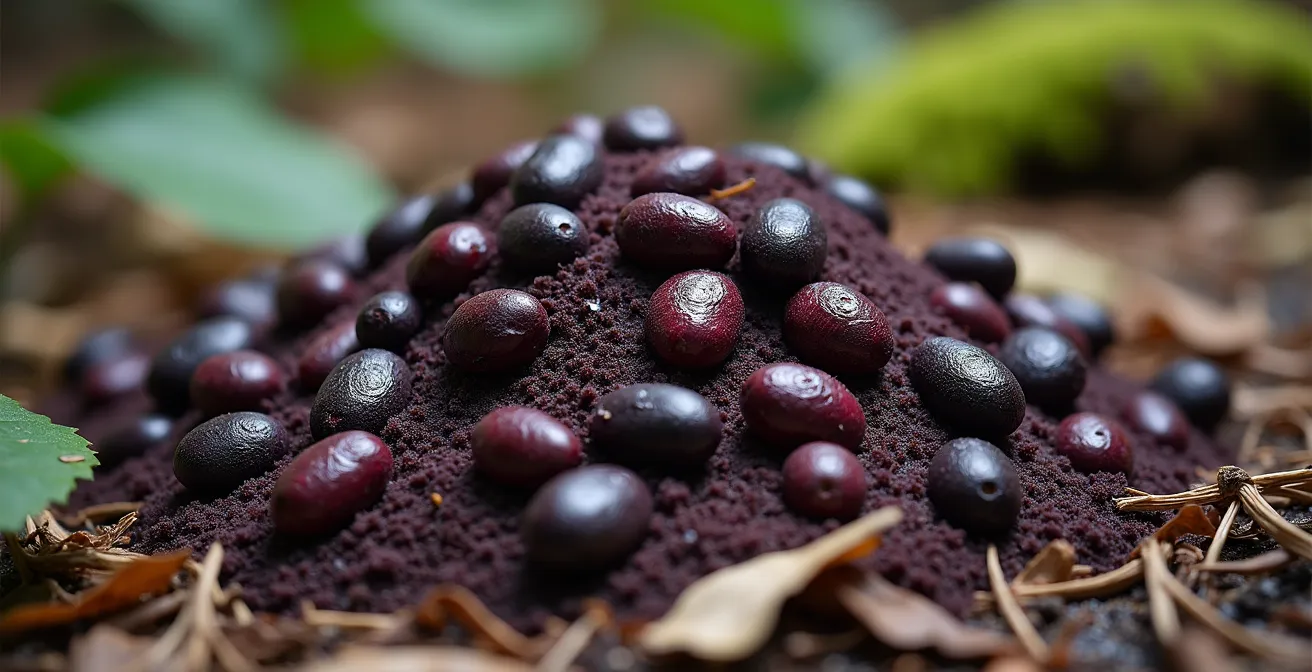
As you can see, the droppings are not just seeds but are bound in a mass of fruit pulp. The glossy, wet appearance indicates it is recent. This moisture dries within a few hours, and the vibrant colours will begin to dull. Learning to spot this on the trail is as important as watching the path ahead.
Action Plan: Identifying Fresh Cassowary Scat
- Visual Check: Look for a purple-black coloration and a moist, glossy sheen. This wet look disappears within 2-3 hours of deposition.
- Odor Check: Fresh scat has a distinct sweet and vinegary smell of fermented fruit, not a foul fecal odor.
- Seed Integrity: Observe for large, intact seeds (some as big as an avocado seed) embedded within the purple pulp. In older scat, the pulp has decayed and the seeds are more separated.
- Insect Activity: Fruit flies are attracted within 30 minutes. If you see them, the scat is very fresh. Beetles typically arrive within two hours.
- Fungal Growth: In the high humidity of the rainforest, fine white fungal threads will begin to appear on the surface after about 12-24 hours.
Back away slowly: why turning and running triggers the chase instinct?
If you round a corner and find yourself face-to-face with a cassowary, your instincts will scream “RUN.” You must ignore them. Turning your back and running is the single most dangerous action you can take, as it activates the bird’s innate chase response. These are not predators that hunt in the traditional sense, but they are territorial and curious animals. Fleeing signals you are prey or a subordinate creature to be driven off, and they will pursue. Research published in the Journal of Zoology shows that of 221 recorded attacks, a staggering 71% involved chasing when victims tried to run.
The correct protocol is to stop, stand your ground, and then slowly back away, always facing the bird. Make yourself look as large as possible by holding your arms out or holding your backpack up in front of you. This object acts as a barrier and makes you a less appealing, more formidable subject. Speak to the bird in a low, calm, and assertive voice. The goal is to signal that you are not a threat, but also not easy prey.
Case Study: The Mount Whitfield Trail Incident
In April 1995, a female jogger, Doon McColl, was chased up a tree by a cassowary on the Mt Whitfield trail near Cairns after she tried to run from it. The bird waited below for hours. Weeks later, her boyfriend attempted to outrun the same bird but was relentlessly pursued through dense jungle. This incident involving the cassowary, known as “Blue Arrow,” perfectly demonstrated that running triggers a persistent pursuit behavior that can last for hours. The bird can move effortlessly through terrain that will exhaust and injure a human. Had they stood their ground and backed away, the encounter would have likely ended in seconds.
The “slow down” zones: avoiding vehicle strikes in Mission Beach
The greatest modern threat to cassowaries is not from hikers, but from vehicles. This also poses a significant risk to drivers. Hitting a bird that can stand 1.8 meters tall and weigh up to 70kg can cause serious accidents and is almost always fatal for the cassowary. The Mission Beach area is a particular hotspot for these incidents. Mortality studies reveal that 55% of 140 recorded cassowary deaths were from vehicle strikes, with a majority of those happening in this specific region.
When driving through designated “cassowary zones,” your behavior must change. These are not suggestions; they are critical safety protocols. Reduce your speed to 40km/h or less, especially during the low-light hours of dawn and dusk when the birds are most active. This gives you the reaction time needed to brake safely. Cassowaries can and do step out from dense vegetation with no warning. Your focus should be on constantly scanning both sides of the road, not just the tarmac ahead.
It is also crucial to watch for young. Cassowary chicks are brown and striped for camouflage and are much harder to spot than the large black adults they follow. If you see an adult near the road, assume there are chicks nearby. If you do spot a cassowary, never stop your vehicle in the middle of the road to observe or photograph it. This habituated behavior encourages the birds to approach roads and creates a collision risk for other drivers who may not see the bird or your stopped car in time.
Aggressive begging: what to do if a cassowary approaches your picnic table?
In their natural state, cassowaries are shy and wary of humans. The aggressive, bold individuals that approach picnic areas and hikers are almost exclusively a human-made problem. When cassowaries are fed by people, they lose their natural fear and begin to associate humans with an easy food source. This leads to a dangerous behavior known as aggressive begging. Research confirms that 75% of cassowary attacks on humans involved birds that had been previously fed by people. A fed cassowary is a dangerous cassowary.
If a cassowary approaches your picnic table or campsite, do not engage. Secure all food immediately in a sealed container or your vehicle. Do not leave food scraps or packaging in open bins. The goal is to ensure there is no food reward for the bird’s approach. Once food is secured, adopt the same de-escalation posture as on the trail: stand up, face the bird, and back away slowly to a safe distance, using your bag as a shield if necessary. Do not shout, throw things, or make sudden movements.
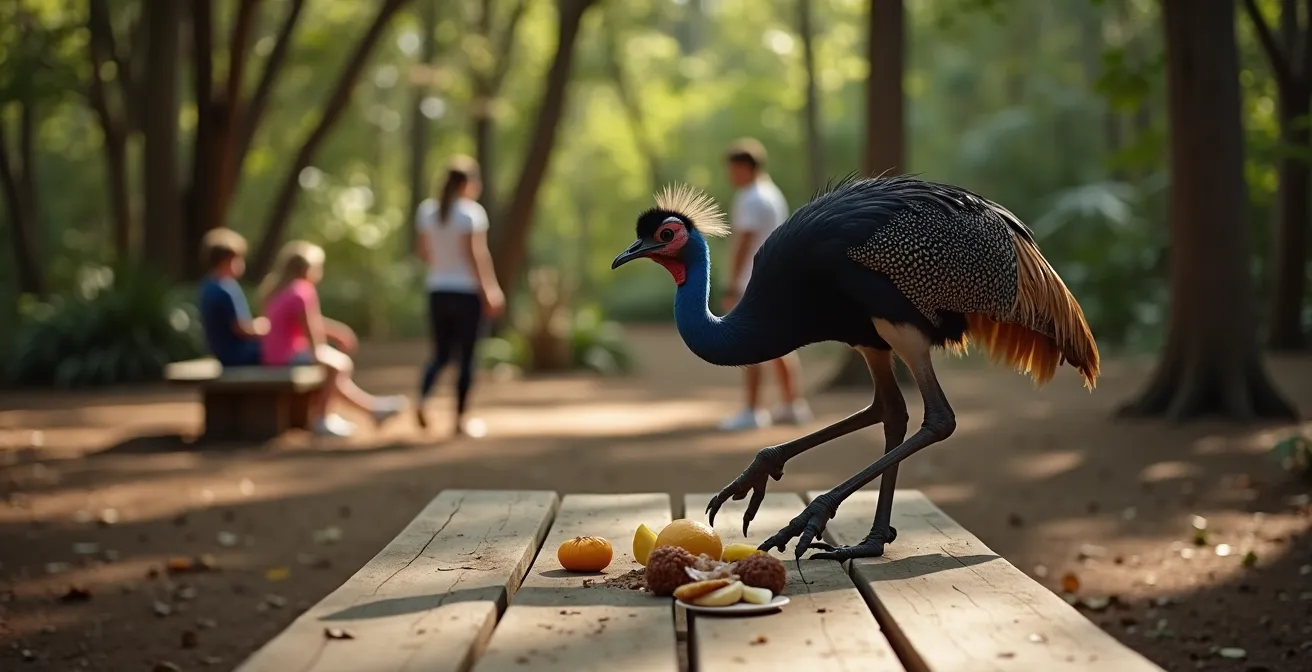
The scene above, with people calmly retreating while the bird investigates, is the correct response. Panic leads to escalation. Your calm retreat teaches the bird that approaching humans yields no reward.
Case Study: Habituated Cassowaries of Lake Barrine
At the Lake Barrine tourist area, several cassowaries became so dangerously habituated from tourist feeding that they had to be removed from the wild. These birds would snatch food directly from visitors’ hands, chase people who didn’t offer food, and patrol picnic areas aggressively. This demonstrates the direct link between human feeding and the creation of “problem birds” that ultimately cannot coexist with people and must be relocated to captivity, a tragic outcome for a wild animal.
The rainforest gardener: why the forest dies without the cassowary spreading seeds?
Understanding the cassowary’s vital ecological role is essential to respecting its presence. These are not just another large bird; they are a keystone species, meaning the entire rainforest structure depends on them. The Southern Cassowary is one of the only animals large enough to consume and disperse the seeds of over 238 species of rainforest plants, including many with large, toxic fruits that no other creature can handle.
The bird’s digestive system is unique. It doesn’t grind up the seeds but instead passes them through relatively intact. The gut passage scarifies the seed coat and the scat provides a perfect, ready-made pile of fertilizer. This process dramatically increases the chances of germination. Rainforest ecology studies demonstrate this effect with startling clarity: the rare Ryparosa tree seed has a 92% germination rate after passing through a cassowary’s gut, compared to just 4% if it falls to the forest floor without this intervention.
Without the cassowary constantly moving through its large territory and planting these seeds, many tree species would be unable to reproduce effectively. The genetic diversity of the forest would plummet, and the ecosystem would slowly unravel. When you see a cassowary, you are not just looking at a potentially dangerous bird; you are looking at the primary gardener of the entire Wet Tropics World Heritage Area. Respecting its space and ensuring its survival is an act of preserving the whole forest.
Camouflage masters: how to spot the reptiles blending into the tree trunks?
While the cassowary is the largest and most imposing presence, the rainforest is filled with other creatures that rely on the opposite strategy for survival: camouflage. Developing your “rainforest eyes” to spot these hidden animals is not just for wildlife enthusiasts; it’s a crucial part of trail awareness. Reptiles, from pythons to forest dragons, are masters of blending in, and being able to spot them prevents surprising them, which can lead to defensive bites.
The key is to stop looking for the animal itself and start looking for patterns that break the natural texture. Scan the environment methodically in vertical zones. Start at ground level, checking the buttress roots and leaf litter for the unnatural coil of a python or the smooth shape of a skink among the debris. Then, raise your gaze to eye level, scanning tree trunks not for a lizard, but for a patch of bark that seems *too* smooth or a straight line (a tail) that interrupts the random patterns. Finally, scan the lower canopy, looking at the junctions of branches where monitors often rest.
Case Study: Daintree’s Boyd’s Forest Dragons
In the Daintree Rainforest, researchers have documented how Boyd’s forest dragons utilize near-perfect camouflage. Their mottled green and brown coloration, combined with a rigid, motionless posture, allows them to blend seamlessly with lichen-covered tree trunks. Camera trap footage reveals they can remain still for hours, with only the faint movement of their breathing distinguishing them from the tree’s surface. This illustrates that you will rarely spot these animals with a casual glance; it requires slow, deliberate observation.
Stand still or run: the correct reaction when you encounter a snake on the path?
Another common and startling encounter on a rainforest trail is with a snake. As with the cassowary, your gut reaction may be to jump back or run, but this sudden movement is precisely what can trigger a defensive strike. The correct protocol for almost every snake encounter is to FREEZE immediately upon sighting. Snakes do not see humans as food; they see us as a large, potential threat. By standing perfectly still, you cease to be a moving threat and often the snake, seeing that you are not advancing, will simply continue on its way.
Once you are frozen, assess the situation. Identify the snake’s position and its likely path. Is it coiled defensively, or is it moving across the trail? Your goal is to give it a wide berth. For non-venomous species like pythons, you can typically maintain a safe distance of at least two meters and slowly sidestep off the path to let it pass. For potentially venomous species, the safest course of action is to remain absolutely still until the snake has moved away on its own, even if this takes several minutes.
After the snake has left the immediate area, do not immediately resume your hike. Wait for at least 30 seconds, then carefully scan your surroundings. Especially during mating season, snakes can sometimes be found in pairs. Ensuring the area is clear before you move on is a final, critical precaution.
Key takeaways
- Your reaction determines the outcome: Never run from a cassowary. Stand your ground and back away slowly to de-escalate the encounter.
- Human food is a death sentence: Feeding cassowaries directly leads to aggressive behavior and creates a danger for everyone. Keep all food secure.
- The cassowary is a keystone species: The health of the entire rainforest ecosystem depends on this “gardener” to disperse seeds. Respecting it is respecting the forest.
Surviving a Multi-Day Rainforest Trek: What Gear Fails in High Humidity?
To safely spend extended time in cassowary country on a multi-day trek, your survival depends not just on your reactions, but on the reliability of your equipment. The extreme humidity of the North Queensland rainforest is a relentless force that breaks down gear in ways you may not expect. Understanding these failure points is essential for preparation. Electronics can fail from internal condensation, waterproof membranes can “wet out” from the inside, and even the adhesives holding your boots together can give way.
A multi-day trek requires a proactive approach to gear maintenance. This means using silica gel packs for electronics and changing them frequently, regularly airing out “breathable” rain gear to allow it to dry, and carrying specialized sealants for potential boot or seam tape failures. Being prepared for these issues is not a matter of ‘if’ but ‘when’.
The following table, based on observations in 100% humidity conditions, outlines a typical timeline for gear failure and how to prevent it.
| Timeframe | Gear Type | Failure Mode | Prevention Method |
|---|---|---|---|
| 6-12 hours | Electronics | Condensation in screens, battery terminal corrosion | Silica gel packs changed every 4 hours |
| 24 hours | Gore-Tex membranes | Wetting out from inside due to vapor transfer failure | Ventilation zips, regular airing |
| 48 hours | Boot adhesives | Sole separation begins at stress points | Shoe Goo preventive application |
| 72 hours | Camera lenses | Fungal growth on glass elements | UV treatment, anti-fungal wipes |
| 4-5 days | Seam tape | Complete adhesive failure on tents/rain gear | Seam sealer reapplication daily |
Ensure your next trek in North Queensland is a safe one by meticulously preparing your gear and, above all, your mindset for the realities of the environment.