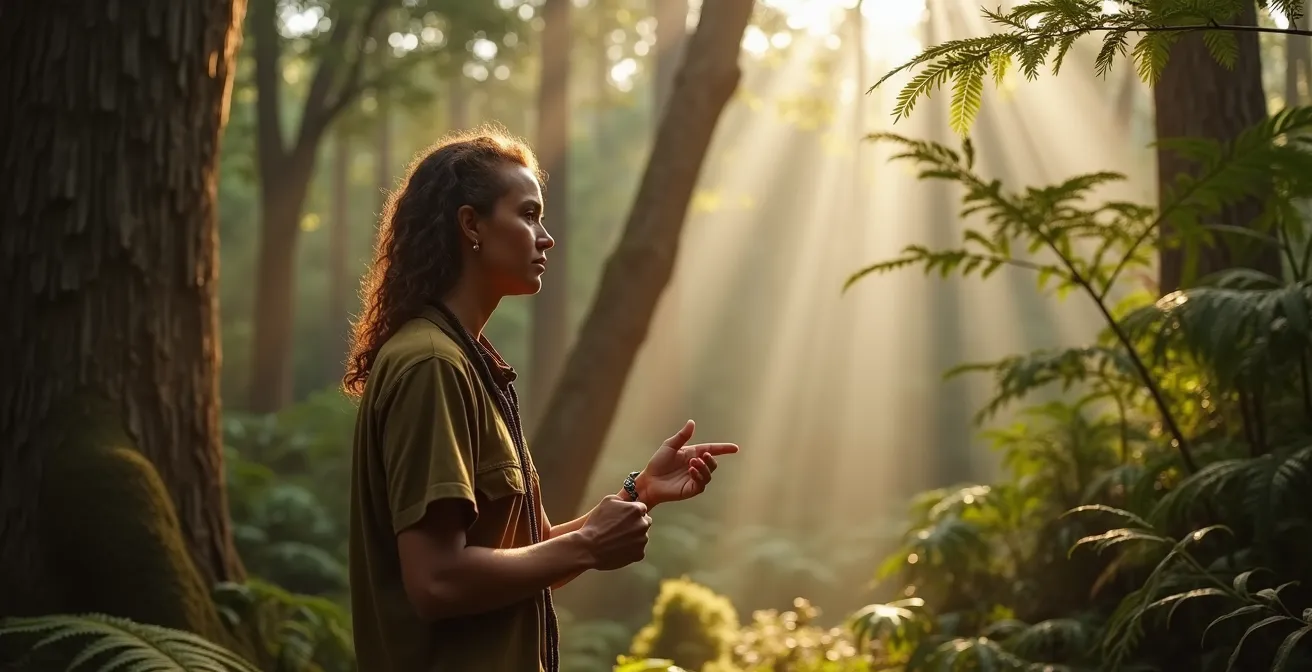
Visiting the Daintree Rainforest with an Indigenous guide isn’t about getting a better tour; it’s about gaining access to a completely different reality hidden in plain sight.
- The rainforest is not just a collection of plants and animals, but a living cultural landscape inscribed with stories, laws, and spiritual meaning.
- An Indigenous guide acts as a translator, shifting your perception from “sightseeing” to “reading” the environment and understanding its deep-time connections.
Our Recommendation: Prioritise a tour led by a Kuku Yalanji guide. It is the only way to move beyond the surface and connect with the ancient, living soul of the Daintree.
To stand within the Daintree Rainforest is to feel the weight of time. It’s a world of emerald canopies, ancient ferns, and sounds that seem to predate human memory. Many travellers arrive hoping to tick off a list: see a cassowary, snap a picture of a crocodile, and swim in a pristine creek. They come to see one of the world’s most beautiful natural wonders, a place often compared to the Amazon for its sheer biodiversity. But this approach, focused only on the visible, misses the most profound dimension of the Daintree entirely.
The common advice focuses on logistics—what to pack, where to stay, how to avoid the ferry queue. While practical, this perspective treats the rainforest as a mere destination, a backdrop for a holiday. What if the true experience wasn’t about looking *at* the forest, but learning to see *through* it? The real story of the Daintree is not written in guidebooks or on tourist maps. It is a living narrative, passed down through generations, and its language is spoken by the land itself. To understand it, you need more than a GPS or a species checklist; you need a cultural translator.
This is where a Kuku Yalanji guide becomes essential. They don’t just point out flora and fauna; they reveal a ‘living landscape’ where every creek, boulder, and plant has a story, a purpose, and a place within a complex cultural and spiritual system. This article will explore why engaging with this perspective transforms a simple visit into a deep, meaningful connection, revealing layers of the Daintree that remain invisible to the unguided eye. We will explore how this cultural lens changes everything from spotting wildlife to understanding the very survival of the forest itself.
This guide will walk you through the key aspects of the Daintree, demonstrating at each step how an Indigenous perspective unlocks a deeper, more authentic experience. The following sections outline this journey.
Summary: Unlocking the Daintree’s Deeper Layers
- Why the Daintree is considered an evolutionary living museum compared to the Amazon?
- The Daintree River Ferry logistics: avoiding the 2-hour queue in peak season
- Mossman Gorge vs open rivers: where can you swim without crocodile risk?
- Camouflage masters: how to spot the reptiles blending into the tree trunks?
- Bush tucker tasting: which native fruits can you safely eat on a tour?
- Under the canopy: why satellite GPS struggles and how to read a topo map?
- The rainforest gardener: why the forest dies without the cassowary spreading seeds?
- Why a Guide Is Essential for Understanding Songlines on Walks?
Why the Daintree is considered an evolutionary living museum compared to the Amazon?
The Daintree Rainforest is often overshadowed by the sheer scale of the Amazon, yet in the story of life on Earth, the Daintree is the far more ancient elder. Scientific evidence confirms the Daintree is the world’s oldest continuously surviving tropical rainforest, an unbroken green thread stretching back into deep time. It is a true ‘living museum’, a direct link to the supercontinent of Gondwana. While the Amazon is a relative newcomer at around 55 million years old, the Daintree has been evolving for an astonishing 180 million years, making it a cradle of evolution.
This immense age has fostered a unique and concentrated biodiversity. The Daintree holds a staggering 30% of Australia’s frog, reptile and marsupial species in an area that makes up just 0.12% of the country’s landmass. But its true evolutionary significance lies in its flora. From a total of 19 primitive flowering plant families on Earth, an incredible 12 families are represented in the Daintree region. This is a level of ancient botanical heritage unmatched anywhere, including the vast expanses of the South American rainforests.
An Indigenous guide doesn’t just recite these facts; they frame them within a cultural context of deep time. For the Kuku Yalanji people, this isn’t just an ancient place; it is the place of creation, where the stories began. The age of the forest is not an abstract number but a felt presence, a continuum of life that connects the present directly to the Dreamtime. A guide helps you feel this timeline, transforming a walk among old trees into a journey through the very library of life itself.
The Daintree River Ferry logistics: avoiding the 2-hour queue in peak season
For most visitors, the Daintree River Ferry is a logistical hurdle, a bottleneck where queues can stretch for hours in peak season. The focus is entirely on getting across as quickly as possible. But through a cultural lens, this crossing is not a delay; it is the first ceremony of your visit. The river is a significant cultural boundary, marking your formal entry into the traditional lands of the Eastern Kuku Yalanji people. To rush it is to miss the point entirely.
An Indigenous guide reframes this waiting time. It becomes an opportunity to slow down and begin ‘reading the landscape’. Instead of frustration, there is observation. You learn to see the mangrove ecosystems not as swampy obstacles but as vital nurseries for marine life. You begin to notice the behaviour of birds and the subtle shifts in the water, signs that hold meaning for those who know the river’s language. This moment of transition is a crucial part of the experience, a mental and spiritual preparation for entering a sacred space.
This perspective is deeply rooted in the Kuku Yalanji worldview, where the river is a provider, a lifeblood, and a spiritual entity. As Eastern Kuku Yalanji elders have stated, the Daintree River holds profound importance. In a guided experience, this truth is palpable.
The Daintree River has great spiritual and cultural significance to our people.
– Eastern Kuku Yalanji elders, Solar Whisper Traditional Owners Guide
The ferry, therefore, is not just a piece of infrastructure. It is a modern point of negotiation between two worlds—the fast-paced world of tourism and the deep-time world of Traditional Ownership. Acknowledging this transforms a mundane wait into a moment of respect and learning.
Mossman Gorge vs open rivers: where can you swim without crocodile risk?
The question of where to swim in the Daintree is, for most visitors, a matter of physical safety. The region is home to saltwater crocodiles, and the advice is clear: only swim in designated, croc-free areas like the pristine, fast-flowing waters of Mossman Gorge. This is sound advice, but it only tells half the story. From a Kuku Yalanji perspective, safety at Mossman Gorge is not just physical; it is also profoundly spiritual.
The experience of visiting Mossman Gorge with an Indigenous guide begins not with a swim, but with a traditional ‘smoking’ ceremony. This ancient ritual uses the smoke of specific plants to cleanse visitors, to welcome them to the country, and to ward off bad spirits. It is a gesture of respect that acknowledges you are a guest in a sacred place. This ceremony establishes a ‘spiritual safety’ that is just as important as the physical absence of crocodiles. It ensures you enter the water with the right intention and with the blessing of the land’s custodians.
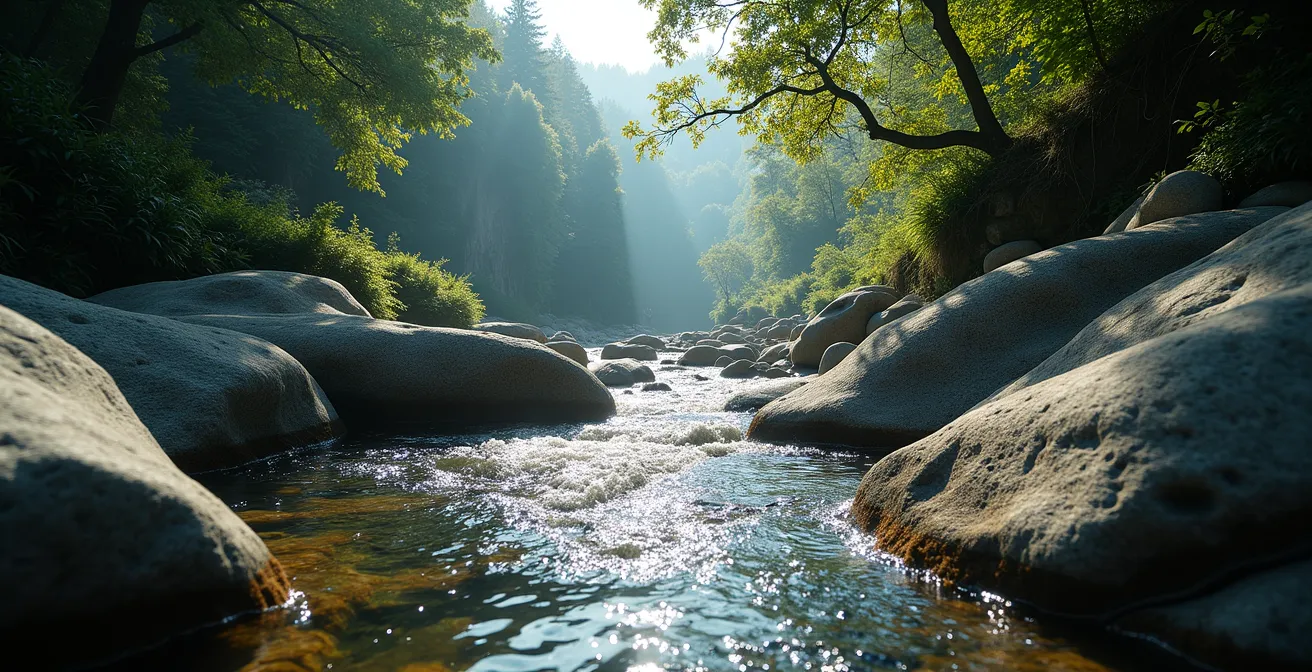
As you look at the crystal-clear water flowing over ancient granite boulders, you understand that this is more than a swimming hole. It is a place for healing and connection. The smooth, cool water is seen as a gift from the land, not just a recreational resource. A guide will share the stories of the gorge, explaining the cultural significance of the rock formations and the water itself. This transforms the act of swimming from a simple cooling-off into a genuine, respectful interaction with a living, sacred site.
Camouflage masters: how to spot the reptiles blending into the tree trunks?
The Daintree is teeming with life, yet many of its most fascinating inhabitants are masters of disguise. With 30% of Australia’s reptile species found here, visitors are often keen to spot lizards, snakes, and other creatures. The typical tourist approach is one of active searching—scanning trunks and branches for a specific target. This ‘hunter’ mindset often results in seeing very little. An Indigenous guide teaches a fundamentally different approach: not searching, but noticing.
This is the art of ‘reading the forest’. It involves a shift from purely visual scanning to a full-body sensory awareness. It’s about recognizing when a pattern is out of place, when a texture doesn’t match the bark around it, or when a subtle movement breaks the forest’s stillness. It’s less about knowing what you are looking for and more about being open to what the forest reveals. This deep awareness is a skill cultivated over a lifetime and is central to the Kuku Yalanji relationship with country.
The difference between these two approaches is profound. The Western method focuses on identification and cataloging, while the Indigenous way is about understanding relationships and reading the story of the ecosystem. The following table illustrates this crucial distinction.
| Observation Aspect | Western ‘Hunter’ Approach | Indigenous ‘Custodian’ Awareness |
|---|---|---|
| Visual Focus | Actively searching for specific targets | Noticing patterns and textures out of place |
| Sensory Use | Primarily visual scanning | Full-body sensory experience including sound and smell |
| Knowledge Base | Species identification | Understanding creature’s role, story, and Kuku Yalanji name |
| Purpose | Spotting and cataloging | Reading relationships within ecosystem |
With a guide, spotting a Boyd’s forest dragon is not just a photo opportunity. It’s a chance to learn its Kuku Yalanji name, to hear the story associated with it, and to understand its role in the ‘living landscape’. This transforms wildlife spotting from a game of ‘I Spy’ into a lesson in ecological and cultural literacy, as highlighted by expert guides from local cultural tour operators.
Bush tucker tasting: which native fruits can you safely eat on a tour?
A ‘bush tucker’ tour is a popular Daintree activity, but it can easily become a superficial novelty—a quick taste of an exotic fruit. With a Kuku Yalanji guide, the experience is transformed from a simple tasting into a deep lesson in ethnobotany, sustainability, and respect. You learn that ‘bush tucker’ is not just food; it is also medicine, tools, and a complex system of knowledge passed down through millennia.
The first and most important lesson is that you only ever touch or taste what a guide explicitly offers you. Many native fruits are toxic without proper preparation. A guide’s knowledge is a protective shield, built on an intimate, generational understanding of the forest’s pharmacy. They will not only identify what is safe but also demonstrate the correct season and method for harvesting. This is not a buffet; it is a highly selective and respectful interaction.
Crucially, this knowledge is tied to strict cultural protocols. Guides from experiences like Walkabout Adventures teach that you only take what is needed, and always in a way that ensures the plant’s continued survival and ability to fruit for others. This might mean leaving a certain amount of fruit on the branch or performing a small act of thanks. This is the core principle of custodianship: using the forest’s resources while simultaneously caring for it. This sustainable practice has allowed the Kuku Yalanji to live in harmony with the Daintree for thousands of years, a powerful lesson in a world grappling with resource depletion.
Under the canopy: why satellite GPS struggles and how to read a topo map?
In the modern world, we outsource our navigation to satellites. But step a few metres into the Daintree, and this technology often fails. The triple-layered canopy is so dense that it can block GPS signals, rendering smartphones useless. Hikers relying on them can quickly become disoriented. While a topographic map and compass are the standard backup, Kuku Yalanji knowledge offers a more integrated and reliable ‘technology’ for navigation—one that is written into the landscape itself.
This is natural navigation, a way of ‘reading the land’ that relies on subtle cues a tourist would never notice. It involves observing the sun’s position through small gaps in the canopy to find direction, following the natural slope of the land towards life-giving water sources, and identifying the orientation of certain plants that grow towards the light. These techniques are not just tricks; they are part of a holistic understanding of how the ecosystem functions. An Indigenous guide makes these invisible signs visible.
Even more profoundly, navigation is woven into the very stories of the land. Topographic ridges and creeks are not just features on a map; they are ‘story-marks’ in a cultural narrative. As you will see later, these narratives, or Songlines, form a living, oral map that has guided people through this complex terrain for countless generations. The land and the story are one.
Your Field Guide: Reading the Land Like a Custodian
- Observe sun’s position through canopy gaps to determine direction.
- Follow the natural slope of the land toward water sources.
- Identify the orientation of certain plants that grow toward light.
- Use topographic ridges as landmarks matching Indigenous story places.
- Follow the sequence of Songline narratives through the landscape features.
The rainforest gardener: why the forest dies without the cassowary spreading seeds?
The Southern Cassowary, with its striking blue neck and prehistoric casque, is a star attraction of the Daintree. Visitors are thrilled to spot this giant, flightless bird. But its importance goes far beyond being a tourist icon. The cassowary is the ‘rainforest gardener’, the keystone species upon which the entire ecosystem depends. Without it, the forest as we know it would slowly begin to die.
The reason lies in its diet. As ecological studies demonstrate, over 100 species of rainforest plants with large fruits depend entirely on the cassowary for seed dispersal. These fruits are too large for any other animal to swallow whole. The cassowary’s unique digestive system allows it to pass the seeds unharmed, scarifying and fertilising them in the process, and depositing them kilometres away from the parent tree. This is the primary mechanism that maintains the Daintree’s incredible plant diversity.
This ecological fact is also a profound cultural truth for the Kuku Yalanji. The cassowary is a highly significant and respected totemic animal. Its health is seen as a direct indicator of the health of the Country. The connection between Indigenous stewardship and cassowary survival is not just theoretical. A 1993 CSIRO survey found only 54 cassowaries in the Daintree lowlands. Today, recent estimates suggest the population may be over 500—a significant recovery directly linked to the success of Traditional Owner land management practices and conservation efforts. A guide shares this story not just as a conservation success, but as proof of the deep, reciprocal relationship between people and the ‘living landscape’.
Key Takeaways
- The Daintree is not just a place, but a living cultural landscape best understood through the Kuku Yalanji worldview.
- An Indigenous guide acts as a translator, shifting perception from simple “sightseeing” to “reading” the forest’s stories and relationships.
- True safety and connection in the Daintree involve both physical and spiritual protocols, from swimming to tasting bush tucker.
Why a Guide Is Essential for Understanding Songlines on Walks?
You can walk a trail in the Daintree and see beautiful scenery. But with a Kuku Yalanji guide, you walk a Songline, and the scenery comes alive with meaning. A Songline is an ‘oral map’, a complex narrative that weaves together creation stories, ancestral journeys, laws, and ecological knowledge. The physical features of the land—a bend in the river, a uniquely shaped boulder, a giant fig tree—serve as ‘story-marks’, mnemonic pegs for these ancient and sacred narratives.
Without a guide, these features are just geography. With a guide, they become chapters in a story. That distant mountain is not just a peak; it is a sleeping ancestor. That creek is not just a water source; it marks a significant event from the Dreamtime. The guide’s role is to share the appropriate parts of this story, transforming the physical landscape into a cultural one. They perform the stories, sing the songs, and explain the connections, making the ancient past a tangible, present reality. As Kuku Yalanji guide Juan Walker explains, learning this history on Country makes it real in a way no book or museum ever could.
The very words used reflect this deep connection. At Mossman Gorge, the guided walks are called ‘Ngadiku’ Dreamtime Walks. The Cultural Centre explains the significance of this term:
Ngadiku means stories and legends from a long time ago in local Kuku Yalanji language.
– Mossman Gorge Cultural Centre, Ngadiku Dreamtime Walks Guide
This is the ultimate reason a guide is not just helpful, but essential. They are the keepers of the Ngadiku, the custodians of the Songlines. They hold the key that unlocks the Daintree’s deepest and most profound dimension. To walk with them is to be invited, however briefly, into this living story, and to see the forest not with your eyes, but with your heart and mind.
Ultimately, choosing to explore the Daintree with a Kuku Yalanji guide is a choice to engage in a more respectful, authentic, and transformative kind of travel. It is an investment in an experience that will stay with you long after you have left the rainforest, forever changing the way you see the natural world. To connect with the true spirit of the Daintree, seek out those who carry its story within them.