
Most “eco-certifications” are marketing fluff; true sustainability is found in operational proof, not logos.
- Scrutinize core utilities like energy and water systems for verifiable metrics.
- Assess social impact through local employment data and supply chain choices.
Recommendation: Adopt an auditor’s mindset. Demand specific data and evidence for every green claim before you book.
As a traveler, you want to do the right thing. You choose the resort with the glossy “eco-friendly” brochure, feeling confident your money is supporting conservation. But is it? The tourism industry is saturated with greenwashing, where marketing departments use vague terms like “green,” “eco-conscious,” and “natural” to create a facade of sustainability. Data suggests that while an overwhelming 80% of global travelers believe sustainable travel is important, the reality on the ground often falls short of the promises made online.
The common advice—to “look for certifications” or “ask questions”—is no longer sufficient. It’s time to stop being a passive consumer and start thinking like a sustainability auditor. This requires a shift in mindset from accepting claims at face value to actively seeking operational proof. An auditor doesn’t care about a resort’s mission statement; they care about its energy grid’s capacity, its wastewater treatment process, and its local employment statistics. This is not about cynicism; it is about demanding a higher standard of accountability.
This guide provides you with an auditor’s toolkit. It will arm you with the specific, technical questions needed to dissect a resort’s claims and distinguish genuine environmental stewardship from clever marketing. We will move beyond the labels and into the forensic details of what makes a resort truly sustainable.
To navigate this complex landscape, this article provides a structured audit process. It breaks down the key areas of a resort’s operations, giving you the specific questions and red flags to look for in each.
Summary: An Auditor’s Framework for Decoding Resort Sustainability
- Solar vs Grid: how to tell if the resort is truly off-grid?
- Greywater systems: where does the soapy water go in a sensitive reef environment?
- Staff composition: are the employees locals or backpackers on rotation?
- Low impact design: is the resort built around the trees or over them?
- Tree planting vs passive stay: does the resort offer active ways to help?
- Green zones vs general use: where to go for the highest biodiversity?
- Supply Nation: using the directory to find businesses owned by traditional custodians
- How to Visit the Great Barrier Reef Sustainably Before It Changes?
Solar vs Grid: how to tell if the resort is truly off-grid?
The image of solar panels glistening on a villa roof is a powerful marketing tool, but it proves nothing. A “solar-powered” resort can still be heavily reliant on a fossil-fuel-powered grid or a diesel generator. An auditor’s first line of inquiry is to determine the resort’s true level of energy independence. This means looking past the panels and investigating the entire energy system: its generation, storage, and management. A truly off-grid operation is a complex and expensive undertaking, especially as battery technology costs evolve, with projections from the National Renewable Energy Laboratory suggesting costs will still be significant, even with an expected drop to $147-$339 per kWh by 2035.
Vague answers are a major red flag. If management cannot provide specific numbers, they either don’t know or don’t want you to know. A genuinely sustainable resort will be proud of its metrics and transparent about its limitations. The difference between a decorative solar array and a functional off-grid system lies in these quantifiable details. Your task is to demand this operational proof and move the conversation from marketing claims to engineering reality. Don’t be afraid to ask for a tour of the facilities; their reaction will be as telling as their answers.
Your Off-Grid Verification Protocol: Key Questions to Ask
- Request specific battery storage capacity in kWh and compare it to the resort’s stated daily energy consumption.
- Ask for the average kWh consumption per guest, per night as a concrete performance metric.
- Inquire about backup generator runtime hours per week; a truly off-grid resort minimizes this to near-zero.
- Verify if they use smart load management to shift energy-intensive tasks (like laundry or pool filtration) to peak solar hours.
- For grid-connected resorts claiming to be “green,” ask if they subscribe to certified renewable energy providers and request proof.
Ultimately, energy forensics is about understanding the balance between generation and consumption. A few panels for show are greenwashing; a fully integrated system with transparent metrics is sustainability.
Greywater systems: where does the soapy water go in a sensitive reef environment?
In a coastal or reef environment, a resort’s most significant environmental impact may be invisible: its wastewater. Every shower, sink, and laundry cycle produces “greywater” laden with soaps, detergents, and chemicals. Simply discharging this into a standard septic system or, worse, directly into the ground, can be catastrophic for fragile marine ecosystems. A genuine eco-resort invests heavily in advanced wastewater treatment, a topic rarely mentioned in brochures but critical for environmental protection.
The gold standard is a multi-stage treatment system, such as a membrane bioreactor (MBR), which can treat water to a tertiary level, making it safe for reuse in irrigation or even for release into the environment. This infrastructure is a significant capital investment and a clear indicator of a resort’s commitment. The visual of a well-maintained facility is a powerful sign of authenticity.
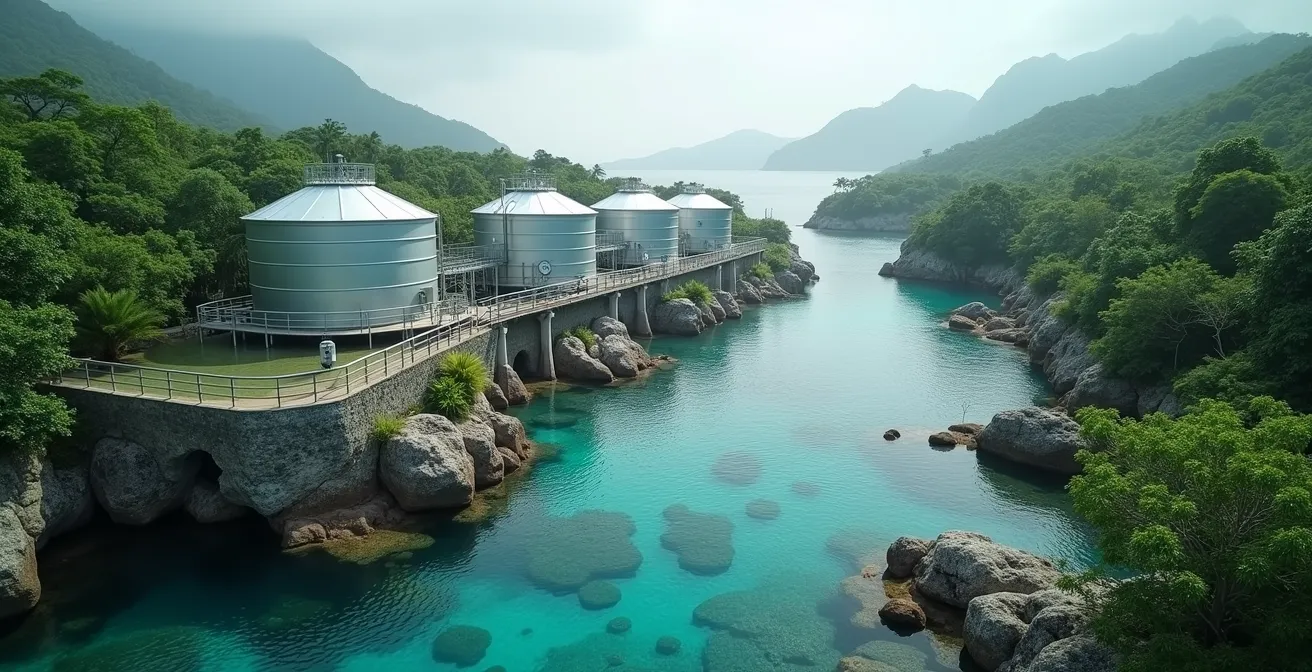
As the image demonstrates, this infrastructure isn’t hidden away; it’s an integrated part of a sustainable operation. In a case study, Secret Bay in Dominica became the first on the island to receive a Green Globe Certificate, partly due to its comprehensive wastewater management system designed to protect the surrounding marine environment. They don’t just talk about protecting the ocean; they have engineered a solution and can prove it. This is the level of operational transparency an auditor looks for.
When you ask a manager, “Where does the shower water go?” a vague answer like “we have a septic system” is insufficient. Demand to know the stages of treatment and the final destination of the treated water. A proud, detailed answer signifies a real commitment to protecting the paradise they profit from.
Staff composition: are the employees locals or backpackers on rotation?
Sustainability is not just about the environment; it has a critical social pillar. An “eco-resort” that displaces local populations, imports its entire workforce, and funnels all profits offshore is an extractive enterprise, not a sustainable one. An audit of a resort’s social credentials begins with a simple question: who works here? And more importantly, who benefits? A high percentage of local employees, especially in management positions, is a strong positive indicator. It shows the resort is investing in the community, providing stable careers, and sharing economic benefits.
As environmental expert Krebs noted in Popular Science, a sustainable resort must play a larger role within its community, not just cut its own plastic use. This includes educating and empowering local staff.
An eco-resort shouldn’t only practice environmentalism in its business by cutting plastic or water use, but should play a larger role within the community. Part of the principle should be to educate residents and staff on composting, recycling, and other sustainable practices.
– Environmental Expert Krebs, Popular Science
This community integration is the opposite of a model that relies on a rotating cast of temporary foreign workers. While cultural exchange is valuable, a system where locals are only employed in low-wage, low-skill jobs while all senior and guest-facing roles are held by expatriates is a colonial-era dynamic, not a sustainable one. Scrutinizing the resort’s employment practices provides a clear window into its true values.
The following framework provides a structured approach for your investigation. These are not comfortable questions, but they are necessary ones.
| Assessment Area | Questions to Ask | Red Flags |
|---|---|---|
| Management Positions | What percentage of management roles are held by locals? | All senior positions held by foreigners |
| Wage Standards | Do you pay certified living wages above legal minimum? | Vague answers about ‘competitive’ wages |
| Profit Sharing | Is there a community trust fund or equity program? | No formal profit-sharing mechanism |
| Career Development | What training programs exist for local staff advancement? | No clear pathway for locals to advance |
A resort that is proud of its community partnership will be eager to share its success stories of local staff advancing into leadership roles. Silence or deflection on this topic suggests that the “community” is merely part of the scenery, not a partner.
Low impact design: is the resort built around the trees or over them?
A resort’s sustainability journey begins before the first guest ever arrives. The design and construction phase has a profound and often permanent impact on the local ecosystem. The core question for an auditor is: was the resort designed to fit the environment, or was the environment cleared to fit the resort? Low-impact design prioritizes the preservation of the existing landscape, building around mature trees, following natural contours, and minimizing soil disruption. This is fundamentally different from razing a plot of land and planting some decorative palms after construction.
This design philosophy extends to the materials used. Are they locally sourced? Are they certified by bodies like the Forest Stewardship Council (FSC)? Is the architecture designed for passive cooling to reduce energy demand? These are not aesthetic choices; they are critical sustainability metrics. With the tourism sector’s emissions footprint growing—a PopSci article noted that transport-related tourism emissions are expected to reach 5.3% of global emissions by 2030—on-site efficiency is more important than ever. An auditor must request to see the pre-construction Environmental Impact Assessment (EIA), a document that should detail the site’s original state and the measures taken to protect it.

The evidence is in the details: elevated walkways that allow wildlife to pass underneath, buildings positioned to maximize shade and airflow, and the visible presence of old-growth nature. A resort that has clear-cut a site will have a sterile, manicured feel, with young, newly planted vegetation. A resort built with a low-impact philosophy feels like it has always been part of the forest. The ultimate proof of long-term commitment is the existence of a decommissioning plan, detailing how the site will be restored to its natural state at the end of the resort’s life—a question that will quickly separate the truly committed from the merely compliant.
Look for evidence of coexistence, not conquest. A resort that respects its environment works with it, and the signs of this partnership are written into the very fabric of its design.
Tree planting vs passive stay: does the resort offer active ways to help?
Many resorts offer “eco-activities” for guests, with tree planting being the most common. While well-intentioned, this can often be a form of performative sustainability—a token gesture that creates a good photo opportunity but has little real ecological impact. An auditor must question the substance behind the activity. Is it part of a structured, long-term reforestation program with a scientific basis? Or is it an isolated event to make guests feel good? The difference is crucial.
Dr. Antje Martins, a sustainable tourism course tutor at the University of Queensland, puts it bluntly: “Does the business have any sustainability credentials, preferably third-party or externally audited? Can the business provide evidence that it manages the resort sustainably or regeneratively? Anything else is greenwashing.” A single tree-planting event is not evidence of regenerative management.
Case Study: The Secret Campsite’s Genuine Conservation Approach
The Secret Campsite in East Sussex provides a powerful counter-example. As highlighted by The Sustainable Agency, instead of focusing on token guest activities, they prioritize substantive operational excellence. Their commitment is demonstrated through award-winning low-carbon design, habitat preservation, and the rigorous pursuit of B Corp Certification. This case shows that genuinely sustainable businesses focus on their core infrastructure and management systems, understanding that this has a far greater impact than any performative guest activity.
The most impactful ways for a traveler to contribute are often passive: choosing a resort with proven low-impact operations, participating in educational talks with local conservationists, or simply following guidelines that minimize disturbance to wildlife. Authentic eco-resorts prioritize substantive impact over symbolic gestures. They focus on getting their own house in order—their energy, water, waste, and supply chain—before asking guests to plant a sapling for a social media post.
Before you sign up for that tree-planting excursion, ask about the resort’s B Corp status or its water treatment capacity. The answers to those questions will tell you far more about its commitment to the planet.
Green zones vs general use: where to go for the highest biodiversity?
Many resorts located in areas of natural beauty will boast about their proximity to “green zones,” “conservation areas,” or “private reserves.” These terms can be meaningful, but they can also be empty marketing. An auditor must probe the definition and management of these zones. A true conservation zone is more than just an undeveloped piece of land; it is an actively managed area with a formal plan, specific goals, and measurable outcomes. Your job is to verify the legitimacy of these claims.
Start by asking to see the Conservation Management Plan. A serious operation will have a documented strategy that maps out different zones, outlines permitted and prohibited activities, and details efforts like habitat restoration or rewilding. The absence of such a document is a major red flag. Another key indicator is partnerships. Is the resort working with reputable environmental NGOs like The Nature Conservancy or collaborating with the biology department of a local university? These affiliations lend credibility and suggest a science-based approach to conservation.
Finally, test the knowledge of the guides. A guide in a genuine eco-zone should be a trained naturalist, capable of identifying species by their scientific names and explaining complex ecological relationships. If the “nature walk” is led by someone who can only point out the most obvious flora and fauna, it’s likely a recreational activity, not a conservation-focused one. You are looking for depth of knowledge and a passion for the ecosystem, not just a scripted tour.
A patch of trees is not a preserve. A real conservation zone is a hub of scientific activity and dedicated protection, and a genuine eco-resort will be your gateway to experiencing it, not just a bystander profiting from its existence.
Supply Nation: using the directory to find businesses owned by traditional custodians
A crucial, often overlooked, aspect of a resort’s sustainability audit is its supply chain. Where does the food in the restaurant come from? Who supplies the linens, the building materials, and the tour services? A resort committed to holistic sustainability will prioritize sourcing from local and, where applicable, indigenous-owned businesses. This practice ensures that the economic benefits of tourism are distributed within the host community rather than being extracted by large, distant corporations. In countries like Australia, directories like Supply Nation provide a verified list of Indigenous businesses, making it easier to hold resorts accountable.
This level of scrutiny aligns with the advice of experts like Debbie Hindle, Chair for the International Center for Responsible Tourism, who warns against vague claims and urges travelers to look for specific, demonstrable impact. Choosing to partner with local organic farms, indigenous tour guides, or community-owned craft cooperatives is a demonstrable good. It is a tangible action that supports cultural preservation and economic empowerment. This is the “socioeconomic and cultural impact” that rigorous certification bodies like those accredited by the Global Sustainable Tourism Council (GSTC) assess.
When auditing a resort, ask for specifics. “We source locally” is a platitude. “We source 70% of our fresh produce from these three specific local farms, and our marine tours are operated in partnership with the local Gumatj clan” is operational proof. This information may not be on the front page of their website, but a truly committed resort will have it available and will be proud to share it. It demonstrates a deep, respectful integration into the local fabric, which is the hallmark of genuine sustainable tourism.
By asking where the money goes, you uncover the true nature of the resort’s relationship with its home. Is it a partnership or a plantation? The supply chain holds the answer.
Key Takeaways
- Sustainability is proven by verifiable metrics (kWh usage, water treatment stages), not by marketing mantras.
- True eco-resorts integrate social responsibility, verifiable through local hiring data and community profit-sharing.
- Scrutinize third-party certifications; only a few, like B Corp or GSTC-Accredited bodies, involve rigorous, independent audits.
How to Visit the Great Barrier Reef Sustainably Before It Changes?
Nowhere is the need for this auditor’s mindset more critical than in globally significant, fragile ecosystems like the Great Barrier Reef. The sheer volume of operators all claiming to be “eco-certified” makes it a minefield of greenwashing. To navigate this, you must synthesize all the principles we’ve discussed and apply them to the final gatekeeper: certifications. With over 180 different sustainable certifications in the tourism industry, most are meaningless. The key is to distinguish between rigorous, third-party audited credentials and self-awarded or paid-for labels.
An auditor doesn’t trust a logo; they trust the process behind it. Certifications like B Corp, EarthCheck, and those accredited by the GSTC are valuable because they require businesses to undergo a comprehensive, evidence-based assessment of their environmental and social performance. They look at the very metrics we’ve discussed: energy and water consumption, waste management, local hiring, and supply chain policies. In contrast, greenwashing labels often focus on a single, highly visible initiative (like “we’ve banned plastic straws”) while ignoring larger, systemic impacts.
The following table, based on expert analysis, provides a clear guide to separating legitimate certifications from the red flags of greenwashing. As this is a critical tool, its information is drawn from a comparative analysis highlighted in publications like Fodor’s Travel.
| Legitimate Certifications | Verification Method | Greenwashing Indicators |
|---|---|---|
| B Corp & Travel By B Corp | Rigorous third-party audit | Self-created eco-labels |
| EarthCheck | Science-backed metrics | Vague ‘eco-friendly’ claims |
| GSTC Accredited | 100+ sustainability indicators | Single green initiative focus |
| Beyond Green Collection | Thoroughly audited properties | Paid-for certifications |
Your next trip is an opportunity to vote with your wallet. Use this auditor’s toolkit not just to choose a resort, but to send a clear message to the industry: the time for vague promises and performative green gestures is over. It is time to demand operational proof.