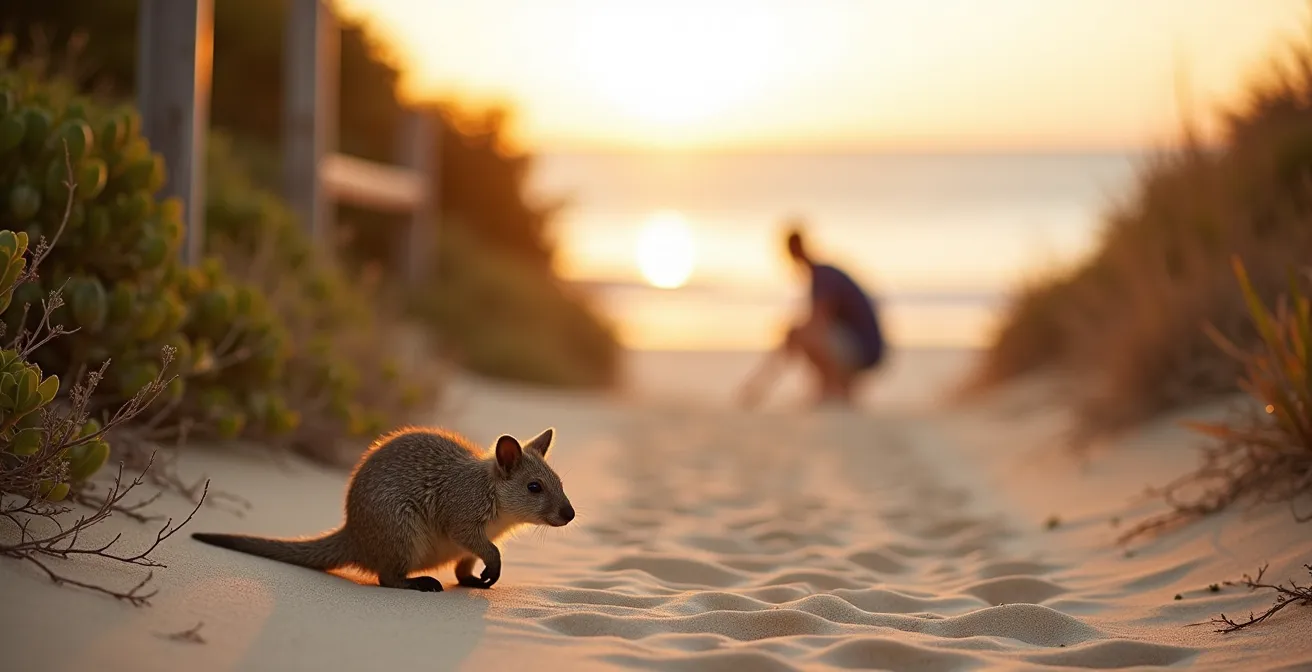
The perfect quokka selfie has nothing to do with a selfie stick and everything to do with earning the animal’s trust.
- Touching or feeding quokkas can lead to severe fines and cause fatal diseases like ‘lumpy jaw’.
- Reading a quokka’s body language is the most critical skill for a safe and respectful interaction.
Recommendation: Get on their level, be patient, and let the quokka approach you—this is the only way to get a truly genuine and ethical photo.
The quokka selfie has become a global phenomenon, a bucket-list item for any visitor to Western Australia’s Rottnest Island. Social media feeds are filled with images of smiling tourists posing next to the seemingly cheerful marsupials. This viral trend, however, hides a more complex reality. The desire for the perfect shot often pushes visitors to engage in behaviors that are not only illegal but also incredibly harmful to the very animals they’ve come to admire. Most guides will tell you the basics: don’t touch, don’t feed. But this advice barely scratches the surface.
True ethical interaction goes beyond simply following rules; it requires understanding the ‘why’ behind them. It’s about shifting your mindset from that of a tourist taking a souvenir to that of a temporary custodian for a vulnerable species. This guide is not about how to game the system for a better photo. It is a manual for responsible engagement. We will explore the serious consequences of improper contact, teach you how to read a quokka’s true feelings through its body language, and show you how to capture that memorable moment without compromising the animal’s health or safety. Your visit has an impact, and it is your responsibility to ensure that impact is a positive one.
For those who prefer a visual format, the following video offers a glimpse into the real-world challenge and reward of interacting with these unique animals responsibly, complementing the detailed advice in this guide.
This article is structured to build your understanding step-by-step, from the legal and biological reasons for the rules to the practical skills needed for an ethical encounter. By the end, you will be equipped not just to take a photo, but to be an advocate for the quokkas’ well-being.
Summary: The Complete Guide to an Ethical Quokka Encounter
- Why touching a Quokka can result in a $150 fine from island rangers?
- The ground-level perspective: how to get the ‘smile’ without baiting the animal?
- Ears back and hissing: recognizing when a Quokka wants to be left alone
- Why giving a cracker to a Quokka causes lumpy jaw and dehydration?
- Beyond the bakery: where to find Quokkas in natural bushland settings?
- E-bike vs standard bike: is the extra rental cost worth it for the hills?
- The “lumpy jaw” disease: how feeding bread to wallabies sentences them to death?
- How Strict Bio-Security Laws Affect What You Can Pack in Your Luggage?
Why touching a Quokka can result in a $150 fine from island rangers?
The rule to “look but don’t touch” is not a friendly suggestion; it is a strict legal mandate with serious consequences. While the on-the-spot fine starts at $150, the penalties can escalate dramatically. According to Rottnest Island’s own regulations, touching a quokka can lead to prosecution with fines up to $10,000. This is because touching them is considered a breach of welfare. The law goes even further, as deliberate acts of cruelty fall under the Animal Welfare Act 2002, which carries penalties of up to $300,000 and five years in prison. These are not empty threats. In a recent incident, authorities used social media to track down a tourist who posted a photo of himself holding a quokka. The man was identified and issued a $200 infringement, a clear demonstration that rangers actively monitor posts and enforce the rules.
The legal framework is built on a biological necessity. Human contact can make quokkas sick by transferring diseases they have no immunity against. Furthermore, if a mother carries an unfamiliar human scent back to her joey, she may abandon it, which is a death sentence for the young. With a vulnerable population of only 10,000-12,000 quokkas on the island, every individual is precious. The regulations are in place to protect this delicate ecosystem from the well-intentioned but devastating impact of tourism. Ignoring them is not just breaking a rule; it’s directly endangering the survival of the species.
The ground-level perspective: how to get the ‘smile’ without baiting the animal?
The secret to the perfect quokka selfie lies not in technology or tricks, but in a principle that is fundamental to all ethical wildlife photography: patience. Quokkas are naturally curious and, in the absence of a perceived threat, will often approach humans on their own. As Shane Kearney, an Acting General Manager at the Rottnest Island Authority, notes, “Quokkas are fairly trusting, [and if you are] patient they will happily come to you.” This is the foundation of an ethical encounter. You are not chasing or luring the animal; you are creating a calm, safe space and inviting it to enter. The goal is to earn a moment of trust, not to force an interaction.
Your role is to become a non-threatening part of the landscape. This involves getting down to their level, quite literally. Lying on the ground signals that you are not a predator. It puts you at their eye level, which is far less intimidating than towering over them. This simple change in perspective is often all it takes to spark their curiosity. Resist the urge to make sudden movements or loud noises. A calm demeanor and quiet observation are your greatest assets. Once a quokka approaches, you can use your camera’s burst mode to capture a series of images, increasing your chances of catching that perfect “smile” as it naturally looks around.
Action Plan: The Art of the Ethical Selfie
- Embrace Patience: Find a comfortable spot in an area where quokkas are present and simply wait. This is a slow art; do not rush the process.
- Assume the Position: Lie down on the ground to be at their eye level. This shows you are not a threat and results in much better, more intimate photos.
- Minimize Your Presence: Keep noise and sudden movements to an absolute minimum. Avoid talking loudly, especially when a quokka first approaches.
- Master Your Timing: The best light and most active quokkas are found in the early morning (around sunrise) and late afternoon (a couple of hours before sunset).
- Use the Right Tools: An ultra-wide-angle lens or a selfie stick (used responsibly) allows you to maintain a safe distance while keeping both you and the quokka in the frame.
Ears back and hissing: recognizing when a Quokka wants to be left alone
While quokkas are known for their friendly appearance, they are still wild animals with a clear set of communication signals to express discomfort, anxiety, or fear. Being an ethical visitor means learning to read this language. Ignoring these signs is not only disrespectful but also a primary reason for negative interactions, including bites. Though not typically aggressive, quokkas will defend themselves if they feel cornered or threatened, leading to what official documentation describes as a few dozen bite cases annually. Recognizing the warning signs is your responsibility and is key to ensuring the interaction remains positive for both you and the animal.
The most obvious signals are auditory, such as a sharp hissing sound. This is a final warning, an unambiguous request for you to back off immediately. However, the visual cues often come first. If a quokka’s ears are pulled back flat against its head, it is a sign of anxiety. If it begins scratching nervously or repeatedly turns its back on you, it is communicating that the interaction is over. The most crucial rule of ethical engagement is to respect the animal’s decision. If a quokka tries to retreat, you must let it go. Following or cornering an animal that is trying to escape is a form of harassment and causes immense stress.
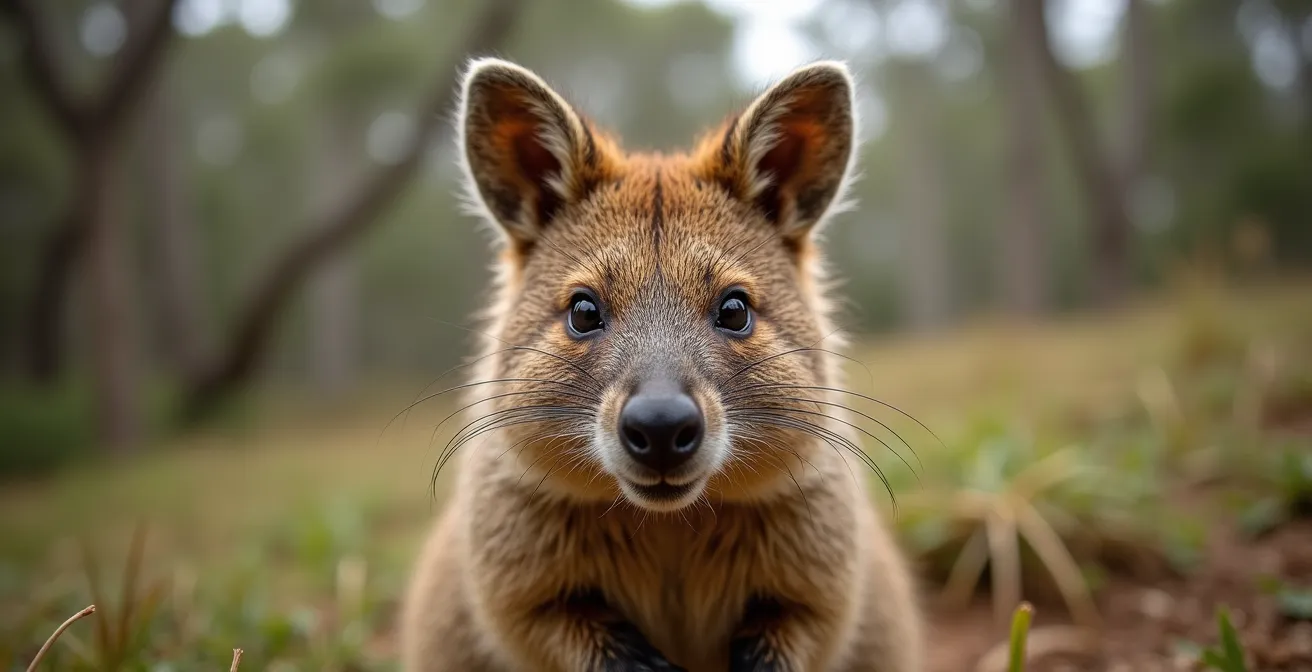
To help visitors become fluent in this non-verbal communication, we’ve compiled a dictionary of common quokka body language. Study these signals and be prepared to act on them instantly.
| Body Signal | Meaning | Required Action |
|---|---|---|
| Ears back | I’m anxious | Step back immediately |
| Hissing sound | Final warning, back off | Leave area quickly |
| Turning its back | This interaction is over | Stop following |
| Nervous scratching | Your presence causes stress | Increase distance |
| Trying to retreat | Seeking escape | Do not pursue |
Why giving a cracker to a Quokka causes lumpy jaw and dehydration?
The “no feeding” rule is the single most important regulation for protecting quokka health, and the science behind it is both clear and devastating. Human foods, even seemingly harmless items like bread, crackers, or fruit, are a death sentence for these marsupials. Their digestive systems are adapted for a specific diet of native grasses and leaves, which are tough and fibrous. Processed human foods are high in refined carbohydrates and sugars, which create a perfect breeding ground for bacteria in their mouths. As marsupial expert Yegor Malaschichev explained to National Geographic, foods like bread “stick between their teeth, which can later cause an infection called ‘lumpy jaw’.”
This infection, known clinically as actinomycosis, is as horrific as it sounds. It is an incredibly painful and often-fatal disease. The bacteria cause abscesses in the soft tissue and bone of the jaw, leading to massive, grotesque swelling. An infected quokka is unable to eat properly, leading to starvation, while the infection slowly and painfully destroys its facial structure. Furthermore, many human foods are high in salt, which quokkas cannot process efficiently. This leads to severe dehydration and kidney damage. Giving a quokka a piece of your sandwich or a cracker might seem like a kind gesture, but you are effectively poisoning it and may be starting a process that leads to a slow, agonizing death.
The animals will happily (and adorably) nibble away at a visitor’s vegemite sandwich, but the bread ‘sticks between their teeth, which can later cause an infection called lumpy jaw’. It would be terrible to cause premature death in one of these nice, and also vulnerable, animals.
– Yegor Malaschichev, National Geographic
Beyond the bakery: where to find Quokkas in natural bushland settings?
The highest concentration of tourists—and consequently, the most habituated and food-habituated quokkas—is found around the Thomson Bay settlement, near the bakery and other food outlets. While convenient, this is not the ideal environment for an ethical wildlife encounter. To truly appreciate quokkas in their natural element and encourage healthy behaviors, you must venture further afield. The island is a diverse ecosystem, and finding quokkas in their native bushland offers a far more rewarding experience.
The key is to explore the island’s walking and cycling trails. Quokkas are most active during the cooler parts of the day, making early mornings and late afternoons the prime time for spotting. As the Rottnest Island Authority officially advises, “Early mornings and late afternoons see most quokkas out and about, in various spots across the island.” Look for them in the shade of native shrubs and trees, where they rest during the heat of the day. A key plant to identify is the Guichenotia ledifolia, a type of native hibiscus whose leaves are a favorite food source. Finding these plants often means finding quokkas nearby.
Here are some key zones to explore for a more natural viewing experience:
- Zone 1 – Thomson Bay Settlement: This is the most popular area, but it’s also where quokkas are at the highest risk from human food and improper interaction. Observe from a distance.
- Zone 2 – Parker Point: Located about 6km from the main settlement, this area features shrub forests of native tea trees and offers a chance to see more natural quokka populations.
- Zone 3 – Wadjemup Bidi Trails: These remote walking trails offer the best opportunity for truly wild quokka observation. Here, you can see them foraging and interacting in their undisturbed habitat.
E-bike vs standard bike: is the extra rental cost worth it for the hills?
Exploring Rottnest Island by bike is a quintessential part of the experience, but choosing the right type of bike can make or break your ability to ethically access the best quokka-spotting locations. While a standard bike is a budget-friendly option, the island’s surprisingly hilly terrain can be a significant challenge for many visitors. This is where the e-bike becomes more than a luxury; it becomes a strategic tool for responsible tourism. The extra rental cost is a small price to pay for the ability to reach the island’s remote and pristine habitats without exhaustion.
An e-bike’s pedal-assist motor neutralizes the island’s notorious hills, making the journey to locations like Parker Point or the more remote trailheads on the Wadjemup Bidi network accessible to people of all fitness levels. This allows you to get away from the crowded settlement and observe quokkas in their natural bushland environment, as discussed previously. It empowers you to make the more ethical choice of observing wild, non-habituated populations. For many, the choice between a standard bike and an e-bike is the choice between being stuck in the main settlement or having the freedom to explore the entire island and its natural wonders.
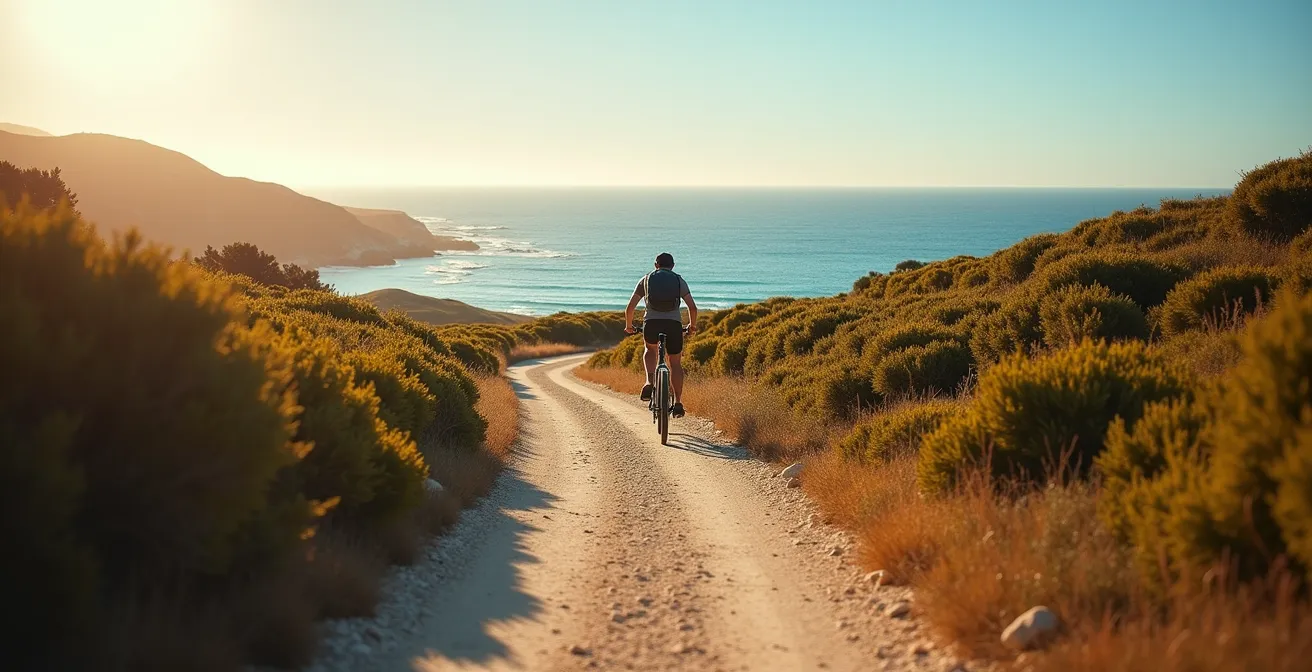
The decision ultimately comes down to your fitness, budget, and goals for the day. This comparison should help you make an informed choice.
| Bike Type | Daily Cost | Best For | Wildlife Access |
|---|---|---|---|
| Standard Bike | $36 adults / $18 children | Fit cyclists, budget travelers | Limited to easier trails |
| E-Bike | $50-70 (varies by provider) | All fitness levels, full island access | Remote quokka habitats accessible |
| Island Bus | $20-30 hop-on/hop-off | Families, limited mobility | Main settlements only |
| Own Bike (freight) | $21 freight charge | Experienced cyclists | Full island access |
The “lumpy jaw” disease: how feeding bread to wallabies sentences them to death?
The tragic impact of ‘lumpy jaw’ disease is not unique to quokkas. It is a scourge that affects many marsupial species, serving as a powerful, universal lesson on the dangers of feeding wildlife. The case of wallabies is another stark example of how a seemingly kind act can lead to a slow and painful death. Just like quokkas, wallabies have specialized digestive systems that are not equipped to handle the soft, sugary, and processed nature of human food like bread. The Perth Natural Resource Management group’s guidelines explicitly identify this as the cause of Lumpy Jaw, a serious bacterial infection of the jaw.
The progression of the disease in wallabies mirrors that in quokkas. The bacterial infection causes severe inflammation and abscesses in the jawbone. Outwardly, this manifests as excess salivation, difficulty chewing, and visible, often grotesque, swelling of the face and neck. The animal is in constant pain and slowly starves as it becomes unable to eat. In managed wildlife populations, the prognosis is so grim that if treatment is unsuccessful, humane slaughter is often recommended to end the animal’s suffering. When you offer bread to a wallaby, a kangaroo, or a quokka, you are not giving it a treat; you are potentially starting this horrific chain of events.
This reinforces a fundamental principle of wildlife ethics: your food is not their food. The prohibition is not arbitrary. It is a critical measure to prevent immense suffering and preserve the health of entire animal populations. The lesson learned with quokkas on Rottnest Island applies to wildlife everywhere. Respect their diet, and you respect their right to a healthy, natural life.
Key Takeaways
- The ‘No Touch, No Feed’ rule is a biological necessity rooted in preventing disease and suffering, not just a guideline.
- Patience and quiet observation are your most effective tools for an ethical encounter, not bait or selfie sticks.
- Your role is that of a temporary guardian; the quokka’s welfare must always be your paramount concern.
How Strict Bio-Security Laws Affect What You Can Pack in Your Luggage?
The final pillar of your role as an ethical custodian extends beyond direct interaction with animals to protecting their entire habitat. Rottnest Island is an A-class reserve, meaning it has the highest level of environmental protection. This is enforced through strict biosecurity laws that dictate what you can and cannot bring to the island. These laws are not about inconveniencing tourists; they are a critical defense against invasive species that could devastate the island’s fragile ecosystem, upon which the quokkas depend for survival.
A primary threat is an invasive, soil-borne water mould called Phytophthora dieback. As the Australian Government’s Department of Environment points out, “Phytophthora dieback is one of the world’s most invasive species and threatens native vegetation that quokkas rely on for food and shelter.” This microscopic organism can be transported in soil attached to shoes, equipment, or vehicles. An outbreak could wipe out the very plants that form the basis of the quokka’s diet and habitat. Therefore, before traveling to the island, you must ensure your shoes, bags, and any equipment are thoroughly clean and free of any soil or plant matter. Do not pack any plants, seeds, or soil from the mainland.
This responsibility also extends to waste disposal. All rubbish must be placed in sealed bins to prevent animals from accessing it and to stop the spread of pests. By respecting these biosecurity measures, you are participating in the highest form of ethical tourism: protecting not just a single animal, but the entire ecosystem that sustains it. It is the ultimate expression of care, ensuring the island remains a sanctuary for generations to come.
By embracing these principles—maintaining distance, refusing to feed, reading their behavior, and protecting their habitat—you do more than just get a photo. You become part of the solution, an active participant in the conservation of one of the world’s most beloved animals. The best souvenir you can take from Rottnest Island is the knowledge that you left it as pristine as you found it.