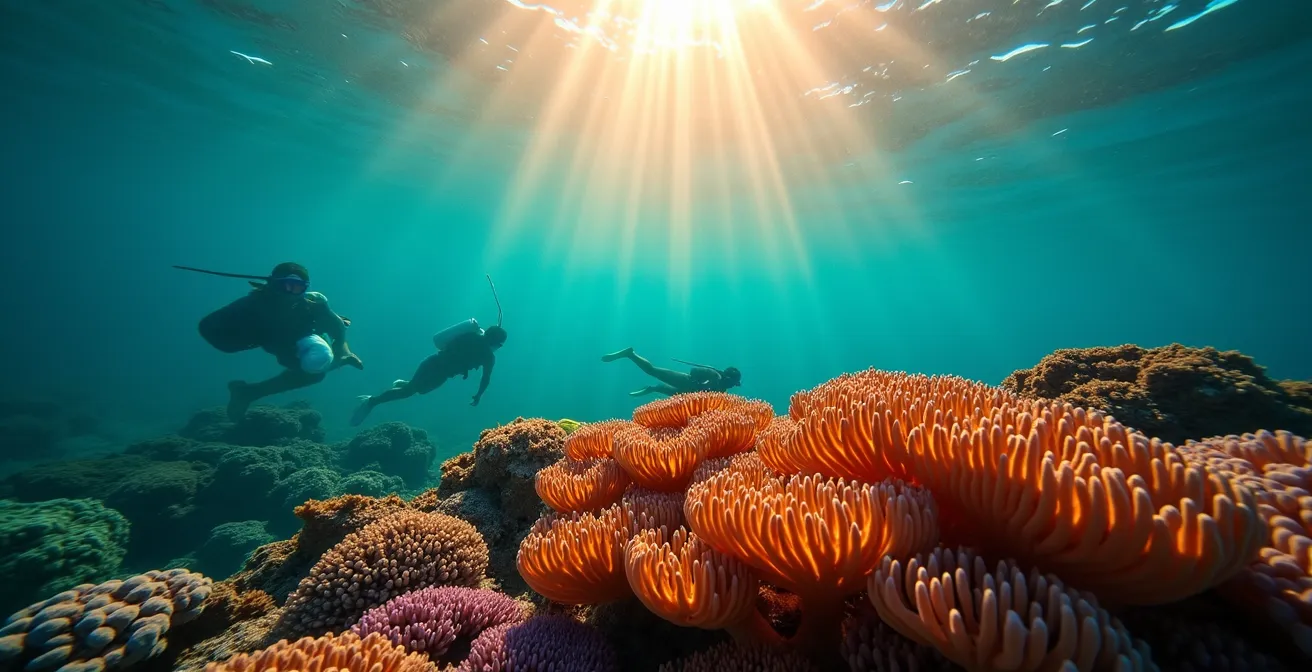
Visiting the Great Barrier Reef today isn’t about a last-chance bucket list; it’s about becoming an active, educated guardian of its future.
- Seeing bleached coral isn’t the end. Understanding the difference between a stressed, recovering, and dead reef is a critical skill for any visitor.
- Your physical presence matters. Mastering simple buoyancy and finning techniques is the most direct way to prevent accidental damage and achieve a benign presence.
- True sustainability lies in the details—from choosing operators in high-biodiversity “Green Zones” to vetting their unseen wastewater management systems.
Recommendation: Shift your mindset from a passive tourist to an active observer. Use this guide to learn the reef’s language, control your impact, and ask operators the tough questions that drive the entire industry toward better practices.
The question hangs in the air for any conscious traveler: is it still ethical to visit the Great Barrier Reef? We see headlines of mass bleaching events and are rightly concerned that our presence might do more harm than good. The desire to witness this natural wonder before it changes forever is a powerful pull, but it’s met with an equally powerful fear of being part of the problem. Conventional advice often stops at “wear reef-safe sunscreen” and “don’t touch anything,” essential but incomplete guidance that barely scratches the surface of what it means to be a truly responsible visitor.
This approach often misses the most crucial point. Sustainable tourism on the reef is not a passive checklist of prohibitions. It is an active, educational pursuit. It’s about developing a new kind of “ecosystem literacy”—learning to read the health of the coral, to understand the behavior of the giants that swim beside you, and to control your own body in a fragile three-dimensional world. The real tragedy would be to visit the reef and not understand what you are seeing, or worse, to cause damage out of sheer ignorance.
But what if the key was not just to minimize your impact, but to transform your visit into a net positive? This guide is built on that premise. As a marine conservationist, I believe the only truly sustainable way to experience the reef is to become a temporary, harmless part of its ecosystem. It requires moving beyond fear and into a state of informed action. It means understanding the science behind the rules, mastering the physical skills for a benign presence, and making choices that support the reef’s incredible, though strained, resilience.
For those who prefer a visual summary, the following documentary trailer captures the urgency and beauty of the coral ecosystems we are fighting to protect. It serves as a powerful reminder of what’s at stake.
This article will guide you through that process. We will explore the nuances of coral health, the science of marine park zoning, the specific techniques for respectful swimming, and the critical questions you must ask your tour operator. This is your training to become not just a tourist, but a reef steward.
Contents: An Urgent Guide to a Responsible Reef Visit
- Why seeing bleached coral doesn’t mean the entire reef system is dead?
- Green zones vs general use: where to go for the highest biodiversity?
- The finning technique that prevents accidental coral breakage for beginners
- Maori Wrasse or Parrotfish: identifying the giants of the reef
- When to book your reef trip to ensure 30-meter visibility?
- Greywater systems: where does the soapy water go in a sensitive reef environment?
- The 3-meter rule: how to swim alongside a giant without touching it?
- Where to Find Snorkeling Spots with 20+ Meter Visibility for Beginners?
Why seeing bleached coral doesn’t mean the entire reef system is dead?
The term “coral bleaching” conjures images of a desolate, lifeless wasteland. While it is a severe sign of stress, it is not an instant death sentence. Understanding what you’re seeing is the first step toward ecosystem literacy. Bleaching occurs when coral, under stress from high water temperatures, expels the symbiotic algae (zooxanthellae) living in its tissues. These algae provide the coral with most of its food and color. When they’re gone, the coral’s transparent tissue reveals its white limestone skeleton. The coral is still alive at this stage, but it is starving and vulnerable.
Recovery is possible if temperatures drop and conditions improve, allowing the algae to return. In fact, following a severe 2024 bleaching event, research from the University of Sydney reveals that 16% of bleached coral colonies showed signs of recovery within months. What you might interpret as a dead reef could be one fighting for its life. Sometimes, corals exhibit a “fluorescence” response, glowing in vibrant neon colors. This is a chemical sunscreen the coral produces under stress and is a sign that it is still alive and trying to protect itself.
The true sign of death is when the coral skeleton becomes overgrown with a turf of brown or green algae. This indicates the coral tissue has died and the skeleton is now just a vacant structure being colonized by other organisms. By learning to distinguish between these stages—paling, stark white, fluorescent, and algae-covered—you move from a passive observer to an informed witness, capable of understanding the dynamic state of the reef’s health.
Green zones vs general use: where to go for the highest biodiversity?
Not all parts of the Great Barrier Reef are managed equally. The Great Barrier Reef Marine Park Authority (GBRMPA) has a comprehensive zoning plan, a bit like a city plan for the ocean, that designates what activities are allowed where. For an eco-conscious traveler, understanding this system is crucial for choosing an operator that will take you to the most vibrant and protected areas. The most important designation to look for is the Marine National Park Zone, commonly known as a “Green Zone.”
These are “no-take” areas where all forms of fishing and collecting are prohibited. They act as protected nurseries, allowing fish populations to grow larger and more numerous. This creates a “spillover effect,” where the abundance of life within the Green Zone overflows into adjacent areas, enriching the entire ecosystem. As a visitor, this is where you will witness the highest levels of biodiversity and see the reef in its most natural, resilient state.
Operators with permits to enter Green Zones are often among the most committed to conservation. They understand the value of these protected areas and are typically more invested in educating their guests. Choosing a tour that advertises snorkeling or diving in a Green Zone is a direct way to support this conservation strategy and ensure your experience is as rich as possible.
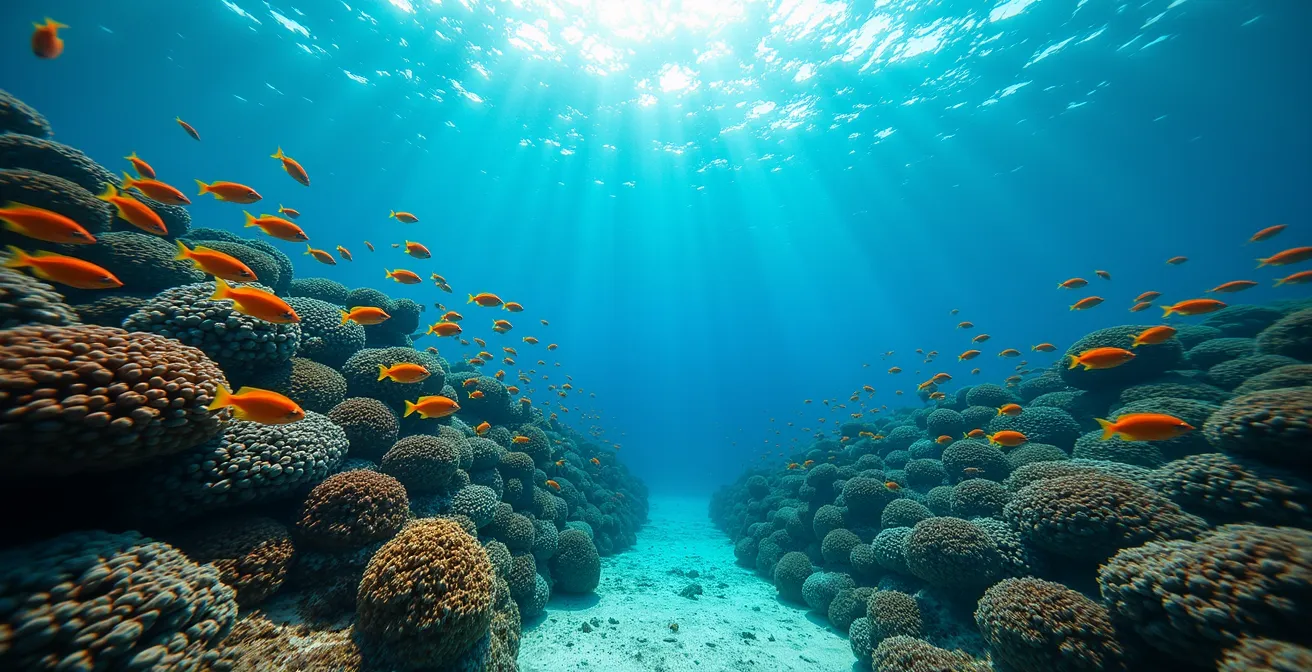
The contrast between these zones is scientifically proven. The following table, based on GBRMPA data, illustrates how protection levels directly impact the richness of marine life you are likely to encounter. As this comparative analysis of zoning impacts shows, the highest protection directly correlates with the highest biodiversity.
| Zone Color | Protection Level | Biodiversity Index | Visitor Access |
|---|---|---|---|
| Green (No-take) | Highest | 30% higher fish biomass | Snorkeling/Diving only |
| Yellow | Moderate | Standard diversity | Limited fishing |
| Blue | Conservation | 15% above baseline | Research priority |
| Orange | General Use | Baseline | Most activities allowed |
The finning technique that prevents accidental coral breakage for beginners
The number one rule on the reef is “don’t touch the coral,” but for many beginners, controlling their body in the water is a significant challenge. Uncontrolled, flailing kicks from a vertical swimming position are a primary cause of accidental coral breakage. The solution lies in mastering a more efficient and controlled finning technique: the “frog kick.” Unlike the scissor kick, where fins move up and down, the frog kick involves a motion similar to a frog’s, with legs moving in a horizontal plane. This propels you forward without creating a downward or upward thrust that can damage coral below or send you crashing into it.
Mastering this technique is about more than just your legs; it’s about achieving neutral buoyancy and a state of “benign presence.” A key part of this is your breath control. As the Master Reef Guide Training Manual explains, your lungs are your natural buoyancy control device. A deep breath makes you more buoyant, lifting you gently, while exhaling allows you to sink slowly. An expert on the matter from the GBRMPA Sustainable Tourism Guidelines puts it best:
A full breath acts as a natural BCD (Buoyancy Control Device) to lift you, and exhaling helps you sink, reducing the need for frantic kicking near coral.
– Master Reef Guide Training Manual, GBRMPA Sustainable Tourism Guidelines
By coordinating gentle frog kicks with controlled breathing, you can hover effortlessly over the reef, moving with precision and purpose. This not only protects the coral but also conserves your energy, allowing for longer, more relaxed snorkeling sessions. Practicing this in a pool or on dry land before your trip can make a world of difference. It transforms you from a potential threat into a graceful observer, fully in control of your impact on this delicate environment.
Maori Wrasse or Parrotfish: identifying the giants of the reef
Part of a responsible visit is appreciating the specific inhabitants of the reef ecosystem. Two of the most charismatic giants you’re likely to encounter are the Humphead Maori Wrasse and the Bumphead Parrotfish. Learning to tell them apart enhances your experience and can even contribute to their conservation. The Maori Wrasse is a magnificent, inquisitive fish that can grow up to two meters long. It’s easily identified by the prominent hump on its forehead and the intricate, maze-like patterns on its face that resemble Maori tattoos. They are a protected species, and your sightings are valuable.
The Bumphead Parrotfish, often mistaken for the Wrasse, is a different kind of giant. They travel in large schools and are the reef’s primary bio-eroders. Using their beak-like mouths, they scrape algae off coral skeletons, producing the fine white sand that forms tropical beaches. They are identifiable by their distinct, bulbous foreheads and uniform greenish-blue color. Watching a school of them graze is a truly primal sight.
Your observations can be powerful. The “Eye on the Reef” citizen science program empowers tourists and operators to log sightings of key species. According to a report on the program’s success by UNESCO, operators have logged over 40,000 Maori Wrasse sightings annually, providing crucial long-term data for managing this protected species. By learning to identify these animals and logging your sightings through an operator participating in the program, you are directly contributing to their survival. Respectful observation is key: maintain your distance, never chase them, and interpret their behavior. A slow, curious approach from a Wrasse is a sign of trust; a rapid departure means you’re too close.
When to book your reef trip to ensure 30-meter visibility?
For many, the dream of the Great Barrier Reef is one of crystal-clear water and seemingly endless visibility. While conditions vary, you can strategically plan your trip to maximize your chances of that 30-meter visibility. The prime season for water clarity is generally during the dry season, from June to October. During these winter months, there is less rainfall, lower humidity, and calmer seas. The reduced runoff from the mainland means fewer suspended sediments in the water, leading to spectacular visibility.
However, the biggest factor determining visibility is not just the time of year, but your location. There’s a significant difference between the inshore, mid-shelf, and outer reefs. The Outer Reefs, situated far from the coast, consistently offer the best visibility, often exceeding 30-40 meters. They are less affected by coastal runoff and are constantly flushed with clear oceanic water. In contrast, inshore reefs, while beautiful and accessible, typically have visibility ranging from 5 to 15 meters.
Choosing an Outer Reef trip comes with a trade-off. It requires longer boat journeys, which means a higher cost and, importantly, a larger carbon footprint. This is a critical consideration for the eco-conscious traveler. A responsible choice involves weighing the desire for perfect visibility against the environmental cost of getting there. The following table, with data compiled from tour operator reports and travel guides like Responsible Travel, highlights this dilemma.
| Reef Type | Average Visibility | Boat Travel Time | Carbon Footprint |
|---|---|---|---|
| Outer Reef | 25-40 meters | 2-3 hours | High (80L fuel/trip) |
| Mid-Shelf | 15-25 meters | 1-2 hours | Medium (40L fuel/trip) |
| Inshore | 5-15 meters | 30-60 minutes | Low (15L fuel/trip) |
Greywater systems: where does the soapy water go in a sensitive reef environment?
One of the most overlooked aspects of sustainable reef tourism is what happens to the wastewater generated on board a tour vessel. Every time a toilet is flushed or a sink is used, that “greywater” or “blackwater” has to go somewhere. In a sensitive marine environment like the Great Barrier Reef, discharging untreated or poorly treated waste can have devastating effects, introducing nutrients, chemicals, and pathogens that harm coral and other marine life. This is where your choice of operator becomes a powerful act of conservation.
The most responsible tourism operators have invested heavily in advanced onboard wastewater treatment systems. While basic vessels might use holding tanks and only discharge waste once back at port, higher-standard operators use Advanced Treatment Units (ATU). These systems treat the waste to a high degree before discharging it far from sensitive reef areas. The gold standard is a complete bio-cycle system, which produces water so clean it’s safe for direct discharge even within the marine park.
As a passenger, you have the power to drive change by asking questions. Before booking, inquire about the vessel’s waste management. An operator who is proud of their system will be happy to tell you about their ATU certification or their discharge policies. An evasive answer is a red flag. Choosing an operator with a high level of eco-certification, particularly from a body like Ecotourism Australia, often ensures these high standards are met. Your choice sends a clear market signal: sustainability, even the unseen parts, matters.
Action Plan: Vet Your Operator’s Wastewater System
- Good Practice: Ask if the vessel uses basic holding tanks, where waste is held and only discharged at designated port facilities away from the reef.
- Better Practice: Inquire if they have an Advanced Treatment Unit (ATU), which biologically treats waste before any discharge occurs, typically at least 3 miles offshore.
- Best Practice: Seek out operators with top-tier bio-cycle systems. These produce fully treated, near-potable water that is safe for the reef environment.
- Key Question: Directly ask the operator, “What level of wastewater treatment system is on your vessel and where is greywater discharged?”
- Certification Check: Prioritize operators with Advanced Ecotourism certification, as this includes audits of their waste management practices.
The 3-meter rule: how to swim alongside a giant without touching it?
Encountering a majestic sea turtle, a graceful manta ray, or a gentle reef shark is a highlight of any trip to the Great Barrier Reef. In these moments, the urge to get closer is powerful, but the most rewarding and respectful approach is to practice passive observation. The “3-meter rule” is a general guideline, but the real skill is in understanding animal behavior and positioning yourself for an encounter, rather than pursuing one. This means no chasing, no cornering, and absolutely no touching.
Chasing an animal triggers its flight response, resulting in a brief, stressful encounter for the animal and a poor experience for you. The key is to anticipate their path and remain still, letting them approach you on their own terms. For manta rays, this means never swimming directly above them, as it mimics the silhouette of a predator. For sea turtles, observe if they are feeding or traveling; interrupting a feeding animal causes significant stress. By remaining calm and giving them space, you become a non-threatening part of the environment, and their natural curiosity may lead them to you.
This “less is more” approach is not just an ethical theory; it’s a proven method for better wildlife interactions. The success of this technique is a core part of the visitor experience at leading eco-resorts.
Case Study: Passive Encounter Success at Lady Elliot Island
According to a report highlighted by guides for sustainable travel, the Lady Elliot Island Eco Resort has proven the value of passive observation. They instruct snorkelers to position themselves calmly in known manta ray corridors and simply wait. This approach has resulted in incredible average interaction times of 8 minutes, compared to just 30-second glimpses when guests actively pursued the animals. Furthermore, this method led to a 70% reduction in measured stress indicators in the mantas. It’s definitive proof that giving animals space leads to a more profound and sustainable connection.
This principle of “benign presence” is the ultimate sign of a respectful visitor. It requires patience and a deep appreciation for the wildlife you are privileged to observe. By adhering to these distance guidelines, you ensure that your unforgettable moment doesn’t come at the animal’s expense.
Key Takeaways
- True sustainability is active, not passive. It requires learning to interpret the reef’s health signals, from coral bleaching stages to animal behavior.
- Your physical skill matters. Mastering buoyancy and a horizontal finning technique like the frog kick is the most direct way to prevent accidental coral damage.
- Vet your operators on substance, not just promises. Ask about their access to protected Green Zones and their onboard wastewater treatment systems.
Where to Find Snorkeling Spots with 20+ Meter Visibility for Beginners?
For a beginner, the idea of snorkeling on the vast Great Barrier Reef can be as daunting as it is exciting. The key to a great first experience is choosing a location that matches your confidence level, not just one that promises the best visibility. Fortunately, tour operators have developed options tailored specifically to ease beginners into the water. If you’re feeling anxious, the best starting point is a pontoon platform moored on the Outer Reef. These provide a stable base with rest stations, lifeguards, and often an underwater observatory, allowing you to get comfortable at your own pace in waters with 15-25m visibility.
For the “cautious explorer,” a trip to a coral cay like Michaelmas Cay or Green Island is ideal. These are small sand islands surrounded by shallow, protected lagoons. You can enter the water directly from the beach, stay in calm, shallow areas, and enjoy fantastic 20-30m visibility without the intimidation of the open ocean. It’s the perfect environment to practice your mask clearing and finning techniques.
For the “confident beginner” ready for the full experience, an Outer Reef trip with a dedicated guide is the ultimate choice. These tours take you to the most spectacular sites with 25-40m visibility. The crucial factor here is the presence of a Master Reef Guide. These guides are elite, highly trained experts who provide not only safety and reassurance but also a deep layer of interpretation about the ecosystem you’re swimming through. As Tourism Tropical North Queensland emphasizes, choosing a tour that guarantees a Master Reef Guide directly addresses a beginner’s need for expert guidance. They will help you hone your skills, point out hidden wonders, and ensure your first deep reef experience is both safe and awe-inspiring.
Your journey to the Great Barrier Reef can be a powerful force for good. Armed with this knowledge, you are now equipped to be more than just a tourist. You are ready to be a steward. The next step is to use this understanding to meticulously select an operator that aligns with these principles and to carry this ethos of a benign, educated presence with you into the water.