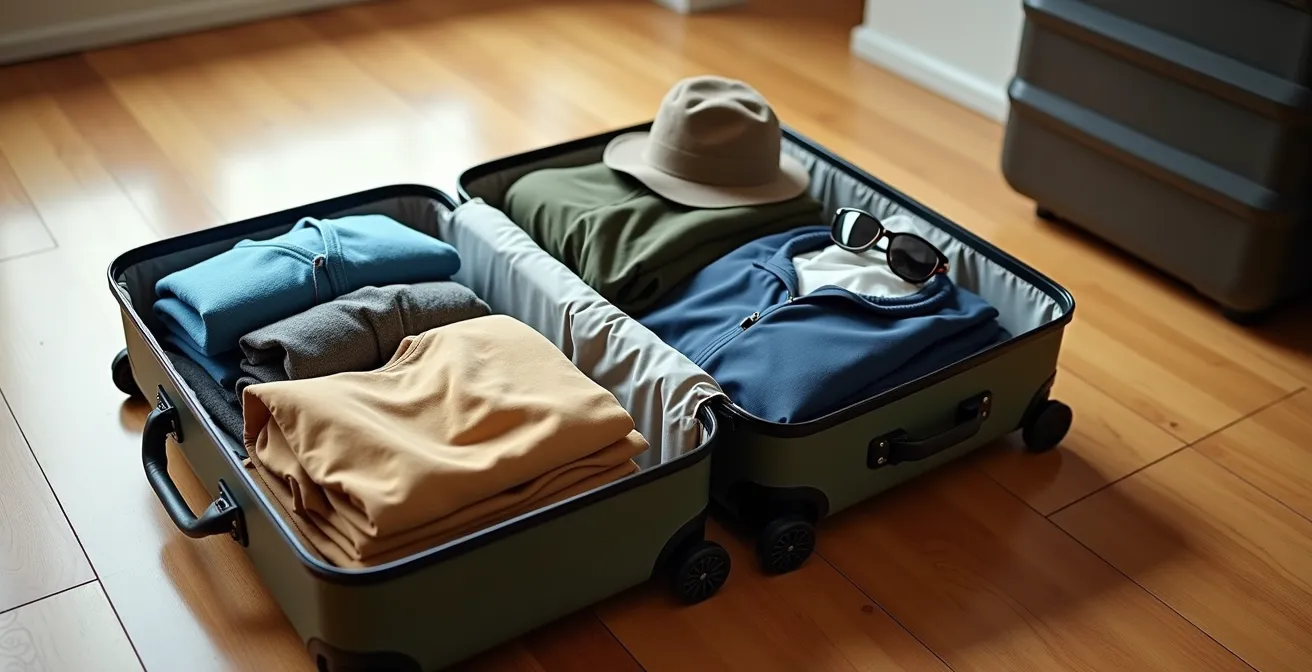
In summary:
- Ditch the “pack for every possibility” mindset and adopt a minimalist, strategic approach.
- Build a versatile “core kit” based on high-performance, multi-functional fabrics like merino wool and synthetic insulation.
- Understand and prepare for specific environmental stressors: extreme UV, humidity, jellyfish seasons, and sudden temperature drops.
- Prioritize gear that is lightweight, compressible, and serves multiple purposes across different climate zones.
- Plan your bookings in a specific 6-month timeline to align activities with optimal weather conditions.
The sheer scale of Australia presents a unique packing paradox. How can one suitcase possibly accommodate the sweltering humidity of the tropical North, the arid 40°C heat of the Outback, and the biting winds of Tasmania? The conventional wisdom to “pack for everything” is a recipe for excess baggage fees and a travel wardrobe that is heavy, bulky, and inefficient. Many travelers fall into the trap of packing multiple heavy coats, a dozen cotton t-shirts, and jeans, only to find their luggage ill-suited for the dynamic reality of Australian weather.
The solution isn’t to pack more; it’s to pack smarter. The key is to move away from a list of items and towards a strategic system. This guide rejects the idea of a bloated wardrobe in favor of a minimalist, high-performance “core kit.” We will focus on the principles of modular layering and performance fabrics, where each piece is chosen for its versatility across different environmental stressors. This is not just a packing list; it’s a packing philosophy designed for the modern traveler who values efficiency and preparedness.
By understanding the ‘why’ behind each choice—from the specific weave of a base layer to the timing of your reef tour booking—you will build a travel system that is light, adaptable, and ready for anything the continent throws at you. We’ll deconstruct the specific challenges of each major climate zone and provide a clear, actionable framework to ensure you are comfortable and protected, from Darwin’s downpours to Hobart’s gales, all from a single suitcase.
This article breaks down the strategic approach to packing for Australia’s diverse climates. Discover how to prepare for each region’s unique challenges, from weather and wildlife to road conditions, and how to structure your planning for a seamless trip.
Summary: Packing for Australia’s 4 Climate Zones in a Single Suitcase
- Why Visiting Darwin in the Wet Season Limits Your Outdoor Activities?
- How to Prevent Dehydration When Hiking in 40°C Desert Heat?
- Layering Clothes for Melbourne Weather: The Strategy Used by Locals
- The Sun Protection Error That Causes Severe Burns in Under 15 Minutes
- When to Swim in Queensland to Avoid Deadly Jellyfish Season?
- Tire Repair and Pressure Gauge: The Minimum Tool Kit for Outback Driving
- The Puffer Jacket Necessity: Why a Standard Coat Isn’t Enough for Hobart Winds?
- The 6-Month Timeline: In What Order Should You Book Your Trip?
Why Visiting Darwin in the Wet Season Limits Your Outdoor Activities?
Darwin’s “wet season,” typically from November to April, is more than just rain; it’s a period of intense environmental pressure that can significantly impact travel plans. The primary challenge is not the downpours themselves, which are often predictable afternoon storms, but the oppressive humidity. Official tourism data confirms that travelers can expect over 80% humidity during the wet season, with temperatures around 33°C. This combination makes even simple outdoor activities feel strenuous and exhausting, limiting your ability to explore comfortably during the day.
Beyond personal comfort, the season directly affects access to major attractions. The heavy rainfall leads to flooding, which forces the closure of key areas within national parks. For instance, some roads and iconic sites in Kakadu National Park become inaccessible, and tour operators often reduce their schedules or cease operations entirely for certain excursions. This means that even if you can tolerate the climate, the very activities you came to experience might be unavailable. Therefore, visiting during this period requires a strategic shift in expectations, focusing more on indoor attractions or being prepared for a much more rugged and unpredictable adventure.
Packing for this environment means prioritizing lightweight, breathable, and quick-drying fabrics. Cotton is your enemy here; it absorbs moisture and takes forever to dry. Instead, opt for synthetic blends or merino wool that will wick sweat away from your body and dry quickly after a downpour, forming the base of your adaptable core kit.
How to Prevent Dehydration When Hiking in 40°C Desert Heat?
The Australian Outback is a landscape of extremes, and underestimating its arid power is a critical mistake. While the dry heat might feel more tolerable than humid heat, the risk of dehydration is severe and rapid. Data shows that Central Australia sees daytime temperatures of 40°C, and the relentless sun quickly depletes your body’s water reserves. The danger is compounded by the fact that you may not feel as sweaty due to the rapid evaporation, creating a false sense of security. Without a proactive hydration strategy, hikers can face heat exhaustion or heatstroke in a surprisingly short amount of time.
A passive approach to drinking water is insufficient. You must adopt a rigorous hydration protocol, treating water as essential survival gear. This involves not just carrying enough water, but also preparing your body and monitoring its condition throughout the day. Simply bringing a single bottle is not an option; a multi-liter capacity is non-negotiable for any desert excursion, no matter how short it seems.
Your Essential Hydration Plan: The Outback Hiking Protocol
- Pre-Hydrate: Drink plenty of water the night before and the morning of your hike to start with a full “tank.”
- Carry Sufficient Volume: Plan for a minimum of 3-4 liters of water per person per day, and calculate 1 liter per hour of walking as a baseline.
- Replenish Electrolytes: Use electrolyte tablets or powders in your water to replace essential salts lost through sweat, avoiding sugary sports drinks which can hinder hydration.
- Monitor Your Body: Pay close attention to your urine color; pale yellow indicates good hydration, while dark yellow or amber is a clear sign you need to drink more immediately.
- Never Assume Availability: Carry all the water you will need for your entire journey. Never assume you will find potable water sources along the trail.
Ultimately, preventing dehydration in the Outback is a mental discipline as much as a physical one. It requires conscious planning, consistent intake, and an unwavering respect for the power of the desert environment.
Layering Clothes for Melbourne Weather: The Strategy Used by Locals
Melbourne is famous for its “four seasons in a day,” a phenomenon where a sunny morning can turn into a windy, rainy afternoon and a chilly evening without warning. This makes dressing appropriately a strategic challenge. The common mistake is to wear a single, heavy coat, which leaves you either sweating or freezing as the conditions change. The local solution is not to pack more clothes, but to adopt a modular three-layer system that allows for rapid adaptation throughout the day. This system is the cornerstone of a versatile travel wardrobe.
This strategy relies on each layer performing a specific function. By combining or removing these layers, you can configure your outfit to handle a wide range of temperatures and weather conditions, from a cool breeze to a sudden downpour, all while maintaining a minimal, packable core kit.
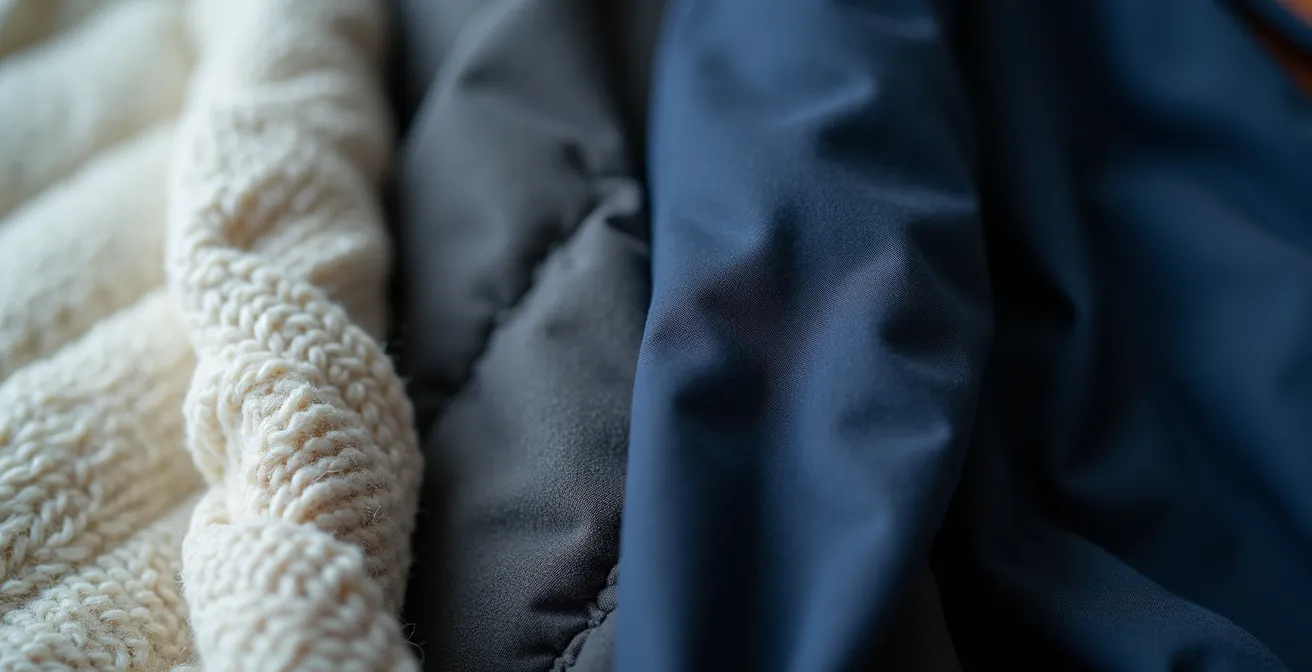
As shown in the system above, the strategy is simple yet effective:
- The Base Layer: This is the layer against your skin. Its job is to manage moisture. A merino wool t-shirt is ideal, as it wicks sweat, insulates even when damp, and is naturally odor-resistant, meaning you can wear it for multiple days.
- The Mid-Layer: This is your insulation layer. Its purpose is to trap body heat. A lightweight, compressible puffer jacket or a fleece is perfect. It provides significant warmth for its low weight and bulk.
- The Outer Layer (Shell): This is your protection from the elements. A thin, waterproof, and windproof shell jacket is essential. It keeps you dry from rain and blocks wind, which is the primary function needed to preserve the warmth generated by your other layers.
By thinking in terms of a functional system rather than individual clothing items, you can pack light and remain comfortable no matter what Melbourne’s notoriously fickle weather decides to do.
The Sun Protection Error That Causes Severe Burns in Under 15 Minutes
The Australian sun is notoriously harsh, and underestimating it is the most common—and dangerous—mistake travelers make. It’s not just about feeling hot; the intensity of the ultraviolet (UV) radiation is significantly higher than in Europe or North America. As travel experts warn, a thinner ozone layer over the region means UV rays are more potent, capable of causing severe sunburn in as little as 15 minutes of unprotected exposure. The biggest error is assuming that a cloudy sky or a cool breeze offers protection; UV radiation penetrates clouds, meaning the risk is high even on overcast days.
Another critical mistake is incomplete application. Many people apply sunscreen to their face and arms but neglect other vulnerable areas. This partial protection leads to painful burns on often-missed spots like the tops of the feet, the part in your hair, the back of your neck, and the tops of your ears. Relying solely on a single application of sunscreen in the morning is also a recipe for disaster. Its effectiveness diminishes with sweat and time, and especially after swimming.
A comprehensive sun protection strategy is non-negotiable and goes far beyond a bottle of sunscreen. It’s an all-day commitment that involves multiple lines of defense. Start by checking the daily UV Index in local weather reports and plan your activities accordingly, avoiding peak sun hours when possible. Always use a broad-spectrum sunscreen with at least SPF30+ and reapply it religiously every two hours. Most importantly, treat clothing as your primary form of sun protection. Look for lightweight, long-sleeved shirts and pants with a UPF (Ultraviolet Protection Factor) rating, which provides a physical, reliable barrier against harmful rays all day long.
Ultimately, sun safety in Australia requires a shift in mindset. It’s not a suggestion; it’s a fundamental part of your daily routine, as essential as drinking water.
When to Swim in Queensland to Avoid Deadly Jellyfish Season?
The idyllic turquoise waters of Queensland are a major drawcard for travelers, but they harbor a hidden and potentially lethal danger: marine stingers. The two most infamous are the Box Jellyfish and the Irukandji, both of which can be deadly. The most critical piece of information for any visitor planning to swim is the timing of “stinger season.” Ignoring this seasonal threat can have fatal consequences, turning a dream beach holiday into a nightmare.
According to official sources, the risk is not year-round. Tourism Australia confirms that stinger season in Queensland typically runs from November to May. During these months, swimming at beaches without proper precautions is extremely risky, especially in the northern parts of the state. The wet season, which runs concurrently from November to April, often brings these jellyfish closer to shore, increasing the danger. This period aligns with the warmest water temperatures, creating the perfect breeding ground for these creatures.
This does not mean you cannot swim at all. The key is to follow local safety protocols strictly. During stinger season, you should only swim at beaches that have protective stinger nets installed. These enclosures provide a safer swimming area, although they are not 100% foolproof as very small jellyfish can sometimes pass through the mesh. The most effective personal protection is to wear a full-body “stinger suit,” a lightweight Lycra or nylon suit that covers you from ankles to wrists to neck. Many tour operators, especially for the Great Barrier Reef, provide these suits as a standard part of their excursions during these months. Wearing one is a non-negotiable safety measure.
By planning your trip outside of these high-risk months or by adhering to the strict safety measures if you travel within them, you can enjoy Queensland’s magnificent coastline without putting your life at risk.
Tire Repair and Pressure Gauge: The Minimum Tool Kit for Outback Driving
Driving in the Australian Outback is an unparalleled adventure, but it demands a level of self-sufficiency that many travelers are unprepared for. Mobile phone service is non-existent in vast areas, and the distance between service stations can be hundreds of kilometers. In this environment, a flat tire is not an inconvenience; it’s a potentially serious situation. Relying on a single spare tire provided with a rental 4×4 is a gamble. The rough, corrugated roads and sharp rocks make multiple punctures a real possibility. A comprehensive tire repair strategy is therefore an essential part of your Outback tool kit.
Your minimum kit should empower you to handle at least two tire failures independently. This means either carrying two full spare tires or, more practically for one-bag travelers, one spare plus the knowledge and tools to repair a puncture yourself. A high-quality tire plug kit is lightweight, inexpensive, and can be used to fix the most common types of punctures, allowing you to reinflate the tire and continue to the next town for a professional repair.
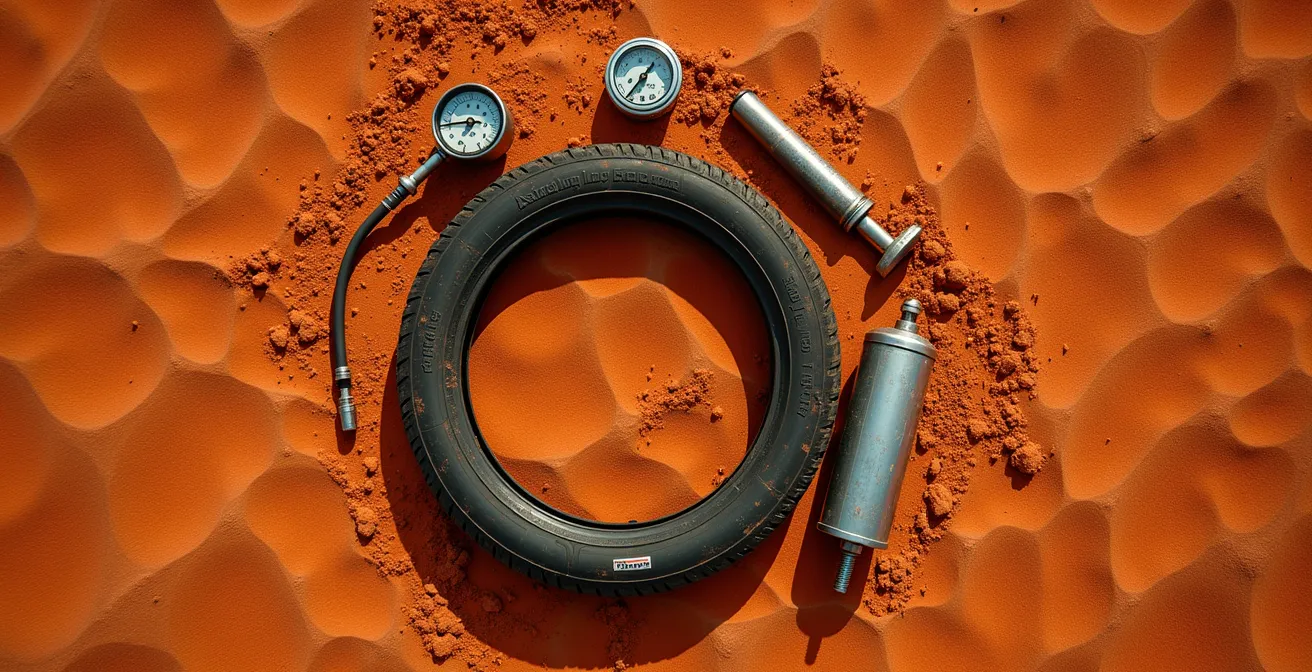
Beyond fixing flats, managing tire pressure is crucial for safety and vehicle performance on varied terrain. Your tool kit must include:
- A Tire Deflator and Pressure Gauge: Lowering tire pressure significantly increases the tire’s footprint, providing better traction on sand and helping to absorb shocks on heavily corrugated roads, reducing the risk of punctures. A gauge is essential to know your pressure, and a deflator makes this process fast and easy.
- A Portable Air Compressor: After leaving the rough terrain, you must be able to reinflate your tires to the correct pressure for driving on sealed roads. A 12V compressor that plugs into your vehicle’s accessory socket is a critical piece of gear.
Before leaving the rental depot, you must locate the jack and tools and practice using your plug kit. This preparation transforms you from a potential victim of circumstance into a capable and self-reliant Outback explorer.
In the Outback, your most important tool is preparedness. This small kit of tire-related gear can be the difference between a minor delay and a major emergency.
The Puffer Jacket Necessity: Why a Standard Coat Isn’t Enough for Hobart Winds?
Tasmania’s beauty is wild and raw, and so is its weather. The island sits in the path of the “Roaring Forties,” strong westerly winds that blow across the Southern Ocean. This creates a significant wind chill factor, making the air feel much colder than the thermometer suggests. A standard city coat or a simple rain jacket, while useful, often fails to provide adequate insulation against this persistent, biting wind. For example, even in summer, inland areas like Liawenee can see February temperatures ranging from just 4-17°C. When combined with wind, this requires serious insulation.
This is where the puffer jacket becomes a non-negotiable part of your Australian core kit. Its superiority lies in its ability to trap a layer of warm air close to your body, creating an effective barrier against the cold. However, not all puffer jackets are created equal, and for the one-bag traveler, the key attributes are high warmth-to-weight ratio and extreme compressibility. A quality puffer can provide the warmth of a bulky fleece and coat combined, yet compress down to the size of a water bottle, saving invaluable space in your luggage.
When selecting a puffer jacket for Tasmania’s specific climate, consider the following criteria to maximize performance and packability:
- Insulation Type: While down is warmer for its weight, synthetic insulation is a smarter choice for Tasmania’s often damp climate. It retains its insulating properties even when wet, whereas down clumps together and loses its loft.
- Compressibility: This is the jacket’s superpower for a minimalist traveler. Test how small it packs down. It should easily fit into a small stuff sack or its own pocket.
- Wind-Blocking Shell: Ensure the outer fabric is tightly woven to block wind. This is just as important as the insulation itself for preventing wind chill.
- Fit: It should be trim enough to fit under your waterproof outer shell as part of the three-layer system, but with enough room to wear over a base layer and a light fleece if needed.
A standard coat is simply too bulky and not specialized enough for the unique challenge of Tasmanian winds. A compressible, synthetic puffer jacket is a strategic investment in comfort and packability.
Key Takeaways
- Strategic Packing Philosophy: Replace a long list of items with a minimalist, high-performance “core kit” based on a modular layering system.
- Fabric is Key: Prioritize performance fabrics like merino wool (base layer), synthetic insulation (mid-layer), and waterproof/windproof shells (outer layer) for maximum versatility and packability.
- Risk Mitigation: Your packing list must actively address specific environmental threats, including extreme UV radiation, dehydration, seasonal marine stingers, and vehicle self-sufficiency in the Outback.
The 6-Month Timeline: In What Order Should You Book Your Trip?
A successful multi-climate trip in Australia depends as much on *when* you book as *what* you pack. A strategic booking timeline allows you to lock in the best prices, secure essential transport, and, most importantly, align your itinerary with optimal weather windows. Trying to book everything a few weeks out often leads to disappointment, with key tours sold out or flights prohibitively expensive. Following a structured 6-month timeline transforms the complex task of planning into a manageable process. The goal is to make decisions when you have the right information, and recent tourism data shows that visitors who time their activities with the best weather achieve up to 40% more satisfactory experiences.
The timeline below prioritizes bookings from the most critical and least flexible (long-haul flights) to the most specific and weather-dependent (local tours). By following this order, you build your trip logically, ensuring each decision is based on the previous one, creating a cohesive and climate-optimized itinerary.
| Timeframe | Booking Priority | Key Considerations |
|---|---|---|
| Months 6-5 | Multi-city flights & iconic accommodation | Lock in climate-optimized route (south in summer, north in dry season) |
| Months 4-3 | Weather-dependent activities & specialized transport | Book reef tours, Uluru walks, 4×4 rentals once weather patterns clearer |
| Months 2-1 | Gear audit & specific equipment purchases | Assess existing gear against booked activities, buy stinger suits, hiking poles as needed |
| Final Month | Digital preparation & documentation | Download offline maps, setup Australian eSIM, verify insurance coverage for adventure activities |
This structured approach removes the guesswork from planning. The “Gear Audit” phase at months 2-1 is particularly crucial; it’s the moment you compare your packed core kit against the specific activities you’ve now booked. This is when you’ll identify any final, specialized items needed, such as a stinger suit for your Queensland leg or a specific type of hiking pole for a Tasmanian trek. This prevents last-minute panic buying and ensures every item in your suitcase has a defined purpose.
By integrating your packing strategy with this booking timeline, you create a holistic plan that ensures you not only have the right gear but are also in the right place at the right time to use it.