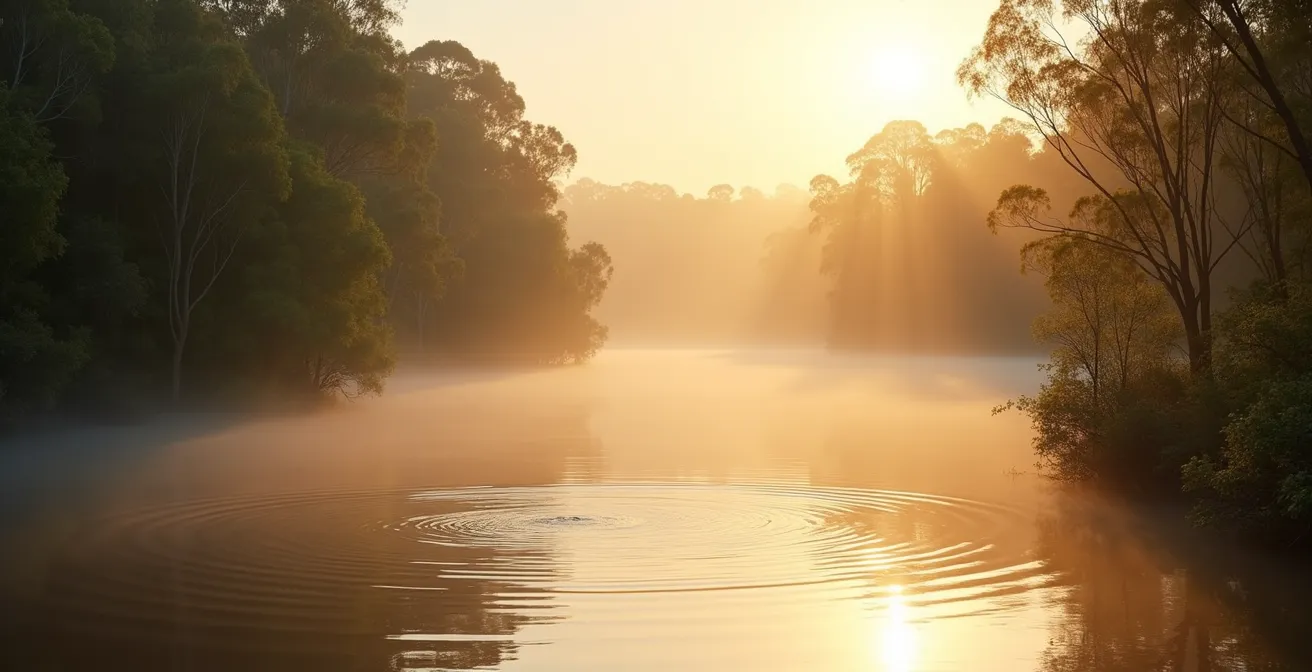
Seeing a platypus isn’t about luck; it’s about skill. This guide moves beyond the generic ‘go at dawn’ advice, teaching you how to read the river’s subtle cues, interpret animal behaviour, and understand the ecological signs that lead to successful and respectful sightings. By learning to see the ecosystem as a whole, you transform from a tourist into a naturalist, and your observation becomes a valuable contribution to conservation.
The advice for spotting a platypus in the wild often feels like a well-worn mantra: go to a freshwater river at dawn or dusk, be silent, and wait. While this guidance holds a kernel of truth, it misses the profound essence of the experience. For the patient nature lover, a successful sighting is not a lottery win but the rewarding result of observation, knowledge, and a deep reading of the environment. It’s the moment when the subtle language of the river finally becomes clear. These unique monotremes, evolutionary marvels that seem pieced together from a dozen different animals, are not deliberately elusive; they simply operate on a different sensory plane than our own.
To truly increase your chances, you must move beyond the platitudes. The real key lies in understanding their world—a world of underwater invertebrates, crepuscular activity patterns, and riverbank burrows. It requires learning to distinguish the V-shaped ripple of a platypus from the splash of a water rat, and recognizing the signs of a healthy ecosystem that can support them. This is not just about ticking a species off a bucket list; it is about engaging with an entire riverine system. This approach transforms a passive wait into an active, immersive process of discovery.
This guide is built on that principle. We will explore how to observe related wildlife without causing stress, how to decipher the tell-tale signs on the water’s surface, and why certain locations offer near-guaranteed success. We will also cover the critical safety protocols and show how your sighting can become a vital piece of data for researchers, connecting your personal moment of wonder to the broader effort to protect this extraordinary species for generations to come.
This article will guide you through the nuanced art of wildlife observation, from understanding the subtle behaviours of monotremes to contributing to their conservation. Follow along to develop the eyes of a naturalist.
Summary: A Naturalist’s Complete Guide to Platypus Spotting and Australian Wildlife Observation
- Rolling into a ball: how to observe an echidna’s defense mechanism without stressing it?
- The tell-tale dive: how to know if the ripple you saw was actually a platypus?
- Eungella National Park: why this rainforest river offers 90% sighting success rates?
- Why you should never pick up a male platypus even if it looks helpless?
- PlatypusSPOT app: how recording your sighting helps researchers track population health?
- The only diurnal marsupial: where in Western Australia can you see a numbat?
- More than weeds: how a guide reveals the pharmacy hidden in the scrub?
- Which Tasmanian Sanctuary Offers the Best Devil Feeding Experience?
Rolling into a ball: how to observe an echidna’s defense mechanism without stressing it?
Before focusing on the river, a lesson in quiet observation can be learned on its banks with the platypus’s terrestrial cousin, the echidna. Watching an echidna is an exercise in understanding an animal that perceives the world primarily through vibrations and smell. Their famous defense—curling into an impregnable spiny ball—is a high-stress response we should strive to avoid triggering. The key is not just to be quiet, but to move correctly and read their subtle pre-curl signals.
An echidna’s primary warning system is in the ground. They detect the heavy footfalls of a predator long before they see or hear it. To approach without alarm, you must adopt a different way of walking, using slow, deliberate heel-to-toe steps to minimize ground vibrations. Professional wildlife photographers have refined this into a science, often using telephoto lenses from a prone position to successfully document echidnas without triggering a defensive curl in the vast majority of their encounters. Before they commit to a full curl, they often give away their anxiety with an increased sniffing rate or a sudden change to a faster, more skittish pace.
Observing these cues and maintaining a respectful distance of at least five metres is fundamental. It’s the first step in shifting your mindset from a mere spectator to a conscientious naturalist. This principle of minimal disturbance is the foundation upon which all meaningful wildlife encounters are built, whether on land or in water.
The tell-tale dive: how to know if the ripple you saw was actually a platypus?
The surface of a river at dawn or dusk is a canvas of constant movement, and the most common mistake for an aspiring platypus spotter is misinterpreting the ripples. A falling leaf, a diving bird, or a native water rat (rakali) can all create disturbances that lead to false hope. The secret is to stop looking for just any ripple and start learning to identify the platypus’s unique “water signature.” This signature is a product of their specific anatomy and foraging behaviour, making it distinct from all other river dwellers.
A foraging platypus is a creature of rhythm. Active and constantly feeding, research shows platypuses typically complete up to 75 dives per hour, spending only about 10 to 20 seconds on the surface to chew their catch before diving again. When a platypus dives, it doesn’t just splash; its broad, flat tail and streamlined body create a characteristic arched-back motion. This generates a clean, circular ring of ripples that expands outwards, often accompanied by a trail of small, consistent bubbles as it displaces air from its fur. This pattern is markedly different from the quick, splashy plunge of a rakali or the head-first dip of a cormorant.
Distinguishing these movements becomes much easier when you know exactly what to compare. The following guide breaks down the key visual differences between a platypus and other common water animals.
| Water Movement | Platypus | Water Rat (Rakali) | Diving Bird |
|---|---|---|---|
| Dive Pattern | Arched back, expanding ring of ripples | Quick plunge with splash | Head-first with wing flutter |
| Surface Time | 10-20 seconds between dives | Variable, often longer | 2-5 minutes underwater |
| Bubble Trail | Consistent small bubbles in line | Few or no bubbles | Large irregular bubbles |
| Tail Visibility | Flat paddle, uniformly dark | Long thin with white tip | No visible tail |
By memorizing these distinctions, you can filter out the “noise” on the water and focus your attention on the patterns that truly matter. It transforms the waiting game into an analytical process of decoding the river’s activity.
Eungella National Park: why this rainforest river offers 90% sighting success rates?
While platypuses inhabit many eastern Australian waterways, few places offer the reliability of Eungella National Park in Queensland. The claim of a 90% sighting success rate is not a marketing gimmick; it’s a testament to a uniquely perfect platypus habitat. The Broken River, which winds through the park, features clear, slow-moving water, stable earth banks perfect for burrows, and an incredibly dense population of the aquatic invertebrates that make up the platypus diet. This ecological richness has been scientifically validated, as recent environmental DNA surveys revealed 90 positive results across 155 sites in the region, confirming a widespread and healthy population.
The park’s infrastructure is built around this natural advantage. Purpose-built viewing platforms at key locations along the Broken River allow visitors to watch over prime foraging pools without disturbing the riverbanks. The most successful sightings consistently occur during the cooler months in the crepuscular windows of 5-7 AM and 4-6 PM. Visitors often report seeing a platypus within the first five minutes of watching from these platforms, a stark contrast to the hours of patient waiting often required elsewhere.
However, the naturalist’s approach means appreciating the entire ecosystem, not just its star attraction. The wait for a platypus at Eungella is an opportunity to observe other rare wildlife. Look to the rainforest canopy for the endemic Eungella Honeyeater, search for the camouflaged leaf-tailed geckos on tree trunks after sunset, or spot Boyd’s forest dragons basking on low branches. The river’s health is a reflection of the forest’s health, and every creature plays a part.
Why you should never pick up a male platypus even if it looks helpless?
A platypus seen out of the water may appear vulnerable or in distress, sparking a natural instinct to help. However, this is one of the most dangerous mistakes you can make, especially with a male. The male platypus possesses a secret weapon: a sharp, keratinous spur on each hind leg connected to a venom gland. This venom is not lethal to humans, but it is excruciatingly potent. In a stark warning to would-be rescuers, male platypus venom research confirms it causes extreme, long-lasting pain that is famously unresponsive to morphine and other conventional painkillers, leading to weeks or even months of debilitating agony.
The venom is primarily used in territorial disputes between males during the breeding season, not for hunting or defense against other predators. A male will not hesitate to use its spur if it feels cornered or threatened, and “being picked up” is the ultimate threat. Females lack functioning venom glands and spurs, but distinguishing between sexes at a distance is impossible for the untrained eye. Therefore, the cardinal rule is absolute: never touch or attempt to handle a platypus under any circumstances.
If you encounter a platypus that is clearly injured, entangled, or far from water and in distress, your role is not to intervene directly but to act as a responsible reporter. Knowing the correct protocol is essential for both your safety and the animal’s welfare.
Your Action Plan: Emergency Protocol for Injured Platypus Encounters
- Do Not Touch: Maintain a safe distance of at least 2 meters. Observe the animal’s location precisely, using GPS coordinates from your phone or noting distinct landmarks.
- Call for Help Immediately: Contact the Australian Wildlife Rescue Organisation at 1300 094 737 or your local state-based wildlife rescue service. Provide them with the exact location and a description of the situation.
- Document from a Distance: If it is safe to do so without causing further stress, take photos or a short video of the animal. Note its condition, any visible injuries, and its behaviour for the rescue team.
- Keep Others Away: Politely inform other people in the area to keep their distance and ensure pets are kept on a leash and far away from the animal while you wait for professionals to arrive.
- Report the Outcome: If possible, follow up on your report with the rescue organization. This information can contribute to a better understanding of local threats and survival rates.
PlatypusSPOT app: how recording your sighting helps researchers track population health?
The thrill of seeing a platypus is a personal one, but it can also have a significant scientific impact. Platypus populations are under increasing threat from habitat loss, river degradation, and climate change. Ominously, climate modeling research indicates a 47-66% population decline is possible over the next 50 years. To combat this, scientists need vast amounts of data on where platypuses are living now—and where they are disappearing. This is a task too large for researchers alone, which is where you, the citizen scientist, come in.
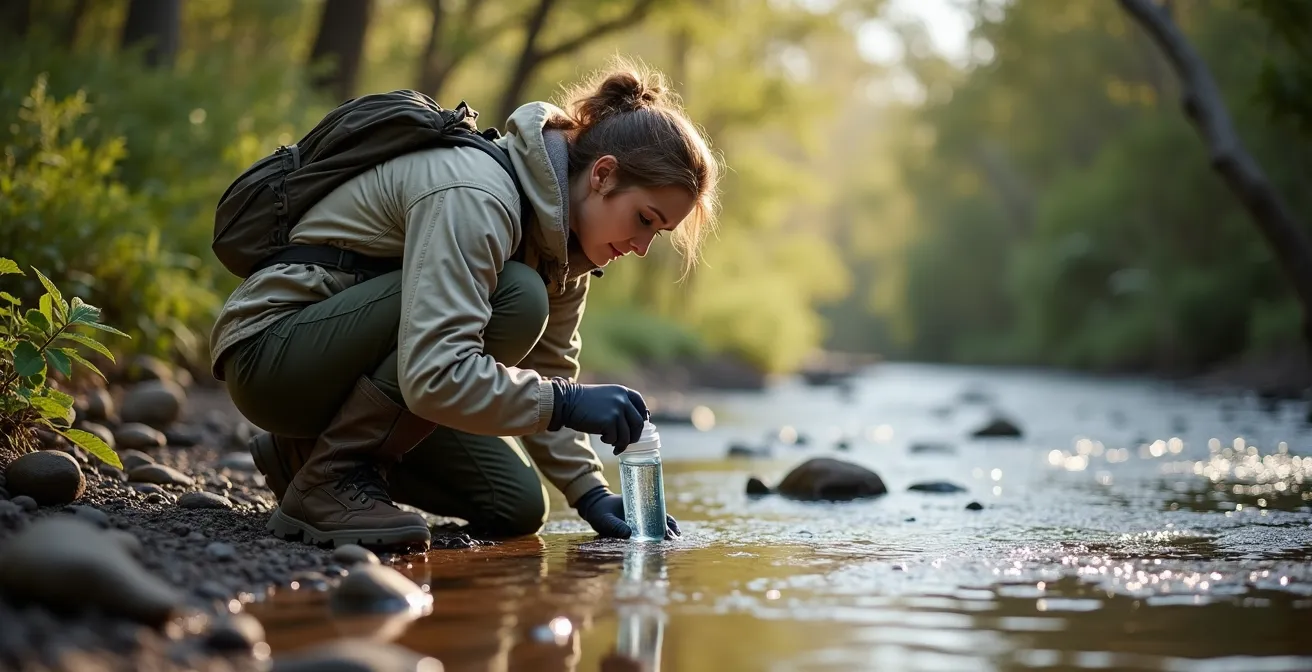
The platypusSPOT app, developed by the Australian Conservation Foundation, is a powerful tool that transforms your sighting from an anecdote into a crucial data point. By simply recording the location, time, and number of platypuses you see, you contribute directly to a national database. This information helps researchers map population distributions, identify trends, and pinpoint areas in decline that require urgent intervention. The platform’s impact is already profound; citizen science data has helped identify waterways that were once home to platypuses but now show no signs of their presence through follow-up eDNA testing.
This simple act elevates your role from a passive observer to an active participant in conservation. Every entry you make helps build a more complete picture of the species’ health across the continent. Your five minutes of awe on a riverbank can provide the very information that helps secure the future of the platypus for the next generation of nature lovers.
The only diurnal marsupial: where in Western Australia can you see a numbat?
The art of ecological observation, honed while searching for platypus, can be applied to other rare Australian fauna. One such creature is the numbat, Western Australia’s faunal emblem and the world’s only truly diurnal (day-active) marsupial. Unlike the crepuscular platypus, the numbat’s life is dictated entirely by its food source: termites. This dietary specialization is the key to finding them.
The premier location for numbat spotting is Dryandra Woodland, a crucial conservation area about two hours southeast of Perth. Intensive conservation efforts, including the control of introduced predators like foxes and cats, have allowed the numbat population here to stabilize. The best time to see them is during the cooler winter months, from June to August. During this period, termites are most active in the warmer, upper layers of the soil during the middle of the day. Consequently, numbats adjust their foraging patterns to match, with peak activity occurring between 10 AM and 3 PM.
Finding a numbat involves looking for their distinctive feeding signs. Search for small, conical holes, about 2-3 cm deep, which they dig with their sharp claws to access termite galleries. They also frequently forage along fallen wandoo and marri logs, which act as natural highways through the woodland and are often riddled with termites. Spotting a numbat—with its elegant, striped coat and bushy tail—is a reward for applying the same principles used for platypus: understanding the animal’s diet, its activity patterns, and the ecological indicators it leaves behind.
More than weeds: how a guide reveals the pharmacy hidden in the scrub?
The most advanced form of wildlife observation goes beyond looking for the animal itself and involves reading the landscape for a deeper understanding of its rhythms. To a master naturalist or an Indigenous guide, the Australian bush is not a homogenous stretch of green but a living calendar and a complex web of interconnected signals. The flowering and fruiting of certain plants are precise indicators of animal activity.
The flowering of certain plants acts as a precise calendar for wildlife activity, with honeyeaters arriving within days of specific eucalyptus blooms.
– Australian Wildlife Journeys, Ecological Interconnections in Australian Bushland
This Traditional Ecological Knowledge has been practiced for millennia. Indigenous guides in regions like Queensland’s Atherton Tablelands use these botanical cues to predict animal movements with remarkable accuracy. For example, when the native ginger flowers bloom, it signals a surge in the insect populations that feed on them. This, in turn, attracts a host of insectivorous birds and mammals to the area, creating predictable and spectacular wildlife viewing opportunities. It’s a system based on a holistic understanding that every part of the environment is linked.
Learning even a few of these key plant-animal relationships can revolutionize your experience. It shifts the focus from a single-minded search for one species to an appreciation of the entire symphony of the bush. You begin to see the flowering banksia not just as a pretty flower, but as a dinner bell for honeyeaters and pygmy possums. The landscape is no longer just a backdrop; it becomes a story waiting to be read.
Key takeaways
- Effective platypus spotting requires reading ecological signs, not just waiting at the water’s edge.
- Learn to distinguish the platypus’s unique “bow wave” and dive pattern from other water animals for accurate identification.
- Your sighting can become a vital conservation tool by contributing data to citizen science projects like the platypusSPOT app.
Which Tasmanian Sanctuary Offers the Best Devil Feeding Experience?
Your journey as a naturalist can extend to supporting critical conservation programs for other iconic Australian species, such as the Tasmanian devil. Sanctuaries in Tasmania offer a fantastic opportunity to see these powerful marsupials up close while directly contributing to their survival. Choosing the right sanctuary depends on your interests, whether they are in photography, education, or understanding the science of the Devil Facial Tumour Disease (DFTD) insurance program, which is vital given that conservation data shows an 85-90% population decline from DFTD in the wild.
Each major sanctuary offers a different focus. Devils@Cradle, set in a stunning alpine environment, provides a highly naturalistic setting and after-dark feeding tours that are fantastic for photographers. Trowunna Wildlife Sanctuary has a strong focus on breeding and rehabilitation, offering a chance to see a large number of joeys and understand the life cycle. Bonorong Wildlife Sanctuary excels at education, with guided keeper talks during daylight feedings that are perfect for families and those new to the devil’s story. Understanding these differences can help you choose an experience that aligns with your personal goals as a visitor.
The following table compares the key features of these top sanctuaries to help you make an informed decision for your visit.
| Sanctuary | Conservation Score | DFTD Research | Photography Conditions |
|---|---|---|---|
| Devils@Cradle | 40 devils, breeding program | Field monitoring since 2006 | Natural alpine setting, after-dark tours |
| Trowunna Wildlife | 100+ joeys bred since 2010 | Insurance population site | Intimate settings, rehabilitation focus |
| Bonorong | 20,000 students educated annually | DFTD awareness programs | Guided keeper talks, daylight feeding |
By visiting these sanctuaries, you are not just a tourist; you are an active supporter of the massive effort to save a species from the brink of extinction. Your entrance fee helps fund breeding programs, disease research, and vital educational outreach.
By applying the principles of patient, informed, and respectful observation, every walk in the Australian bush becomes an opportunity for discovery. Your encounters with wildlife, whether it’s a platypus, a numbat, or a devil, can transform from fleeting moments into meaningful connections with the natural world and vital contributions to its preservation.