Thinking your standard rental agreement has you covered for the Outback is the first, and most expensive, mistake you can make.
- The ‘unsealed road’ clause in most rental contracts is a financial trap designed to void your insurance precisely when you need it most.
- Vehicle dynamics on corrugated roads are brutally unforgiving; knowing the physics of speed and tyre pressure is more critical than knowing how to use the radio.
- Your smartphone is a paperweight out there. True safety isn’t an app; it’s a dedicated emergency device like a PLB or a satellite phone.
Recommendation: Before you book anything, you must audit the rental contract for its exclusions and your own skills against the harsh mechanical realities of remote Australian travel.
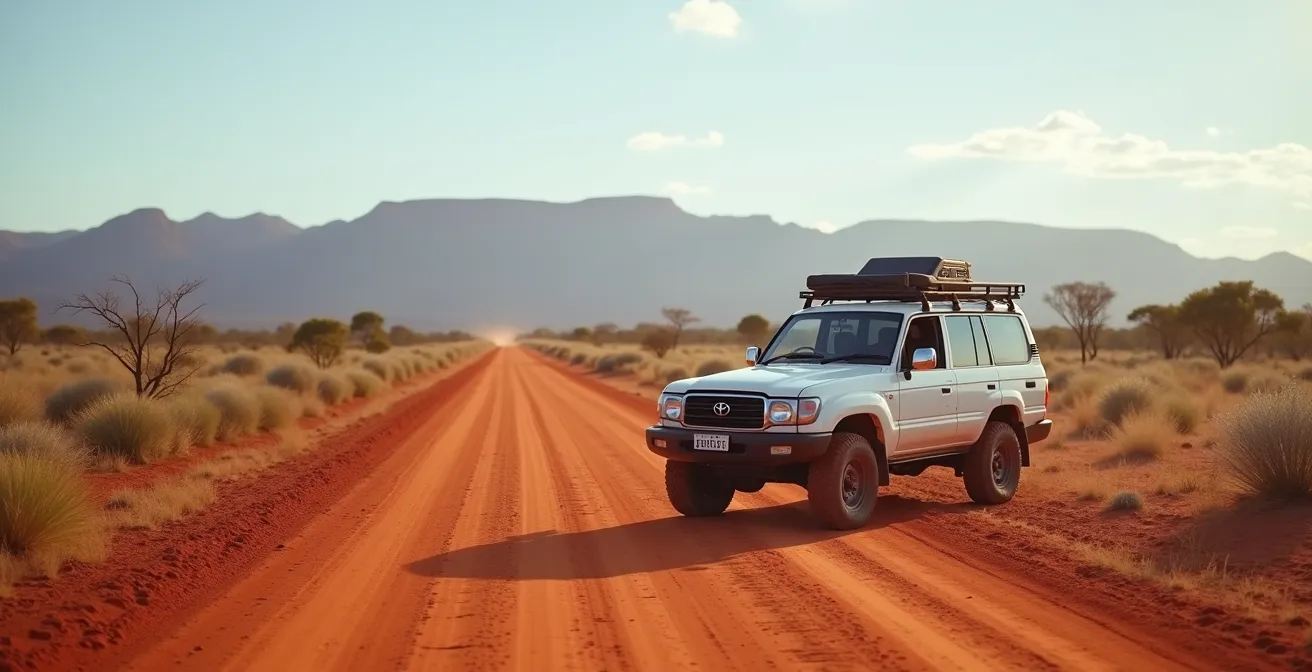
The image of a dusty 4WD against a fiery Outback sunset is a powerful lure for adventurers. It promises freedom, raw nature, and the ultimate road trip. But as a mechanic who has recovered more than a few of these vehicles from the middle of nowhere, I can tell you that this dream can turn into a financial and logistical nightmare in the blink of an eye. The most common advice you’ll hear is to “check your tyres” and “carry extra water.” This is dangerously simplistic. The real risks are not in the brochure; they are buried in the fine print of your rental agreement and in the unforgiving physics of a two-tonne vehicle on a hostile surface.
The gap between what you *think* you’re insured for and the reality of a breakdown on a remote track is what I call the liability gap. It can cost you thousands. Similarly, travelers fail to appreciate the concept of mechanical sympathy—understanding that a 4WD is not invincible. Pushing it too hard on corrugated roads doesn’t just give you a bumpy ride; it induces component-destroying vibrations and torsional stress that can shear a suspension mount clean off the chassis. This isn’t about being scared; it’s about being smart and respecting the machine and the environment.
This guide isn’t a travel itinerary. It’s a pre-mortem, a breakdown of the critical points where trips fail, based on years of seeing it go wrong. We will dissect the insurance traps, the physics of driving on unsealed roads, and the non-negotiable equipment you need. We’ll cover fuel strategy, emergency communications, and how to deal with the unique hazards of the Outback, like 50-metre road trains. Consider this your briefing from the specialist on the ground, designed to keep you from becoming another cautionary tale.
This article provides a technical and cautionary overview of the essential checks and knowledge required for a safe 4WD journey through the Australian Outback. Explore the sections below to understand the specific risks and preparations needed.
Summary: A Mechanic’s Guide to Outback 4WD Rentals
- Why standard insurance won’t cover underbody damage on unsealed roads?
- How to correct a skid on corrugated dirt roads without flipping the car?
- The ‘long range tank’ advantage: planning fuel stops when stations are 300km apart
- Satellite phone or PLB: which emergency device is essential for outback safety?
- Tire repair and pressure gauge: the minimum tool kit for outback driving
- Overtaking 50-meter trucks: the physics of passing a triple road train
- Supermarkets and gear shops: where to buy bulk water and fuel in Alice?
- Avoiding Driver Fatigue on the Nullarbor: The 2-Hour Rule
Why standard insurance won’t cover underbody damage on unsealed roads?
The single most dangerous misconception for 4WD renters is that their insurance policy covers them for off-road driving. In almost all standard agreements, it does not. The moment your tyres leave the tarmac, you enter a financial minefield. Rental companies often have clauses that explicitly void all coverage for damage incurred on unsealed roads, or they charge exorbitant liability amounts. This creates a massive liability gap; data shows that the excess on a 4WD rental can be anywhere from $7,000 to $8,500 for a single incident. A single misplaced rock hitting the transmission sump can cost you more than your entire holiday.
The reason is simple: the risk of underbody and overhead damage skyrockets on unmaintained tracks. Standard insurers are not willing to cover the high probability of impacts to the differential, exhaust, fuel tank, or roof. To mitigate this, you must either secure a specific, written permission slip for certain unsealed roads or purchase a premium “4WD Additional Cover” package, which itself comes with its own set of exclusions. Never take a verbal “she’ll be right” from the depot attendant as a legally binding agreement. Get it in writing or assume you are 100% liable for any and all damage.
This table illustrates the stark difference between the illusion of coverage and the reality. It highlights what is typically left unprotected by a standard policy, leaving you financially exposed to the most common types of Outback damage.
| Coverage Type | Standard Insurance | 4WD Additional Cover |
|---|---|---|
| Underbody damage | Not covered | Covered |
| Overhead damage | Not covered | Covered |
| Windscreen/Tyres | Limited or excluded | Unlimited cover |
| Single vehicle rollover | Not covered | Covered |
| Unsealed road damage | Void | With permission only |
| Liability amount | Up to $7,500+ | $0 (with exclusions) |
Before leaving the rental depot, your first job is to document the vehicle’s condition like a forensic investigator. Photograph and video everything: every panel, the roof, the dash, and, crucially, look underneath for any pre-existing scrapes or damage. This evidence is your only defence against being blamed for a previous renter’s mistake.
How to correct a skid on corrugated dirt roads without flipping the car?
Corrugated roads, or “washboarding,” are the single greatest threat to vehicle control in the Outback. These rhythmic bumps are not just uncomfortable; they create a dangerous situation where your tyres can lose contact with the road surface hundreds of time per minute. The key to navigating them safely is understanding a principle of physics called corrugation harmonics. There is a “sweet spot” speed, usually between 70-90 km/h, where the vehicle’s suspension frequency matches the road, allowing the 4WD to effectively “float” over the tops of the corrugations. Driving too slow causes a bone-jarring ride that puts immense stress on vehicle components, while driving too fast can lead to a catastrophic loss of traction.
If you feel the rear of the vehicle start to skid or “fishtail,” your instincts will scream at you to brake hard and wrench the steering wheel in the opposite direction. This is the worst possible reaction and the primary cause of rollovers. Abrupt inputs—braking or steering—will unsettle the vehicle and amplify the skid. The correct, albeit counter-intuitive, procedure is to:
- Ease off the throttle gently. Do not brake.
- Look where you want to go, not at what you’re about to hit.
- Make small, smooth steering corrections into the skid. If the rear is sliding right, steer slightly right to bring the front back in line.
This requires calm and a light touch. The goal is to reduce speed gradually while maintaining the vehicle’s balance until the tyres regain their grip.

The most effective way to prevent a skid is proper setup before you even hit the dirt. Reducing your tyre pressure is not optional; it’s a fundamental safety requirement. Lowering pressure from highway levels (e.g., 40 PSI) to around 28-32 PSI for gravel roads increases the tyre’s footprint, improving grip and allowing the rubber to absorb some of the harshness, which keeps your suspension from being overworked. Maintaining a steady throttle is just as important to avoid breaking traction.
The ‘long range tank’ advantage: planning fuel stops when stations are 300km apart
Running out of fuel in the Outback is not an inconvenience; it’s a life-threatening emergency. While major sealed highways may have fuel stops every 200km or so, on more remote tracks, the distance between roadhouses can easily exceed 300-400km. A standard 4WD fuel tank might hold 80-90 litres, giving you a theoretical range of 700-800km on a perfect highway. This number is dangerously misleading. You must calculate your consumption based on a “fuel burn multiplier” that accounts for terrain.
Your vehicle’s fuel efficiency plummets the moment you leave the bitumen. The increased rolling resistance of gravel, the power needed to push through sand, and the use of low-range 4WD gearing can increase your fuel consumption by 40% or more. A vehicle that gets 12L/100km on the highway might get 18-20L/100km or worse on a sandy track. A “long range” tank, typically 120-150 litres, is not a luxury; it’s a critical piece of safety equipment. It provides a buffer that allows you to handle unexpected detours or higher-than-anticipated consumption without risking an empty tank.
Your fuel plan must be conservative and based on worst-case scenarios. Here is a simple framework for calculating your needs:
- Establish a Baseline: Know your vehicle’s official highway fuel consumption (L/100km).
- Apply the Multiplier: Add a minimum of 20% for driving on well-maintained gravel roads. Increase this to 40-50% for soft sand, heavy corrugations, or extensive low-range 4WD use.
- Build in a Reserve: Your plan should ensure you arrive at your next fuel stop with no less than 40% of a tank remaining. This is your emergency reserve for headwinds, navigation errors, or finding a fuel station unexpectedly closed.
- Carry Spares: If any leg of your journey exceeds 60% of your vehicle’s *calculated worst-case range*, you must carry additional fuel in certified jerry cans.
Never trust your vehicle’s digital “distance to empty” gauge. It’s calibrated for highway driving and is wildly inaccurate on variable terrain. Use your trip meter and your own conservative calculations.
Satellite phone or PLB: which emergency device is essential for outback safety?
Once you are more than a few kilometres from an Outback town, your mobile phone is useless. There is no reception. Relying on it for safety is gambling with your life. Your only connection to the outside world in an emergency is via satellite. The two primary devices for this are a Personal Locator Beacon (PLB) and a Satellite Phone. They serve very different purposes, and for inexperienced travellers, understanding the “rescue chain” each one initiates is vital.
A PLB is a one-way distress signal. When you activate it, it sends a powerful emergency signal with your GPS coordinates to an international rescue coordination centre. This is a “red button” for life-threatening situations only (e.g., critical injury, fire, vehicle rollover). It tells rescuers *where* you are, but not *what* is wrong. A rescue operation will be launched, but you have no way to communicate details or receive updates. It is a simple, effective last resort.
A Satellite Phone provides two-way voice communication. Its value is in situations that are serious but not immediately life-threatening. If your 4WD has a mechanical failure, you can call a recovery service directly and explain the problem. You can check on changing weather conditions, inform family of a delay, or receive medical advice from the Royal Flying Doctor Service. This ability to convey context can be the difference between a simple recovery and an unnecessary, full-scale emergency response.
For a complete picture, a third option, the Satellite Messenger, offers a middle ground. It allows for two-way text messaging and can send pre-set “I’m OK” messages, which is excellent for peace of mind.
| Feature | PLB (Personal Locator Beacon) | Satellite Phone | Satellite Messenger |
|---|---|---|---|
| Primary Function | Emergency rescue only | Two-way voice communication | Two-way text messaging & SOS |
| Use Cases | Life-threatening emergencies | Breakdown, weather checks, medical advice | Check-ins, complex situations, SOS |
| Cost | Low rental/purchase cost, no subscription | Higher rental/purchase + call costs | Moderate purchase + mandatory subscription |
| Best For | A non-negotiable backup for everyone | Managing complex, non-critical problems | A hybrid of communication and safety |
So which is essential? A PLB is the absolute, non-negotiable minimum. It is your ultimate safety net. However, for a self-drive trip where a mechanical breakdown is a real possibility, a satellite phone (or messenger) offers far more flexibility to manage the situation without triggering a massive emergency response. The ideal solution is to carry both.
Tire repair and pressure gauge: the minimum tool kit for outback driving
The most common mechanical failure in the Outback is not engine or transmission failure; it’s a flat tyre. Your tyres are the single point of contact with a brutal environment, and you must treat them as your most critical system. Relying on roadside assistance is not an option; you are the roadside assistance. At a bare minimum, your tool kit must include the skills and equipment to manage your own tyre-related issues. This starts with understanding and managing tyre pressure.
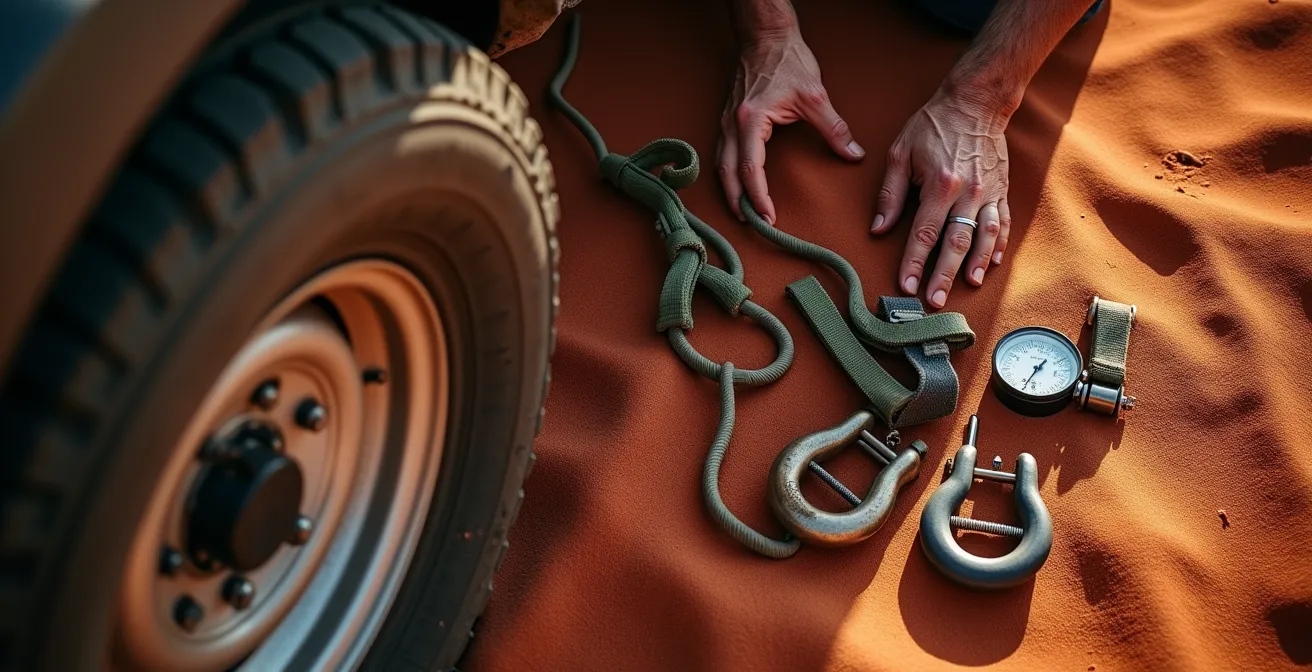
As discussed, pressure is everything. Driving on sealed roads requires high pressure (e.g., 38-40 PSI) for fuel economy and stability. As soon as you hit gravel, this high pressure becomes a liability, making the tyre hard and prone to punctures. Reducing it to 28-32 PSI allows the tyre to flex over sharp rocks rather than being pierced by them. On soft sand, you may need to go as low as 18-22 PSI to create a large footprint and “float” on the surface. Therefore, your kit must contain:
- A high-quality tyre pressure gauge to take accurate readings.
- A tyre deflator to quickly and accurately lower pressure.
- A reliable 12V air compressor to reinflate your tyres when you return to the tarmac.
Beyond pressure management, you must be prepared to repair a puncture. Your rental should come with a jack and a wheel brace to change a tyre, but what happens when you get a second flat? You must carry a puncture repair kit (or “tyre plug kit”) and, most importantly, know how to use it. Practicing on an old tyre in your driveway before you leave is infinitely better than trying to learn from a YouTube video with no internet in 45°C heat.
Your Pre-Trip Tyre System Audit
- Points of Contact: Inspect all tyres, including the spare(s). Check for cuts, uneven wear, and check the manufacturing date (a tyre older than 5-6 years is a risk).
- Tool Collection: Inventory the supplied kit. Do you have a functional jack that can lift a 4WD, a wheel brace that fits the nuts, a pressure gauge, a deflator, and a complete puncture repair kit?
- Competency Check: Confront the tools with your own ability. Have you ever plugged a tyre before? If not, practice on an old one before your trip. This skill is not optional.
- Pressure Strategy: Define and write down your target PSI for the three main surfaces you’ll encounter: highway (tarmac), gravel/corrugations, and soft sand.
- Integration Plan: Make a non-negotiable rule to perform a walk-around and check all tyre pressures every single morning before you start driving for the day.
Your tyres are your lifeline. Treating them with this level of mechanical respect is the foundation of a safe and self-sufficient Outback journey.
Overtaking 50-meter trucks: the physics of passing a triple road train
One of the most intimidating and dangerous situations you will face on Outback highways is the need to overtake a road train. These are some of the largest road-legal vehicles in the world, often consisting of a prime mover pulling three or even four trailers, reaching lengths of over 50 metres and weights exceeding 120 tonnes. The physics involved in passing them safely are unforgiving, and a moment’s misjudgment can be fatal.
The first rule is patience. Never be in a hurry to pass a road train. The sheer length of the vehicle means your exposure time in the oncoming lane is immense. A 124-tonne road train accelerates and decelerates with massive inertia; it cannot and will not brake or swerve to help you. The responsibility for the entire manoeuvre is yours alone. According to Northern Territory authorities, you need a minimum of 1 to 1.5 kilometres of straight, clear road ahead to even consider overtaking. Anything less is a gamble.
The process itself must be deliberate and communicated. Most professional truck drivers monitor UHF radio channel 40. A quick call like, “Road train ahead, this is the white Prado behind you. Is it clear to come around when you’re ready, mate?” can make a world of difference. The driver may tell you when the road is clear or flash their right indicator to signal it’s safe to pass. Once you commit to the overtake:
- Accelerate decisively. Do not linger alongside the truck.
- Be prepared for significant air turbulence as you pass the prime mover and each trailer. It can buffet your 4WD and requires a firm grip on the steering wheel.
- Do not pull back in until you can see both of the truck’s headlights in your rearview mirror. Cutting a road train off is extremely dangerous as they have enormous stopping distances.
- Give a quick flash of your hazards or a wave as a thank you.
The “bow wave” of air pushed by an oncoming truck is also a hazard. When you see one approaching on a dirt road, slow down and move as far left as is safe to minimise the risk of your windscreen being shattered by flying stones.
Supermarkets and gear shops: where to buy bulk water and fuel in Alice?
Alice Springs is the last major supply hub before you venture into the vastness of the Western Deserts or head north. Treating it as your strategic staging point is crucial. Everything you purchase here will be significantly cheaper and more readily available than at remote roadhouses, where prices can be 30-50% higher. Your shopping trip in Alice isn’t just for groceries; it’s for survival essentials.
Your first priority is water. The standard advice is to carry a minimum of 7 litres of water per person, per day. For two people on a 3-day remote leg, that’s 42 litres. This is for drinking, cooking, and washing. Relying on small 1.5L bottles is inefficient and creates huge amounts of plastic waste. Head to a major supermarket like Coles or Woolworths in the Yeperenye Shopping Centre and buy large 10L or 15L bulk water containers. These are more robust and easier to store.
Next are fuel and vehicle gear. While your rental might come with some basic equipment, do not assume it’s complete or of high quality. As one traveller noted, while their rental included a compressor and tools, they still found it necessary to buy “a better tool to deflate the tires, recovery tracks and a diesel can.” This is a common experience. Visit a dedicated automotive or camping store like BCF (Boating, Camping, Fishing) or Repco to fill any gaps. This is your chance to buy:
- Spare fuel cans (jerry cans): Essential if your route includes long stretches between fuel stops.
- Specialized 4WD gear: This includes a quality tyre deflator, a reliable pressure gauge, and a puncture repair kit if not supplied.
- Recovery equipment: For more serious tracks, consider purchasing a set of recovery tracks (like MAXTRAX).
Finally, be aware of local regulations. Alice Springs has strict alcohol purchasing restrictions, often requiring you to show a photo ID and limiting purchase times. Plan your shopping itinerary to account for this. Stocking up in Alice is your final, best chance to prepare for self-sufficiency.
Key Takeaways
- Your rental insurance is likely void on unsealed roads; secure specific 4WD cover in writing.
- Mastering vehicle control on corrugated surfaces by managing speed and tyre pressure is a life-saving skill.
- Always plan for worst-case fuel consumption (add 40%+) and carry a significant reserve.
Avoiding Driver Fatigue on the Nullarbor: The 2-Hour Rule
The long, straight, and monotonous roads of the Outback, like the famous Nullarbor Plain, are a breeding ground for a particularly insidious killer: driver fatigue. The hypnotic landscape and lack of stimulation can lull a driver into a micro-sleep, a brief lapse in consciousness that is all it takes to drift into the path of an oncoming truck or off the road. The statistics are chilling; the Royal Flying Doctor Service confirms that the rate of transport-related serious injury is four times higher in remote areas than in cities. Fatigue is a major contributor to this grim figure.
The “2-Hour Rule” is a non-negotiable safety protocol. You must stop, get out of the car, and take a break for at least 15 minutes every two hours. This isn’t just about stretching your legs; it’s about resetting your brain’s alertness level. Simply swapping drivers is not enough if the person in the passenger seat has been sleeping or zoning out. The entire crew needs to be alert.
Beyond the mandatory breaks, you must actively manage your cognitive engagement to fight off mental drowsiness. Passive entertainment, like repetitive music, can actually contribute to the hypnotic effect. Instead, implement strategies that require active thought:
- Limit daily driving: Never plan to drive more than 8-10 hours in a single day. Pushing for more is a recipe for disaster.
- Avoid night driving: The risk of hitting wildlife, especially kangaroos, increases exponentially between dusk and dawn. Plan to be at your destination before sunset.
- Alternate drivers frequently: Swap drivers at every 2-hour break to ensure the person behind the wheel is fresh.
- Listen to engaging content: Podcasts or audiobooks that follow a narrative are far better at keeping your mind engaged than a music playlist.
- Play road trip games: Simple verbal games that require active thinking can be surprisingly effective at keeping the driver and passengers alert.
Fatigue doesn’t feel like a sudden event; it creeps up on you. Yawning, heavy eyelids, or finding you can’t remember the last few kilometres of road are all red flags. When you feel them, the only cure is to stop and rest. Pushing through is not a sign of toughness; it’s a sign of poor judgment.
The Outback doesn’t forgive ignorance or arrogance. It’s an environment that demands respect, preparation, and a deep understanding of your equipment’s limits. Use this guide not as a simple checklist, but as a new mindset for assessing risk and building self-sufficiency before you ever turn the key.