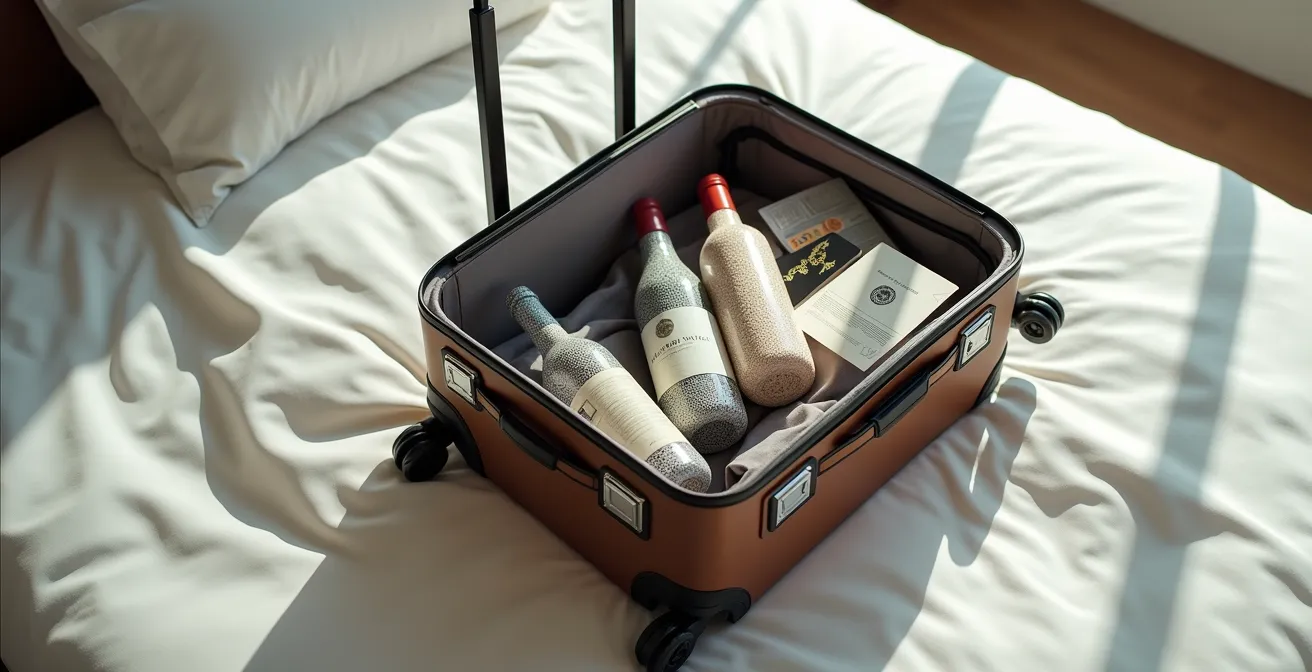
The success of transporting your wine investment isn’t about hope, it’s about a clear logistical strategy.
- Mastering packaging engineering and weight distribution in your checked luggage is your first line of defense against breakage.
- Understanding the total landed cost, including potential duties and insurance, of professional shipping prevents expensive surprises.
Recommendation: Choose your transport method based on wine value and quantity; DIY packing is viable for a few bottles, while professional shipping is a necessary investment for valuable cases.
You’ve found it in the Barossa or Hunter Valley—that perfect bottle of Shiraz that captures the essence of your Australian journey. Now comes the most critical phase of your acquisition: the logistical operation of getting this perishable asset home to the UK, intact and uncompromised. Many travelers simply wrap a bottle in a jumper, place it in their soft-sided suitcase, and hope for the best, vaguely aware of customs limits and completely unaware of the thermal risks involved.
This approach treats a valuable investment like a common souvenir. But what if you approached this not as packing, but as a small-scale perishable goods transport operation? The real key to success lies in systematically mitigating risk at every step of the logistical chain, from impact forces and thermal shock to the final customs clearance. It’s about engineering a solution, not just wrapping a bottle. This requires a shift in mindset from tourist to logistics manager.
This guide provides a technical framework for that operation. We will deconstruct the process, covering the legal and customs framework, packaging engineering, asset value preservation, and even the often-overlooked peripheral logistics of your trip that directly impact the success of your primary mission: bringing your wine home safely.
This article provides a detailed operational breakdown for transporting wine. Explore the sections below to master each stage of the process, from regulatory compliance to the final delivery.
Summary: Shipping Wine Home: A Logistical Guide to Transporting Bottles Without Breakage
- Duty-free allowances: how many liters can you actually bring back to the UK?
- The “wine diaper” method: protecting bottles in soft suitcases
- Drink now or cellar: which Australian Shiraz increases in value over 10 years?
- Barossa vs Margaret River: which region produces the best Cabernet Sauvignon?
- When to visit vineyards to see the crushing process in action?
- Declare or dump: why ticking ‘yes’ on the arrival card saves you from a $2600 fine?
- Food courts vs cafes: finding high-quality Asian food for under $15
- Melbourne vs Sydney: Which City Fits Your Creative Style Better?
Duty-free allowances: how many liters can you actually bring back to the UK?
The first step in any logistical operation is understanding the regulatory framework. For travellers returning to Great Britain, the rules governing alcohol are surprisingly generous but strictly enforced. The primary constraint is volume. According to official UK government regulations, you are permitted to bring in 18 litres of still wine. This is the equivalent of 24 standard 750ml bottles, a significant quantity for personal use or cellaring.
This allowance is distinct from that for sparkling wine, fortified wine, or spirits, which have lower limits. It’s crucial to understand that these categories are not interchangeable. You cannot, for example, trade your spirits allowance for more still wine. The system is designed around specific categories of alcoholic beverages, and your consignment must fit within these defined limits to qualify as duty-free.
The critical point of failure for many travellers is misunderstanding how the limits are applied if they are exceeded. If you go over your allowance, you are liable for tax and duty on the entire quantity of goods in that category, not just the excess. This is a common and costly mistake. Therefore, accurate accounting of your bottles is not just good practice; it’s a fundamental risk mitigation strategy to avoid unexpected financial penalties upon arrival. Before you even consider packing, you must have a precise inventory of your liquid assets.
The “wine diaper” method: protecting bottles in soft suitcases
Once the regulatory landscape is clear, the next phase is physical asset protection. The common “wrap it in a sweater” method is an amateur’s gamble. A professional approach requires engineering a protective cell for each bottle. This is where the so-called “wine diaper” method—a multi-layered system of absorption and cushioning—becomes a critical technique, especially when using soft-sided luggage which offers minimal structural protection.
The core principle is to create a buffer zone that can absorb both impact and potential leakage. This involves a primary absorbent layer (like a sock or specialized absorbent sleeve) directly against the glass, followed by a robust cushioning layer. Bubble wrap is a standard component, but the key is to ensure complete coverage, paying special attention to the vulnerable neck area.

As the image demonstrates, the texture and layering of protective materials are paramount. The final step is to position the wrapped bottle in the center of the suitcase, buffered on all sides by soft clothing. This placement ensures it is as far as possible from any potential point of impact. While effective for a small number of bottles, for serious collectors, a dedicated hard-shell case with foam inserts is the superior logistical choice.
Case Study: The Professional’s Choice for High-Volume Transport
A sommelier with a decade of experience transporting wine globally highlights the value of specialized equipment: ‘I’ve had a VinGardeValise 12-bottle suitcase for almost 10 years now. It has been around the world with me, and is still going strong. The case is ultra-light, so it can accommodate wine bottles without going over the 50 pound limit and has four wheels for easy maneuvering. The foam inserts are sturdy, and can accommodate uniquely shaped bottles.’ This demonstrates a long-term investment in purpose-built hardware to mitigate transport risk.
Drink now or cellar: which Australian Shiraz increases in value over 10 years?
The decision to transport a premium Australian Shiraz is often driven by its potential to appreciate in both flavour and value over time. However, the journey itself can severely compromise this potential. The phenomenon known as “bottle shock” or “travel sickness” is a temporary condition where a wine’s flavours can seem muted or disjointed after agitation during transit. This is a critical factor in your logistical planning.
To preserve the wine’s intended structure and ageing potential, a post-transport resting period is non-negotiable. For most wines, a period of several weeks is sufficient to recover. However, experts recommend waiting no less than four to six weeks for all shipped wines, with a minimum of three months for particularly fine, complex, or expensive vintages intended for cellaring. Rushing to open a bottle is the surest way to be disappointed and misjudge the wine’s true quality.
Beyond agitation, temperature fluctuation is the greatest enemy of a wine’s longevity. A wine industry expert from the “Wine: Decoded” blog emphasizes the importance of environmental control during the shipping process:
Wine is a living, breathing organism. When shipping wines, you’d like them to be somewhere between 30˚- 65˚F on their journey. If you cannot avoid temps outside of that range, it is always recommended to pay the extra and have your wines’ shipping expedited.
– Wine industry expert, Wine: Decoded Blog on Transportation & Bottle Shock
This highlights a crucial trade-off: the added cost of temperature-controlled shipping is not a luxury, but an essential form of insurance for any bottle you intend to cellar. Without it, you risk your investment arriving already damaged and unfit for long-term ageing.
Barossa vs Margaret River: which region produces the best Cabernet Sauvignon?
While oenophiles can debate the stylistic differences between a Barossa and a Margaret River Cabernet Sauvignon endlessly, the logistics expert poses a different question: which region offers a more efficient logistical chain for getting the wine home? Beyond terroir and tasting notes, the practical feasibility of shipping is a critical factor in your purchasing decision. A world-class wine is useless if it cannot be transported safely.
Major, well-established wineries in accessible regions often have sophisticated, in-house international shipping programs. In contrast, smaller, boutique producers in more remote areas may offer no shipping services at all, shifting the entire logistical burden onto you. Before purchasing a case, you must evaluate the winery’s shipping capabilities as rigorously as you evaluate their wine.
Your Action Plan: Winery Shipping Services Evaluation
- Verify Capabilities: Ask the direct question: “Do you ship internationally to the UK and handle all customs paperwork?”
- Assess Risk Mitigation: Inquire about their process: “What is your insurance policy for breakage or spoilage during transit?”
- Conduct Cost Analysis: Get a specific quote: “What is the total landed cost for a case of 6 bottles, including shipping, insurance, and duties?”
- Check Environmental Controls: Ask about preservation: “Do you use temperature-controlled shipping, especially during the Australian summer?”
- Confirm Final Delivery: Ensure legality: “Can you guarantee shipment to my specific address without any local state restrictions?”
If a winery cannot provide satisfactory answers to these questions, you must be prepared to manage the transport yourself. This could involve using a third-party shipping service or relying on your own luggage—decisions that carry their own costs and risks. Therefore, the “best” region from a logistical standpoint is often the one with the most robust and transparent shipping infrastructure.
When to visit vineyards to see the crushing process in action?
Timing your visit to coincide with the harvest and crushing process (typically February to April in Australia) provides a fascinating glimpse into winemaking. However, from a logistical perspective, this period presents the highest level of thermal risk for wine transport. Shipping wine during the heat of the Australian autumn is a significant gamble unless stringent environmental controls are in place.
Wine is extremely sensitive to thermal excursion. According to shipping experts Hillebrand Gori, the ideal wine temperature range during transport is between +10°C to 20°C (+50°F to 68°F). This is often referred to as the “wine comfort zone.” Departures from this range, especially on the higher end, can cause irreversible damage. A bottle left in a hot car, on a loading dock, or in the unpressurised cargo hold of an aircraft can quickly “cook.”
The consequences of thermal damage are severe. As the internal bottle temperature rises above 26°C (80°F), the wine begins to deteriorate. As it approaches 30°C (86°F), the liquid expands, creating pressure that can push the cork out, breaking the seal. This allows oxygen to enter, leading to oxidation. The resulting wine will not be fresh but will have subdued, stewed, or “cooked” flavour characteristics, completely destroying the nuance and value of the vintage. Therefore, if you are purchasing wine during the hottest months, opting for temperature-controlled shipping or delaying shipment until a cooler season is not an optional extra; it is a fundamental requirement to protect your asset.
Declare or dump: why ticking ‘yes’ on the arrival card saves you from a $2600 fine?
The final checkpoint in your logistical operation is customs. After meticulously packing and transporting your wine, the declaration process is the one place where absolute transparency is your greatest asset. The temptation to not declare, especially if you are slightly over the allowance, is a high-risk gamble with severe financial consequences. In Australia, failure to declare items can result in fines up to $2,600 and cancellation of your visa. Honesty is the only viable policy.
When you tick ‘yes’ on the arrival card to declare goods, you are not admitting to a crime; you are initiating a standard inspection process. For customs officers, the primary concerns are biosecurity (food, plants) and commercial importation. Declaring a few extra bottles of wine for personal use is a low-priority issue. In many cases, as experienced travellers report, officers may waive the duty for small quantities over the limit simply because the administrative effort outweighs the revenue collected. However, this discretionary leniency is only extended to those who declare upfront.
The key is to be prepared and professional. Have your purchase receipts ready to show the value of the wines. When speaking to an officer, state clearly and concisely what you have: for example, “I have 9 bottles of wine for personal consumption.” This demonstrates transparency and cooperation. Attempting to conceal the items, on the other hand, is treated as deliberate deception and will be met with the full force of customs regulations, including potential confiscation of the goods and significant fines. The choice is clear: the momentary inconvenience of an inspection is infinitely preferable to the risk of a major penalty.
Food courts vs cafes: finding high-quality Asian food for under $15
A successful logistics operation depends on the efficient management of all available resources, including your time and travel budget. While your primary mission is securing valuable wine, optimising ancillary costs—such as daily meals—frees up capital for what truly matters: investing in proper packing materials or upgrading to temperature-controlled shipping. In Australian cities, the choice between a quick meal in a food court and a leisurely cafe lunch is a clear example of this resource allocation.
Food courts in major hubs like Sydney and Melbourne offer a huge variety of high-quality Asian cuisines at an exceptional value, often under $15 per meal. This represents a significant cost and time saving compared to a full-service cafe. By making strategic choices for daily sustenance, you can reallocate an extra $20-30 per day directly into your wine transport budget. Over a week, this can amount to the entire cost of a professional shipping box or a significant portion of an international shipping fee.
This principle of trade-offs is central to logistics. Every decision has a cost and a benefit. The table below illustrates the fundamental choice between handling the shipping yourself versus engaging a professional service—a decision made easier when your travel budget is managed efficiently.
| Method | Cost | Risk Level | Convenience | Best For |
|---|---|---|---|---|
| DIY in checked bag | $15-30 (supplies only) | Medium | High | 1-6 bottles, short trips |
| Extra suitcase | $50-150 (baggage fee) | Low | Medium | 6-12 bottles |
| Professional shipper | $100-200 per case | Very Low | Low | Valuable/rare wines |
| Winery direct ship | $150-250 per case | Very Low | Very High | Large quantities |
Key Takeaways
- The UK’s personal duty-free allowance for still wine is a generous 18 litres (24 bottles), but you must declare all alcohol you are carrying.
- Temperature is a greater threat to wine quality than impact. Avoid shipping in extreme heat or cold without investing in thermal-controlled transit.
- For valuable or irreplaceable wine, the cost of professional, insured shipping is a necessary investment to protect your asset, not a luxury.
Melbourne vs Sydney: Which City Fits Your Creative Style Better?
Your base of operations—whether the sprawling, energetic metropolis of Sydney or the arts-focused, structured hub of Melbourne—is the starting point of your logistical chain. This choice has direct implications on your access to wine regions like the Hunter Valley (from Sydney) or the Yarra Valley (from Melbourne). From a logistics perspective, this decision also parallels the fundamental choice between two primary transport philosophies: managing the transport yourself via checked luggage versus outsourcing it to a professional shipper.
Opting for a DIY approach using checked luggage is akin to navigating the dynamic, sometimes chaotic, energy of Sydney. It offers high convenience and speed, as the wine arrives with you. However, it requires you to personally manage all the risks, from packing and weight limits to navigating the airport. It is a hands-on, high-involvement process.
Engaging a professional shipper is more like embracing the structured, curated style of Melbourne. It is a lower-risk, lower-convenience option where you delegate the complexities to an expert. Your wine is handled in a controlled environment and delivered to your door, but it requires patience and a higher financial investment. You trade immediate access for long-term peace of mind.
The table below breaks down the factors involved in this critical strategic choice, which should be made based on the value of your wine, your risk tolerance, and your budget.
| Factor | Checked Luggage | Professional Shipper |
|---|---|---|
| Cost | $25-50 extra baggage fee | $150-300 per case |
| Speed | Same day as your arrival | 2-4 weeks delivery |
| Safety | Good with proper packing | Excellent – temperature controlled |
| Convenience | Must carry through airport | Direct to your door |
| Volume Limits | Weight restrictions apply | Unlimited (cost increases) |
| Insurance | Limited airline coverage | Full insurance available |
To ensure your next vintage arrives safely and maintains its value, your next step is to perform a pre-travel risk assessment. Use the evaluation checklist and comparison tables in this guide to build a personal wine transport plan tailored to your specific needs and the value of your acquisitions.
Frequently Asked Questions About Transporting Wine
What’s the safest position for wine bottles in luggage?
Place bottles in the center of your suitcase, wrapped thoroughly in clothing or protective sleeves. The most effective strategy is to position them centrally, cushioned on all sides by soft items to create a buffer zone against external impacts.
Should I use hard or soft luggage for wine transport?
Hard-sided luggage offers superior protection against compression and external impacts. The rigid shell is less likely to bend under pressure, making it the safer choice, especially when transporting multiple or particularly valuable bottles.
How much does a wine bottle add to luggage weight?
An average 750ml bottle of wine weighs between 1.2kg and 1.4kg (approx. 3lb). With most airline checked baggage allowances set around 23kg (50lb), even a few bottles represent a significant portion of your total weight allowance.
What happens if I exceed my duty-free allowance and have declared it?
You will be required to pay customs duty and any applicable VAT on the goods. The key is that by declaring them, you avoid penalties or confiscation. The process is administrative, not punitive.
Do I pay duty only on the excess amount over the allowance?
No, this is a critical point. If you go over your personal allowance, you are required to pay tax and duty on the total value of all the goods in that category, not just the amount that is over the limit.