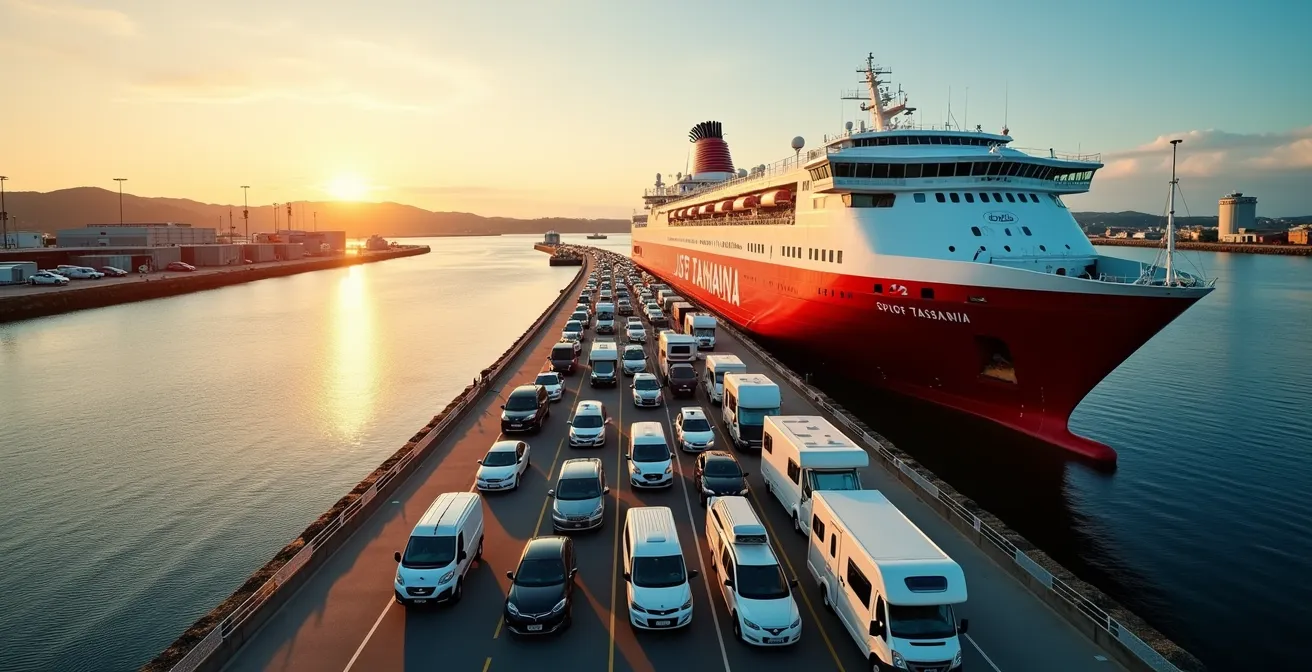
In summary:
- Peak season booking for the Spirit of Tasmania is a logistical mission that requires anticipating operational bottlenecks.
- Strategic choices about your cabin’s location, understanding biosecurity procedures, and preparing for pet travel are as critical as booking early.
- Vehicle loading is a directed process; complex reversing is not typically required, but you must be prepared for tight manoeuvres.
- This guide extends beyond the Bass Strait, tackling similar logistical challenges in other iconic Australian travel hotspots.
Attempting to book a vehicle on the Spirit of Tasmania during the summer peak season feels less like making a reservation and more like a high-stakes logistical operation. Every road tripper knows the familiar dread: frantically refreshing the booking page only to find all vehicle spots have vanished. The common advice is always the same—book months, even a year, in advance. But this only scratches the surface of the challenge. True success lies in navigating the operational blind spots that most travellers only discover when it’s too late.
What if the key wasn’t just *when* you book, but *how* you prepare for the journey’s hidden complexities? The real tactical advantage comes from understanding the sailing dynamics of the Bass Strait, the non-negotiable biosecurity checks that can derail your plans, and the precise steps to ensure your pet is safe and comfortable. These are the details that separate a smooth passage from a stressful ordeal. This isn’t just about securing a ticket; it’s about mastering the system.
This guide provides a tactical playbook for the Spirit of Tasmania, addressing the critical questions that arise before, during, and after booking. We will then broaden the lens to examine similar logistical bottlenecks across Australia, from ferry queues in the far north to accommodation caps on protected islands, equipping you with a strategic mindset for tackling the nation’s most demanding travel challenges.
Summary: A Strategic Guide to Australia’s Toughest Travel Logistics
- The Bass Strait Chop: Where Is the Most Stable Cabin on the Ship?
- Fresh Produce Checks: What Happens if You Forget Fruit in Your Car Boot?
- Kennels on Deck: Ensuring Your Dog Is Comfortable During the Night Crossing
- Reversing Skills: Do You Need to Reverse Your Trailer onto the Ferry?
- View vs Sleep: Is the Day Sailing Boring or Relaxing?
- The Daintree River Ferry Logistics: Avoiding the 2-Hour Queue in Peak Season
- Lord Howe Island Cap: Why You Need to Book Accommodation 12 Months Out?
- Why Regional Flights in Australia Cost More Than International Ones?
The Bass Strait Chop: Where Is the Most Stable Cabin on the Ship?
The Bass Strait is notorious for its rough seas, a major concern for anyone prone to motion sickness. While the Spirit of Tasmania vessels are built for these conditions, your cabin choice can dramatically alter your comfort level. The key principle is to book a cabin that is as close to the ship’s centre of gravity as possible. This means prioritising lower decks and a mid-ship position, where the pitching and rolling motions are significantly dampened. Think of it like a seesaw; the ends experience the most movement, while the centre remains the most stable.

As the diagram above illustrates, stability is a game of physics. The most sought-after locations for a smooth journey are on Deck 7, in the central third of the vessel. Cabins on Deck 8 offer moderate stability, but anything higher, or too close to the bow (front) or stern (back), will be subject to more pronounced movement. Although the ships are robust—indeed, one of the vessels proved its capability by navigating a 20-metre wave height in extreme conditions—your personal comfort depends on this tactical cabin selection. During the booking process, use the deck plan view to pinpoint a cabin in this prime stability zone.
Fresh Produce Checks: What Happens if You Forget Fruit in Your Car Boot?
Tasmania’s strict biosecurity is a critical operational blind spot for many travellers. Forgetting a single piece of fruit or a vegetable in your car won’t result in a hefty fine on the spot, but it will trigger a clear and methodical process. Before you even board in Geelong, biosecurity staff will question you about restricted items like fresh fruit, vegetables, plants, and honey. This is your chance to declare anything you might have. If you are honest, you will be directed to dispose of the items in designated amnesty bins with no penalty.
If you fail to declare and items are suspected, or if your vehicle is chosen for a random check, a ‘Notice to Stop’ sticker will be placed on your windscreen. This signals that your vehicle requires a secondary inspection upon arrival in Devonport. While the initial check is about declaration and voluntary disposal, the arrival inspection is more thorough. It’s a logistical bottleneck you want to avoid, as it can delay the start of your Tasmanian holiday. The best strategy is a proactive one: clean out your vehicle, fridge, and esky before you even leave home.
Your Pre-Boarding Biosecurity Checklist
- Inspect Food Storage: Thoroughly check your car fridge, esky, and glovebox for any fresh fruits, vegetables, and honey.
- Clean Outdoor Gear: Inspect hiking boots and camping equipment for soil or plant matter and clean them completely.
- Check Fishing Equipment: Ensure all fishing gear, including tackle boxes and waders, is free from bait and organic material.
- Empty All Plant Matter: Dispose of any plant materials, including potted herbs or flowers, before reaching the terminal.
- Declare at Check-In: Be upfront and declare any questionable items to the staff at the check-in booth for guidance.
Kennels on Deck: Ensuring Your Dog Is Comfortable During the Night Crossing
Travelling with a pet adds another layer of logistical pressure. The primary concern for owners is the welfare of their dog during the 9.5 to 11.5-hour crossing. The good news is that Spirit of Tasmania has a strong safety record, having safely transported over 32,000 pets since July 2018. The kennels are located on ventilated vehicle decks (Decks 3 and 5) and are climate-controlled. Fresh water is supplied for the duration of the journey, and staff perform regular checks.

However, the most crucial rule to understand is that for safety reasons, you cannot access your pet during the sailing. This makes preparation paramount. Your tactical advantage lies in making the kennel as comforting as possible. You must provide your dog’s bedding, and it is highly recommended to include an item with your scent, like an old t-shirt or blanket. This familiar smell can significantly reduce stress in the unfamiliar environment. A favourite chew toy can also provide a welcome distraction. Booking a kennel (which costs around AUD $22 one-way) is mandatory and, like vehicle spots, they fill up extremely fast during peak season.
Reversing Skills: Do You Need to Reverse Your Trailer onto the Ferry?
The thought of reversing a car, let alone a caravan or trailer, in a tight, high-pressure environment is a major source of anxiety for many drivers. Fortunately, the vehicle loading process on the Spirit of Tasmania is a highly organised, directed operation. You will not be left to figure it out on your own. In most cases, drivers of standard vehicles will simply drive on and drive off. The ship is designed for this flow-through process.
The loading pattern is determined by the wharf crew based on a complex puzzle of vehicle sizes, types, and arrival times. While it’s rare for a standard car to be asked to reverse a significant distance, drivers with trailers or caravans must be prepared for anything. The crew are experts at directing traffic, but you must have confidence in manoeuvring your vehicle in tight spaces, both forwards and backwards. The key is to follow their instructions precisely and remain calm. The staff are known for being helpful and will guide you through every turn. Priority loading or unloading cannot be guaranteed, and disembarking can take up to 90 minutes, so patience is a required part of your tactical toolkit.
View vs Sleep: Is the Day Sailing Boring or Relaxing?
Choosing between a day and a night sailing is a strategic decision that shapes the first 24 hours of your Tasmanian holiday. A night sailing is the traditional choice, allowing you to sleep through the crossing and arrive in Devonport early in the morning, ready to explore. A cabin is essential for this option to ensure you are well-rested. The day sailing, only available during the peak season from September to April, presents a different value proposition. It transforms the journey from a simple transit into a mini-cruise experience.
On a day sailing, you get to witness the full expanse of the Bass Strait, with special entertainment often provided on board to pass the time. A cabin becomes an optional private retreat rather than a necessity for sleep. The major trade-off is arrival time. You’ll dock in the evening, meaning you lose a day of exploration and must have accommodation booked for that first night. There is no right or wrong answer; the choice depends entirely on your travel style and priorities.
The following table, based on information from an RACV travel guide analysis, breaks down the key differences to help you make a tactical choice.
| Aspect | Day Sailing | Night Sailing |
|---|---|---|
| Duration | 9.5-11.5 hours | 9.5-11.5 hours |
| Schedule | September-April only | Year-round |
| Views | Full Bass Strait scenery | Departure/arrival views only |
| Entertainment | Special daytime activities | Limited evening options |
| Cabin value | Optional rest space | Essential for sleep |
| Arrival energy | Arrive evening, need accommodation | Arrive morning, start exploring |
The Daintree River Ferry Logistics: Avoiding the 2-Hour Queue in Peak Season
The logistical bottlenecks of Australian travel are not confined to the Bass Strait. In Far North Queensland, the Daintree River Ferry is the only way to get a vehicle into the Cape Tribulation section of the Daintree National Park, and during peak season, the queue can stretch for hours. This is another classic case where simply showing up is a recipe for frustration. A tactical approach is essential.
The primary strategy is to travel outside of peak hours. The ferry operates from 5 am to midnight, but the major rush occurs between 10 am and 2 pm. Aim to cross early in the morning or later in the afternoon to avoid the worst of the congestion. Unlike the Spirit of Tasmania, you can often buy ferry tickets online in advance or from local tour operators, which can sometimes allow you to use a priority lane. Always check the latest operational advice before you go. Planning your crossing like a military operation, by timing it perfectly and securing tickets beforehand, can save you hours of sitting in a hot car.
Lord Howe Island Cap: Why You Need to Book Accommodation 12 Months Out?
Moving from transport to accommodation, Lord Howe Island presents one of Australia’s most challenging booking puzzles. The reason you must book up to a year in advance is not just popularity, but a deliberate policy of scarcity. The island has a strict cap on tourist numbers, allowing only 400 visitors at any one time. This is a conservation measure to protect its delicate, World Heritage-listed ecosystem.
This hard limit creates intense competition for both flights and the limited number of beds on the island. There is no secret trick or last-minute deal to be found here. The system is rigid. Your only tactical advantage is time. Identify your desired travel window and be ready to book accommodation and flights the moment they become available, which is often 11 to 12 months in advance. Subscribing to newsletters from the island’s lodges is a good way to get alerts on booking openings. Failure to plan this far ahead almost guarantees disappointment.
Key takeaways
- Mastering Australian travel logistics means looking beyond the obvious and preparing for specific operational challenges.
- For the Spirit of Tasmania, cabin location, biosecurity compliance, and pet preparation are as crucial as securing a ticket.
- Whether it’s a ferry queue, an accommodation cap, or flight pricing, the core strategy is to understand the system’s rules and plan far in advance.
Why Regional Flights in Australia Cost More Than International Ones?
The final logistical frustration for many travellers in Australia is the seemingly illogical cost of regional air travel. It can often be cheaper to fly from Sydney to Bali than from Sydney to a remote town in Western Australia. This isn’t an error; it’s a result of fundamental economic principles. The primary driver is a lack of competition. Many regional routes are serviced by only one or two airlines, creating a duopoly or monopoly that keeps prices high.
Furthermore, regional flights lack the economies of scale that international routes enjoy. They use smaller aircraft with fewer seats, meaning the high fixed costs (fuel, staff, airport fees) are spread across a smaller number of passengers. These smaller airports also have higher relative operating costs. While you can’t change these market dynamics, understanding them provides a tactical advantage. It allows you to manage your budget expectations and reinforces the importance of booking regional flights as far in advance as possible to secure the lowest available fare tier before they sell out.
Navigating the unique logistical challenges of Australian travel, from the Bass Strait to the outback, is a skill. Success is not accidental; it is the direct result of strategic planning, a deep understanding of the operational rules, and the foresight to act well before the peak season pressure begins. Start planning your logistical mission today.
Frequently Asked Questions About Spirit of Tasmania Logistics
Will I need to reverse my vehicle onto the ferry?
All drivers board in their vehicle with passengers. The Spirit of Tasmania wharf crew will direct you when loading and advise where to park. The loading pattern depends on vehicle size, arrival time, and operational requirements; significant reversing is not standard for most cars, but you should be comfortable manoeuvring in tight spaces.
How long does vehicle unloading take?
On a regular crossing, the discharge of all vehicles is typically completed within 90 minutes of the vessel tying up at the wharf. Priority loading or unloading cannot be guaranteed due to the complex nature of operational procedures.
What about high vehicles like caravans?
Space for high vehicles (over 2.1 metres) is limited and in high demand. It is essential to book as early as possible, especially during peak periods. You must measure your vehicle’s total height, including any roof-mounted items like solar panels or antennas, and declare it accurately at the time of booking to ensure you are allocated an appropriate space.