
Successfully surfing the Gold Coast’s legendary breaks is less about wave-catching skill and more about understanding the complex social hierarchy of the lineup.
- Respect is demonstrated through specific actions like strategic positioning and yielding waves, not just generic friendliness.
- Safety is a personal responsibility; the right gear is non-negotiable on shallow reefs, regardless of what the pros use.
Recommendation: Shift your mindset from a wave-hungry visitor to a respectful student of the break. Observe more than you surf, and your wave count will paradoxically increase.
The image is burned into every surfer’s mind: a seemingly endless, mechanical sand-bottom point break peeling for hundreds of meters under a golden sun. This is the promise of the Gold Coast Superbank. You arrive, board under your arm, and see that the promise is real. But then you see the reality: a hundred surfers packed into a take-off zone the size of a tennis court, a clear pecking order, and an intensity that can feel impenetrable. The common advice—”be respectful,” “wait your turn”—feels painfully inadequate when the “turn” system seems non-existent and the rules are all unwritten.
Many visiting surfers paddle out with the best intentions, only to find themselves inadvertently breaking a subtle rule, getting “snaked,” or simply being ignored for two hours straight. The frustration can lead to giving up and surfing lesser-quality beach breaks, feeling that the iconic waves are reserved only for locals and pros. This guide challenges that assumption. It’s not about finding a secret back door to the front of the line; that doesn’t exist. It’s about understanding the deep-rooted social ecosystem of these breaks.
The key isn’t to challenge the hierarchy, but to respectfully integrate into it. This requires more than basic etiquette; it demands situational awareness, strategic positioning, and a genuine understanding of the physical and social dynamics at play. It’s about learning the unwritten code of conduct, from managing the logistics of a pre-dawn arrival to knowing how to recover from a social misstep in the water. This is the insider’s playbook for not just surviving, but genuinely enjoying a session at one of the world’s most crowded, high-performance surfing arenas.
To grasp the sheer intensity and level of talent that defines the top of this ecosystem, the following video showcases a classic final at Snapper Rocks. It’s a perfect illustration of the precision and competitive fire you’ll be observing from the shoulder.
This guide breaks down the essential strategies a visiting surfer needs to master. From the subtle rules of the lineup to the practicalities of where to stay and what to do when it’s flat, we’ll cover the knowledge you need to navigate the Gold Coast with the quiet confidence of a local.
Summary: A Visitor’s Strategic Guide to Gold Coast Surf Culture
- The “snake” and the “shoulder”: unspoken rules you must not break at Snapper
- Booties and helmets: are they necessary for surfing shallow setups like Kirra?
- Cyclone season: when to visit for the legendary Superbank barrels?
- South of the border: driving 20 minutes to find empty peaks near Cabarita
- The 4am alarm: why arriving before sunrise is the only way to get a park?
- The 3-meter rule: how to swim alongside a giant without touching it?
- Surry Hills or Newtown: which suburb offers better value for budget stays?
- Where to Find Snorkeling Spots with 20+ Meter Visibility for Beginners?
The “snake” and the “shoulder”: unspoken rules you must not break at Snapper
At a normal break, priority is simple: the surfer deepest at the peak gets the wave. At Snapper Rocks, this is just the starting point. The real currency is the unwritten social code, and the two cardinal sins are the “snake” and the “shoulder-hop.” Snaking is paddling around another surfer who has priority to steal the deeper position. It’s an aggressive, disrespectful move that will instantly mark you. Shoulder-hopping is taking off on the shoulder of a wave when someone is already up and riding from the peak. On a long, sectiony wave like the Superbank, it might seem harmless, but it disrupts the flow of the rider and is considered a major offense.
The intensity of this social code is a direct result of the pressure on the wave. As local legend and World Champion Joel Parkinson noted, the dynamics of the Superbank have changed the very nature of surfing there. In a frank interview with Tracks Magazine, he explained the frustration of the established order being disrupted:
Any enjoyment surfing out there has been taken away for the locals. That’s why Kirra is even more special now than ever. It breaks once every few years and it is the last stretch where the normal lineup rules that apply to every other break on the planet still operate.
– Joel Parkinson, Tracks Magazine Interview
This sentiment underscores the tension. As a visitor, your goal is to be a ghost. Never paddle for a wave a recognized local is paddling for. If you do make a mistake—and it happens—don’t argue or make excuses. A quick, sincere apology and a retreat to the back of the pack is the only way to begin to repair the social damage. Your actions after a mistake are watched more closely than the mistake itself.
Your Action Plan: The Social Recovery Framework
- Immediate Acknowledgement: Acknowledge your mistake immediately without making excuses. A simple, “My bad” or “Sorry mate” is far more effective than a long story.
- Voluntary Penalty: Back off from the next 2-3 waves that come your way, even if you might have a claim. This shows you understand you need to reset the social balance.
- Show Deference: Give a respectful nod to recognized locals when they catch good waves. This demonstrates you understand and respect the established hierarchy.
- Wait for Scraps: Wait for a wide, inside, or overlooked wave that nobody else is paddling for before attempting another ride. Prove you’re not there to compete for the best sets.
- Tactical Retreat: If tensions remain high, consider changing your position in the lineup or even taking a 15-minute break on the beach to let the situation cool down.
Booties and helmets: are they necessary for surfing shallow setups like Kirra?
When you watch videos of local pros effortlessly navigating the shallow, sand-and-rock bottom of Kirra or the inside section at Snapper, you’ll rarely see them wearing protective gear. This can create a dangerous illusion for the visiting surfer. The reality is that these surfers have an intimate, millimeter-by-millimeter knowledge of the reef. For an intermediate surfer, especially on a lower tide or a heavy day, the risk of hitting the bottom is very real. A simple miscalculation can lead to serious reef cuts on your feet or a head-on collision with rock or your own board.
The decision to wear gear is a personal risk assessment, not a fashion choice. Reef booties can significantly reduce your board feel, but they can also save your trip from being cut short by a deep gash that requires stitches. A helmet might feel cumbersome, but in a chaotic, crowded lineup where loose boards are common, it provides critical protection. In fact, studies show helmets can reduce the severity of head injuries by 70%, a compelling reason to consider one when surfing over shallow rock shelves.
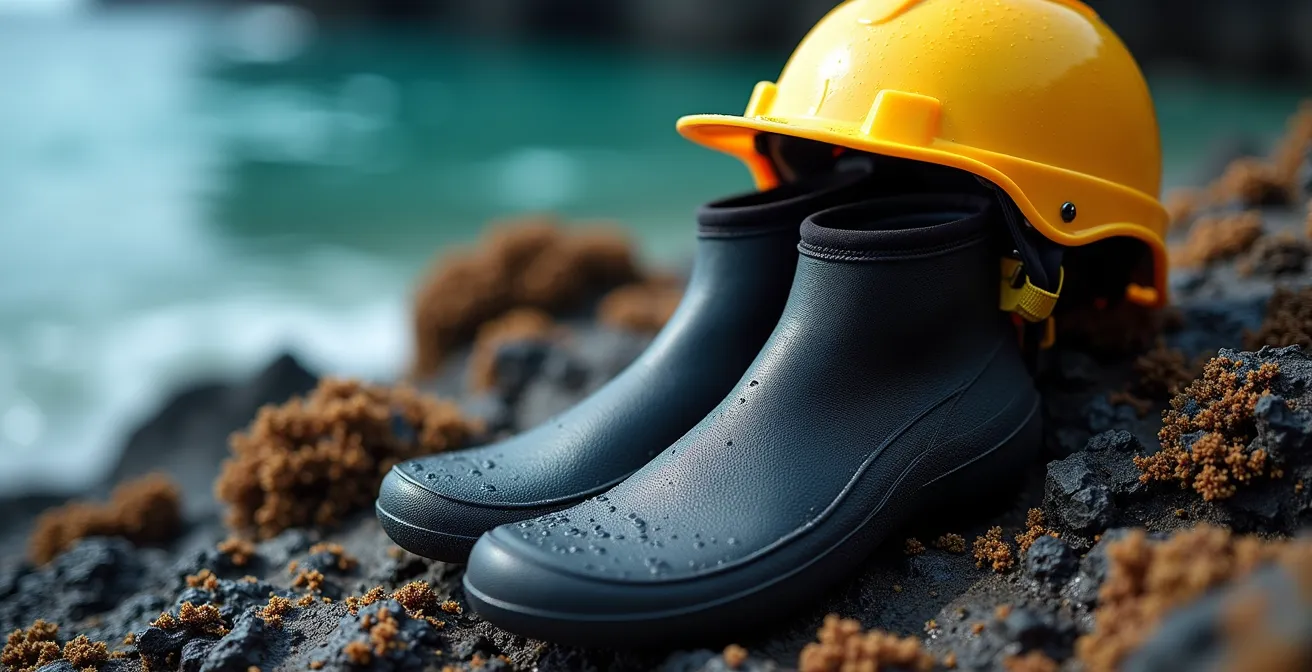
Another factor to consider is board choice. While a high-performance PU board offers the best feel and flex, it’s also incredibly fragile. An epoxy board, while having a different feel, is far more durable and can handle the inevitable bumps and knocks of a crowded take-off zone or a run-in with the rocks. The bottom line is this: your equipment should match your skill level and risk tolerance, not the local pros’. It’s far better to have a slightly less “core” session with booties and a helmet than to spend your holiday in the emergency room.
Cyclone season: when to visit for the legendary Superbank barrels?
Timing a trip to the Gold Coast for surf is a game of balancing wave quality with crowd density. The prime swell window, known as cyclone season, typically runs from December through mid-April. This is when tropical cyclones form in the Coral Sea, sending powerful ENE groundswells down the coast, lighting up the sand-bottom points and creating the world-famous “Superbank” barrels. However, this is also when crowds are at their absolute peak, exacerbated by the major professional surfing events held during this period.
A strategic breakdown of the season reveals distinct opportunities:
- December-January: The early season offers a good chance of swell with slightly smaller (but still significant) holiday crowds. It’s a gamble, but you could score great waves with a little more breathing room.
- February-March: This is the absolute peak. Swells are most consistent and powerful, but so are the crowds. You will be sharing the water with the world’s best surfers and a throng of visitors. This is prime time for watching, but challenging for wave-catching.
- April-May: Often called the “local’s summer,” this period can be a golden window. The cyclone swells begin to taper off, but consistent south swells start to fill in, and the crowds thin out dramatically after the Easter holidays.
Interestingly, some of the most respected local authorities argue that the best sand formations—the key to perfect barrels—actually arrive later in the season. Legendary surfer and shaper Wayne ‘Rabbit’ Bartholomew explained that the ideal bathymetry isn’t just about the swell, but how the sand settles. According to a Surfline analysis of Superbank conditions, he notes that the sand is often at its best in April and May, after early-season swells have done their work. This is when the man-made sand pumping and the natural flow of the ocean find a perfect equilibrium, creating hollow, predictable barrels with a fraction of the February crowd.
South of the border: driving 20 minutes to find empty peaks near Cabarita
There will be days when the Superbank is firing on all cylinders, but the crowd is simply too much to handle. Having a “Plan B” is not a sign of defeat; it’s a sign of a smart, strategic surfer. The coastline stretching from the southern Gold Coast into Northern New South Wales (NSW) is packed with high-quality alternatives that work on different swell and wind combinations. A short drive can often be the difference between a frustrating session fighting for scraps and a fun session with plenty of waves.
The key is to understand how different swells affect different spots. When a classic ENE cyclone swell has the main points packed shoulder-to-shoulder, a spot like Duranbah (D-bah), right on the border, offers powerful, peaky waves that spread the crowd out. If a big south swell is running with a southerly wind, the protected corners at spots like Miami Beach can offer clean A-frame peaks with half the crowd of Burleigh Heads. Sometimes, the best option is to head south of the border into NSW.
A 20-30 minute drive south can transport you to a different world. The town of Cabarita Beach, for example, has a world-class right-hand point break of its own that can handle significant cyclone swell but often with a much more manageable and less aggressive crowd. The stretch of coastline is littered with other beach breaks and points that can offer sanctuary when the main Gold Coast breaks are at a breaking point. Having a car and a willingness to explore is your greatest asset in scoring waves on a crowded day.
The 4am alarm: why arriving before sunrise is the only way to get a park?
On the Gold Coast, the surf session doesn’t start when you paddle out; it starts with the battle for a parking spot. During peak season or on any day with a good swell forecast, the car parks at Snapper Rocks, Greenmount, and Kirra fill up well before the sun even hints at the horizon. The “dawn patrol” isn’t just a romantic notion of surfing at sunrise; it’s a critical logistical strategy. If you roll up at 7 a.m., you will likely spend more time searching for a park than you will in the water.
The 4 a.m. alarm is your ticket to the game. Arriving by 4:30 a.m. usually guarantees you a prime spot in the main car parks, just a few yards from the main peak. This allows you to assess the conditions, wax up at a leisurely pace, and be in the water for the first slivers of light, often enjoying a brief window before the main pack arrives. As one surf guide notes, the wave is incredibly accessible, but only if you play the early morning game.

If you do miss the pre-dawn window, you need a backup plan. The paid parking lot at the Rainbow Bay Surf Club is a reliable, albeit more expensive, option. The next level of strategy is the “park and ride.” This involves parking on quieter residential streets in Coolangatta or Tweed Heads—streets around Charlotte Street are a good bet—and then using a skateboard or bike for the final 5-10 minute journey to the beach. This strategy requires a bit more effort but can save you immense frustration. Treating parking as the first part of your surf strategy is fundamental to a successful Gold Coast surf trip.
The 3-meter rule: how to swim alongside a giant without touching it?
This title sounds like it’s about marine life, but on the Gold Coast, the “giants” are the professional surfers and seasoned locals who command the lineup. Surfing alongside them is an incredible learning opportunity, but it requires adhering to an unspoken “3-meter rule”—a bubble of respect. You are there to observe, not to interact or compete. As one experienced surfer on a forum wisely put it, the hierarchy is a natural law: “If it’s an A-grade spot those people will surf it most, know it better and get the best waves by virtue of those two factors. It’s really not that complicated.” Your job is to respect this law.
The best way to do this is to employ the “Orbit Strategy.” Instead of sitting in the main pack, position yourself a consistent 10-15 meters wide of the primary take-off zone. From here, you can watch without interfering. Your goal is to identify the key players. Look for surfers with stickers on their boards, or spotters on the beach with cameras. These are the individuals who are “at work” and require an even wider berth. Pay close attention to their rhythm, their wave selection, and how they navigate the crowd.
Never paddle directly behind a pro or a heavy local. You risk getting in their way if they pull back, and you risk being in the impact zone if they take off. Maintain lateral distance at all times. By orbiting the main pack, you’ll learn the nuances of the lineup and will often be in the perfect position to pick off the wider, less-contested waves that the A-team lets go. It’s a strategy of patience and observation that will earn you more respect—and ultimately more waves—than aggressively trying to fight for a position you haven’t earned.
Surry Hills or Newtown: which suburb offers better value for budget stays?
While a traveler in Sydney might debate the merits of Surry Hills versus Newtown for a budget-friendly base, a surfer on a Gold Coast mission faces a much more relevant dilemma. The crucial choice isn’t between trendy city suburbs, but between different beachfront towns, each with a unique vibe, price point, and proximity to the waves. Your choice of accommodation will fundamentally shape your trip. The main contenders are Coolangatta, Burleigh Heads, and the quieter suburbs like Bilinga or Tugun.
Each location presents a clear trade-off between convenience, cost, and culture. Staying in Coolangatta puts you at ground zero. You can walk to Snapper, Greenmount, and D-bah, immersing yourself in the core surf scene. However, this convenience comes at a premium, with higher accommodation prices and a more crowded, intense atmosphere. Burleigh Heads offers another world-class wave and a trendier, more developed food and bar scene, but it requires driving to the Superbank and generally has an even higher price tag for both lodging and dining.
For the value-conscious surfer, the smartest play is often the suburbs in between. As a comparative analysis shows, areas like Bilinga and Tugun offer a peaceful retreat with significantly better value. You sacrifice the walk-to-the-break convenience and the bustling nightlife, but you gain a quieter residential atmosphere and easier airport access. For longer stays, serviced apartments with kitchens in these areas can offer huge savings. Furthermore, alternative models like campervan rentals provide ultimate freedom to chase swells up and down the coast, while dedicated surf hostels near Kirra offer budget-friendly dorms and an invaluable network for sharing real-time local knowledge.
The following table breaks down the pros and cons to help you make a strategic choice for your home base, based on an analysis of the local surf accommodation landscape.
| Location | Pros | Cons | Average Nightly Rate |
|---|---|---|---|
| Coolangatta | Walking distance to Superbank, core surf atmosphere, close to airport | Higher prices, intense crowds, limited dining options | $150-250 AUD |
| Burleigh Heads | World-class wave, trendy food/bar scene, more accommodation options | Different crowd dynamic, requires driving to Snapper, pricier dining | $180-300 AUD |
| Bilinga/Tugun | Quieter residential, better value, peaceful retreat, easy airport access | Less nightlife, need transport to main breaks | $100-180 AUD |
Key Takeaways
- Respect is Actionable: True respect in a crowded lineup is shown by giving space, yielding waves, and apologizing for mistakes, not just by being friendly.
- Safety Over Style: Use protective gear like booties and helmets based on your own skill level and the conditions, not based on what local pros are doing.
- Strategy Beats Aggression: A smart plan for parking, timing your visit, and choosing alternative surf spots will lead to more waves and less frustration than battling the main pack.
Where to Find Snorkeling Spots with 20+ Meter Visibility for Beginners?
When a week-long flat spell hits the Gold Coast, the water turns crystal clear and the temptation to trade your surfboard for a snorkel is strong. But for a surfer dedicated to improvement, a flat day isn’t a day off—it’s a day for active reconnaissance. Using this downtime strategically can give you a significant advantage when the swell returns. It’s an opportunity to study the very thing that creates the magic: the reef and sandbanks.
Instead of looking for fish, look for the bottom contours. At low tide, walk the entire stretch of the Superbank from the rocks at Snapper, past Greenmount, all the way to Kirra. You can physically see the sand build-up, the channels, and the rock shelves that shape the wave. This mental map is invaluable. You’ll understand why the wave sections a certain way and where to sit to be in the right spot. This is what separates the locals who are always in the perfect position from the visitors who are constantly scrambling.
Beyond studying the terrain, flat days are for maintaining physical and cultural awareness. Swim laps in the ocean pools at Kirra or Burleigh to keep your paddling fitness up. Visit the iconic local surfboard shapers like DHD or Pyzel; their factories are temples of design, and you can learn more about board dynamics in an hour there than in a year of surfing. To understand the area’s deep heritage, spend an afternoon at the Surf World Gold Coast museum. Finally, if there’s a local boardriders club competition running, go and watch. You’ll learn more about lineup dynamics and local style from the beach than you ever could in the water.
Ultimately, a successful surf trip to the Gold Coast is a holistic endeavor. By combining lineup intelligence, logistical planning, and a genuine curiosity for the local culture, you can respectfully find your place in one of surfing’s most revered and challenging environments. To put these strategies into practice, start by building your own personalized reconnaissance plan for your next trip.