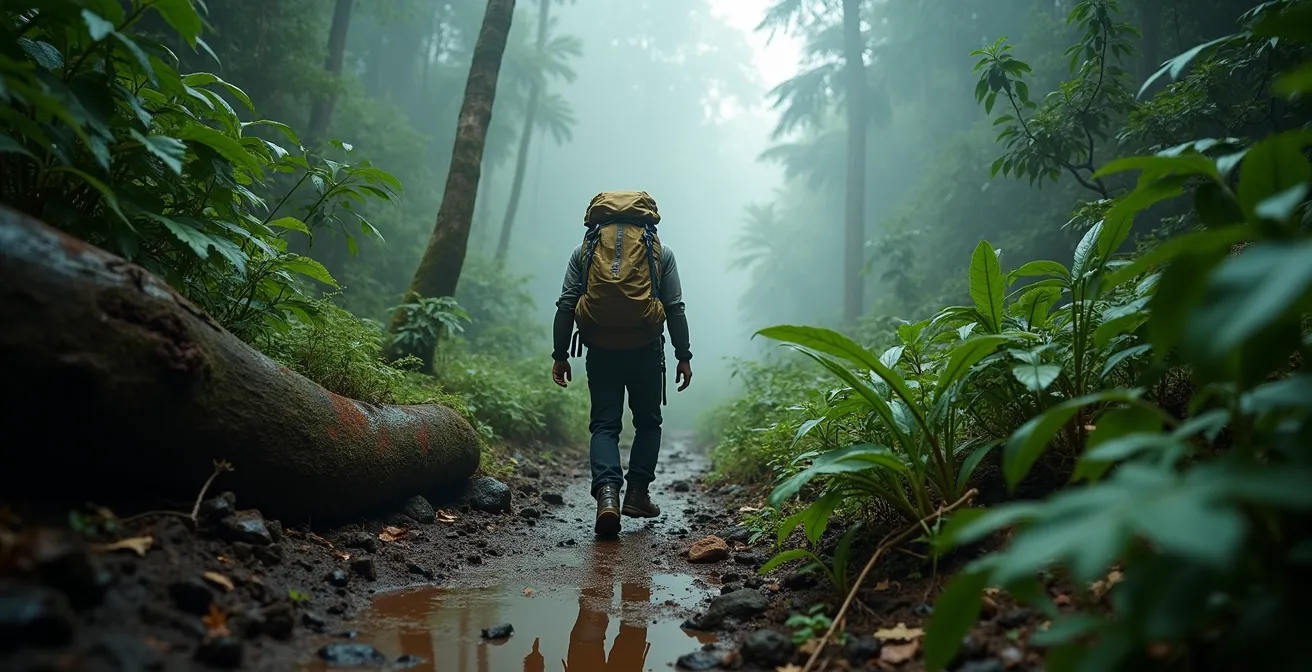
Forget ‘waterproof.’ In the jungle, the only winning strategy is a moisture management system; everything else will rot.
- Waterproof boots become buckets of stagnant water, guaranteeing trench foot.
- Satellite GPS is a fantasy under a triple-canopy forest; it’s a battery-draining brick.
Recommendation: Adopt a ‘get wet, dry fast’ mindset for your gear, your feet, and your electronics. The jungle always wins against a seal; your only hope is drainage and airflow.
You’ve summited peaks in the Rockies and crossed deserts in Utah. You have a four-season tent, a sub-zero sleeping bag, and a Gore-Tex shell that cost more than a month’s rent. You think you’re prepared for anything. You’re wrong. The rainforest is not another tick on your hiking checklist; it’s a living, breathing organism that wants to consume you and your expensive kit. The enemy isn’t the cold, the altitude, or the distance. The enemy is the air itself—a soupy, 90% humidity that breeds fungus, causes rot, and short-circuits your will to live. Your dry-climate survival instincts are a liability here.
Most guides give you a pleasant little packing list. “Bring bug spray,” they chirp. “Don’t forget your rain jacket.” That advice is worse than useless; it’s dangerous. It gives you a false sense of security. The truth is, the jungle environment is a constant battle against systemic failure. It’s not about keeping the water out; that’s a losing fight. It’s about managing the moisture that will inevitably get in. It’s about understanding the specific failure points of your gear before they compromise the mission—and your life.
This is not a checklist. This is a debrief on what fails and why. We will dissect the common gear mistakes that turn a tropical adventure into a story of misery and evacuation. We will cover the critical difference between hydration and electrolyte balance, the hard truth about your “waterproof” boots, why your GPS is a paperweight, and how to build resilient systems that respect the power of “The Rot.” Forget everything you think you know. Your training starts now.
This debrief will systematically break down the critical failure points of common gear and strategies. Study the following sections to understand how to build a resilient system for the tropics.
Summary: A Veteran’s Guide to Tropical Gear Failure
- Why drinking water isn’t enough: the importance of electrolytes in the tropics?
- Leech socks vs salt: what actually works to keep bloodsuckers off?
- Silica gel and dry bags: keeping your camera functioning in 90% humidity
- Under the canopy: why satellite GPS struggles and how to read a topo map?
- Gore-Tex vs mesh: why waterproof boots are a mistake in constant rain?
- The Daintree River Ferry logistics: avoiding the 2-hour queue in peak season
- Piles of fruit seeds: how to identify fresh cassowary scat on the trail?
- Preventing Ross River Virus: Mosquito Safety in the Tropics
Why drinking water isn’t enough: the importance of electrolytes in the tropics?
In the desert, you worry about running out of water. In the jungle, you can die with a full canteen. The air is so thick with moisture that your sweat doesn’t evaporate; it just drips off you in sheets. You’re losing more than water—you’re hemorrhaging vital salts and minerals. On the ground, jungle trekkers lose significant amounts of fluids and salts through perspiration, a fact many first-timers dangerously underestimate. This isn’t simple dehydration; it’s a rapid depletion of sodium, potassium, and magnesium, which are essential for muscle function and cognitive clarity.
The first sign of failure is a headache. Then come the muscle cramps, often at night when your body is trying to recover. Then dizziness and disorientation. This is hyponatremia, and it’s a killer. You make bad decisions, you stumble, you get injured. All because you thought chugging water was the answer. You must actively manage your electrolytes with a disciplined system. Don’t wait until you feel thirsty or tired; by then, it’s too late. Your hydration strategy needs to be proactive, not reactive.
Your electrolyte management system should be a constant, low-level process throughout the day. Here’s how you do it:
- Add electrolyte tablets or powder to your water, especially in the afternoon, to pre-empt evening cramps.
- Carry salty snacks like nuts and seeds (almonds, cashews) and eat them consistently while on the move.
- Pack dehydrated fruits and trail bars for a dual boost of energy and minerals.
- Monitor your urine. If it’s clear, you’re drinking too much plain water and flushing out salts. It should be a pale yellow.
Leech socks vs salt: what actually works to keep bloodsuckers off?
Nothing demoralizes a rookie faster than looking down to see a dozen leeches feasting on their ankles. Panic, disgust, and bad decisions follow. Your first instinct is to rip them off, which leaves their mouthparts in your skin, leading to infection. You need a system for both prevention and removal. Forget the myths about bug spray or citronella; leeches are hunters, and they are relentless. The only things they respect are physical barriers and chemical warfare.
Your primary defense is a physical one. Standard hiking socks are useless; a leech’s proboscis will go right through the weave. You need dedicated leech socks. These are not a luxury; they are mission-critical equipment. They are typically made of tightly woven calico and worn over your regular socks, extending up to your knees. They create an impenetrable barrier that denies the leech purchase on your skin. They can be hot, but the alternative is becoming a walking blood bank.
Field Report: The Borneo Guide’s Leech System
Veteran Borneo guide Al Davies doesn’t rely on a single method; he uses a layered defense. His primary tool is knee-length calico leech socks, creating a physical shield. But barriers get breached. For removal, his weapon of choice is a small fabric pouch filled with salt. A simple touch from the salt bag causes immediate detachment. But the crucial final step is what separates the professional from the amateur: Davies neutralizes every removed leech by cutting it in half with his parang. This prevents the same leech from re-attaching to you or your teammates later. It’s a brutal but effective part of a complete leech management system.
For an added layer of chemical defense, pre-treating your boots, socks, and the bottom of your trousers with Permethrin is highly effective. It acts as a repellent and can incapacitate leeches that try to climb aboard. Salt is your tool for removal, not prevention. Carry it in a small, easily accessible pouch. When a leech attaches, don’t pull it. Just touch it with the salt, and it will release instantly.
Silica gel and dry bags: keeping your camera functioning in 90% humidity
The same humidity that breeds leeches and fungus will actively try to destroy your electronics. “The Rot” doesn’t just attack organic material; it corrodes battery terminals, fogs lenses internally, and nurtures fungus on your camera’s sensor. Your expensive, “weather-sealed” camera is not immune. Weather-sealing is designed for rain, not for the all-pervasive, microscopic moisture of a tropical rainforest. Condensation is your biggest enemy.
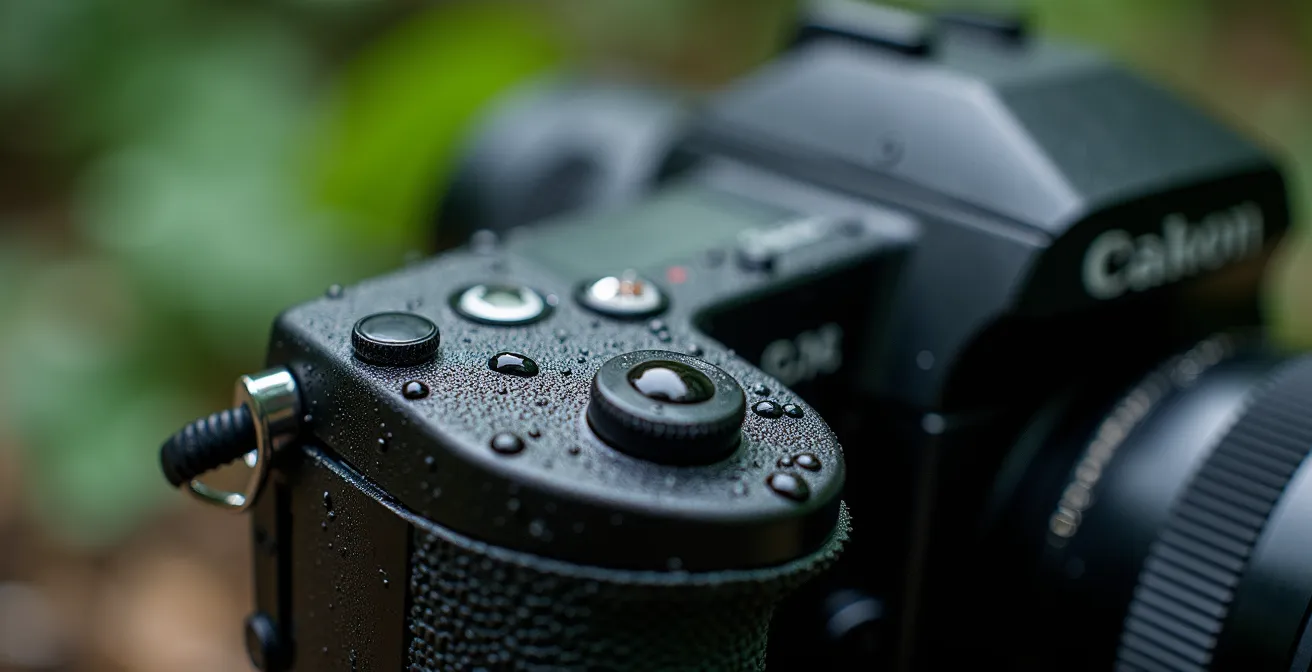
The critical failure point occurs when you move from a cool, air-conditioned space to the hot, humid outdoors, or even from the cool night air into the morning heat. The cold camera body instantly attracts condensation, both outside and inside the lens. The only way to fight this is through a strict environmental acclimatization protocol. When not in use, your camera lives in a waterproof dry bag. Not a Ziploc, a real roll-top dry bag. Inside that bag, you have multiple desiccant packs (silica gel). These absorb the ambient moisture within the sealed environment. When moving between temperature zones, leave the camera in the sealed bag for at least 30-60 minutes to allow it to slowly adjust to the new ambient temperature. This prevents condensation from forming.
Rains come down without warning and are usually very powerful but short lived. Having a dry bag for electronics saved my gear multiple times. The humidity is relentless – I kept my DSLR in double protection with silica gel and only brought it out for specific shots.
– Wildlife photographer in Gunung Leuser National Park, The Inertia Network
Your system must be disciplined. Use a cheap plastic shower cap as a rain cover for quick shots. Keep spare batteries in a separate, smaller dry bag with their own desiccant pack. A light coating of dielectric grease on battery terminals can prevent corrosion. This isn’t about one piece of gear; it’s a complete moisture management system for your most sensitive equipment.
Under the canopy: why satellite GPS struggles and how to read a topo map?
Your GPS, the one that guides you flawlessly through city streets and open country, is a liability in the jungle. The triple-canopy forest ceiling is a thick, wet blanket that blocks or severely degrades satellite signals. You might get a fix in a clearing, but deep in the jungle, it will become a frustrating, battery-draining brick. Relying on it as your primary navigation tool is a rookie mistake that can have fatal consequences.
A GPS app on my phone is handy, but in a rainforest, battery life drains fast, and signal is often non-existent. Practice using topographic maps and compass before your trip; GPS units and smartphones can fail.
– Abie, MountainIQ Adventure Guide, Rainforest Hiking: Essential Gear and Considerations
The jungle demands respect for old-school skills. Your primary navigation system must be a waterproofed topographic map and a quality compass. These tools have no batteries, they are unaffected by canopy cover, and they never lose signal. Before you even think about stepping into the jungle, you must be proficient in reading contour lines, identifying terrain features like ridgelines and gullies, and shooting a bearing. Your GPS, if you bring one, is a secondary tool—a luxury for confirming your position when you have a clear view of the sky. It is not a tool for active navigation under the canopy.
The following table, based on data from field navigation analysis, breaks down the reliability of your options. The conclusion is clear: analog tools are your lifeline.
| Navigation Tool | Reliability Under Canopy | Battery Dependency | Weather Resistance | Learning Curve |
|---|---|---|---|---|
| Satellite GPS | Poor – Signal blocked by canopy | High – Drains quickly | Varies by model | Low |
| Topographic Map | Excellent – Always works | None | Poor unless waterproofed | High |
| Compass | Excellent – Unaffected | None | Excellent | Medium |
| Phone GPS (Offline Maps) | Poor signal, maps work | Very High | Poor | Low |
| Handheld GPS with Replaceable Batteries | Fair – Better antenna | Medium – Can swap batteries | Good | Low-Medium |
Gore-Tex vs mesh: why waterproof boots are a mistake in constant rain?
This is the single most critical, counter-intuitive lesson for the dry-climate hiker. Your prized, $400 waterproof Gore-Tex boots will become your worst enemy. The concept of “waterproof-breathable” is a fantasy in 90% humidity. The membrane cannot breathe if the outside air is as saturated as the inside of your boot. But the real failure point is the big hole at the top where you put your foot in. During a river crossing or a torrential downpour, water will pour over the collar. Once inside, that waterproof liner does its job perfectly: it keeps the water in.
Your boot is now a bucket. A warm, stagnant swamp strapped to your foot. This leads to skin maceration, blisters, and, in prolonged cases, trench foot—a serious condition that can end your expedition. You cannot keep your feet dry. Stop trying. The mission is to manage the wetness. The winning strategy is to choose footwear that drains and dries as quickly as possible.
Field Report: Borneo River Crossing Boot Failure
A hiker on a Borneo trek learned this lesson the hard way. During a chest-deep stream crossing, his waterproof boots filled instantly. For the rest of the day, he was sloshing around in what he described as “foot soup.” The constant wetness led to severe blistering. He eventually switched to a pair of simple water shoes, which, despite offering less support, kept his feet far more comfortable because they drained immediately after each immersion. The experience proved that quick-draining footwear is vastly superior to waterproof boots that become water traps in tropical conditions.
The right choice is a pair of lightweight, non-waterproof trail running shoes or trekking boots with mesh panels. They will get soaked instantly, but they will also start to drain and dry the moment you are on solid ground. Combine them with thin, quick-drying wool or synthetic socks. You must also have a strict foot care regimen: change into dry socks at every major stop, apply foot powder, and at night, wash and thoroughly dry your feet, letting them air out for as long as possible.
The Daintree River Ferry logistics: avoiding the 2-hour queue in peak season
Your expedition doesn’t start at the trailhead. It starts with logistics. Underestimating the time and complexity of getting to a remote jungle access point is a common mistake. Places like the Daintree River in Australia or remote access points in Vietnam are notorious bottlenecks. You can lose half a day of trekking time stuck in a ferry queue or waiting for a rural bus that runs on its own schedule. You need a logistics and access strategy long before you pack your bag.
Peak season travel means peak season crowds and inflated prices. The solution is to think like a military planner, not a tourist. Avoid traveling on weekends or public holidays if possible. Arrive at choke points like ferry crossings or park entrances at first light to be ahead of the main wave of traffic. For truly remote treks, your planning needs to be even more robust. This means researching permit requirements and park entry fees months in advance, as quotas can fill up quickly. Don’t assume you can just show up.
For multi-day unsupported treks, your logistical plan becomes part of your survival system. This can involve pre-arranging supply drops with local boat operators or having multiple backup transportation plans in case your primary option fails. Guided treks can simplify this, but you must still do your due diligence. Verify what equipment is provided versus what you need to bring, and confirm access is guaranteed with your booking. Your ability to navigate the human and infrastructure landscape is just as important as your ability to navigate the jungle itself.
Piles of fruit seeds: how to identify fresh cassowary scat on the trail?
The jungle is not an empty museum. It is alive, and you are a visitor in the territory of animals that are bigger, faster, and more dangerous than you. Knowing how to read the signs they leave behind is a matter of safety and situational awareness. A pile of fruit seeds on the trail isn’t just a curiosity; if it’s from a cassowary, it tells you one of the world’s most dangerous birds is nearby. The key is knowing how to tell if the sign is fresh.
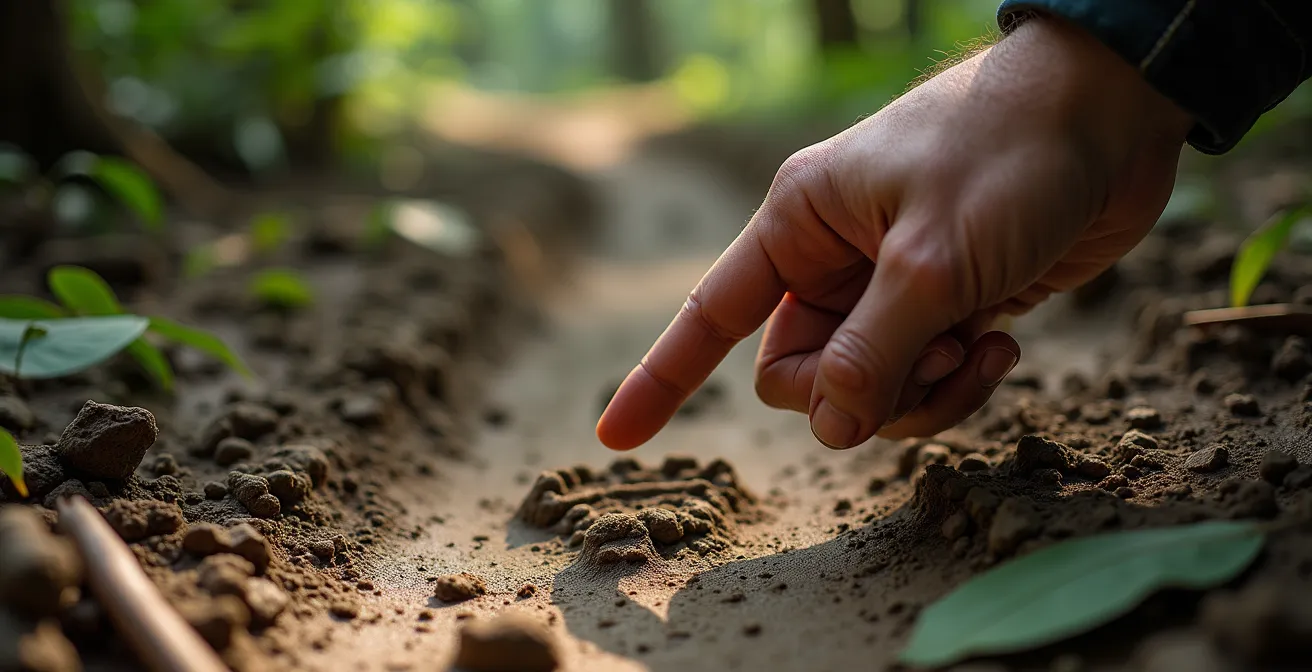
Reading the trail is a skill you must develop. It’s about observing your environment with all your senses. Fresh scat will be moist and likely have insects on it; old scat will be dry and crumbling. Animal tracks with sharp, defined edges in the mud are recent; tracks that are blurred or filled with water are old. Listen. A sudden silence in the cacophony of birds and insects often means a predator is close. Use your nose. The musky odor of a cat or a wild pig can linger long after the animal has passed. This isn’t about becoming a master tracker overnight. It’s about cultivating a state of constant awareness and understanding that you are not alone.
This awareness informs your actions. If you find very fresh signs of a large, territorial animal like a cassowary or a big cat, you make noise, you group up, and you move through the area with heightened vigilance. You don’t pitch your tent near fresh feeding signs or on a well-used game trail. Your survival depends on interpreting these signals correctly.
Action Plan: Wildlife Sign Recognition Audit
- Scat Analysis: Check moisture level and insect presence. Is it moist and fresh, or dry and old?
- Track Inspection: Examine the edges of any prints. Are they sharp and defined (recent) or blurred and weathered (old)?
- Vegetation Disturbance: Look for broken branches, trampled plants, or freshly stripped bark. This indicates recent passage of a large animal.
- Auditory Clues: Pay attention to the baseline sounds of the jungle. A sudden, unnatural silence is a universal alarm signal.
- Scent Identification: Note any unusual smells. A strong, musky odor can indicate a recent territorial marking.
Key Takeaways
- System Over Gear: Stop buying “solutions.” Build systems for moisture management, navigation, and health that are redundant and reliable.
- Embrace the Wet: You will not stay dry. Your goal is to drain and dry out as quickly as possible. This applies to your feet, your clothes, and your mindset.
- The Environment is the Enemy: The true threat is the relentless humidity—”The Rot”—that degrades gear, saps morale, and breeds disease. Fight it with discipline and the right protocols.
Preventing Ross River Virus: Mosquito Safety in the Tropics
In the jungle, the smallest things can be the most dangerous. A single mosquito bite can infect you with Malaria, Dengue, or Ross River Virus, ending your expedition and potentially causing long-term health problems. Your mosquito defense cannot be casual; it must be a disciplined, multi-layered system that you adhere to without fail, especially around dawn and dusk when mosquitos are most active.
Forget the “natural” repellents. They are useless. Your primary chemical weapon is DEET. Don’t waste your time with low-concentration formulas; in the most demanding environments, field testing has shown that only a 25-30% DEET concentration was effective against the most aggressive Amazonian mosquitoes. Apply it to all exposed skin. If you use sunscreen, apply it first, wait 15 minutes for it to absorb, and then apply the repellent. The repellent must be the top layer.
But chemicals are only one part of the system. Your clothing is your armor. Pre-treat all your trekking clothes—shirts, pants, and socks—with Permethrin before you leave home. Permethrin is a contact insecticide that kills or incapacitates insects that land on your clothing. It’s your first line of defense. At camp, especially as the sun goes down, you must have a strict sundown protocol: long sleeves and long pants, no exceptions. When you sleep, it must be under a mosquito net, preferably one also treated with Permethrin. This is a non-negotiable system for survival.
Your survival in the rainforest is not determined by the price tag on your gear, but by the robustness of your systems and the discipline with which you apply them. Stop thinking like a tourist and start thinking like an operator. Assess every piece of kit for its potential failure point in extreme humidity and build a plan around that weakness. That is how you survive.
Frequently Asked Questions About Jungle Trekking Gear
Why shouldn’t I wear waterproof boots in the rainforest?
Waterproof boots trap water once it enters from the top during river crossings or heavy rain. In high humidity, they prevent moisture escape, leading to maceration and fungal infections. They effectively become buckets of water strapped to your feet.
What’s the best footwear alternative for jungle trekking?
Lightweight, quick-drying trail shoes with mesh panels or water shoes with good grip. They get wet but drain and dry quickly, which is the correct strategy. Many locals wear simple rubber boots as they’re fully waterproof yet easy to empty and clean after immersion.
How do I prevent trench foot in humid conditions?
Implement a strict foot care system: change socks at every long rest, use foot powder to absorb moisture, ensure your shoes have excellent drainage, and maintain nightly foot care including washing, thorough drying, and applying antifungal powder.