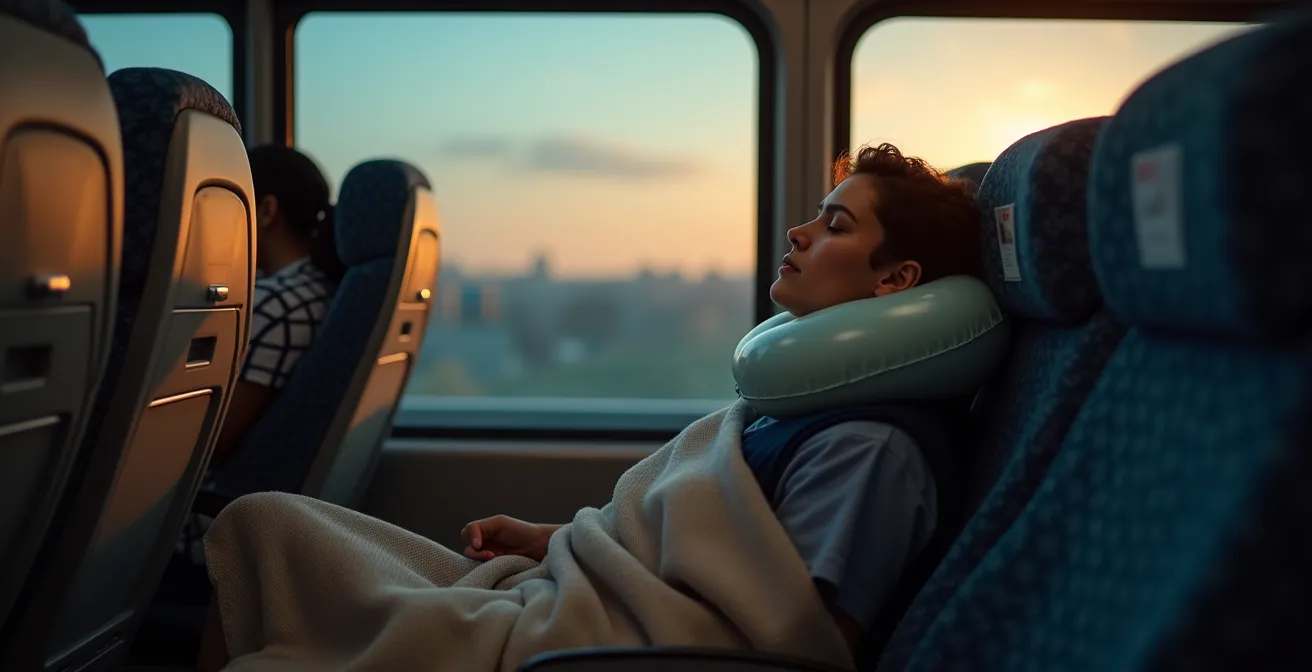
In summary:
- Surviving a long bus ride is less about gear and more about a proactive strategy of managing your personal environment.
- Mastering your “personal bubble” through seat choice and temperature control is the first step toward rest.
- A robust power and food strategy (“energy arbitrage”) prevents reliance on unreliable bus amenities and poor roadhouse food.
- A multi-layered security system for your belongings is non-negotiable for achieving peace of mind and actual sleep.
The low hum of the engine, the endless ribbon of highway stretching into the dark, and the creeping realization that you have another 18 hours to go. For any budget backpacker, the 24-hour bus journey is a rite of passage, a test of endurance exchanged for a hefty saving. Well-meaning advice often centers on buying the right gear: a U-shaped neck pillow, a silk eye mask, noise-canceling headphones. While helpful, these are merely tools. They don’t address the fundamental challenge of turning a public, moving, and unpredictable space into a place of rest.
The truth veteran travelers know is that comfort on a long-haul bus isn’t found, it’s created. It’s an active, strategic process. Relying solely on a pillow is like bringing a bucket to a house fire; it misses the scale of the problem. You’re battling fluctuating temperatures, unreliable power sources, questionable food stops, and the low-grade anxiety of keeping your valuables safe while you doze off. True survival—and the coveted prize of actual sleep—comes from a different mindset.
This guide isn’t about what to pack. It’s about how to think. We’ll introduce the concept of ‘Controlled Discomfort’—a system for proactively managing your environment, energy, and security. Instead of passively enduring the ride, you’ll learn to assert control over your personal space, turning a test of endurance into a manageable, even restful, state. We will deconstruct the journey into its core challenges and provide actionable strategies for each, transforming you from a passenger into the master of your domain.
This article will walk you through the essential strategies, from selecting the optimal seat to fortifying your belongings against theft, ensuring you arrive at your destination not just with your wallet intact, but your sanity too.
Summary: A Backpacker’s Blueprint for Conquering the 24-Hour Bus Ride
- Window vs Aisle: which seat offers better head support for sleeping?
- The air-con freeze: why you need a down jacket on a bus in the tropics?
- Power bank strategy: do bus USB ports actually work reliably?
- Roadhouse food: how to eat healthy when the bus only stops at fast food joints?
- Theft prevention: watching your bag when the bus stops for a break
- Flight vs Coach: is saving $200 worth the extra 12 hours of travel time?
- Domestic flights or rental car: the best choice for covering 1000km+
- Avoiding Driver Fatigue on the Nullarbor: The 2-Hour Rule
Window vs Aisle: which seat offers better head support for sleeping?
The first decision you make sets the tone for the next 24 hours: window or aisle? The common wisdom isn’t wrong, but it lacks nuance. The window seat is the undisputed champion for sleep stability. The ability to lean against the hard, vibrating wall provides a level of head support an aisle seat simply cannot match. For those who can only sleep upright with their head stabilized, the choice is clear, as sleep experts recommend window seats for better rest due to the solid surface they provide for support.
However, this stability comes at a cost: confinement. You are at the mercy of your neighbor’s bladder and their desire to stretch. The aisle seat, while offering inferior head support, grants you freedom. You control your access to the aisle for bathroom breaks or a quick leg stretch, which can be crucial for comfort and preventing stiffness. This choice is a classic trade-off within our Controlled Discomfort framework. Do you prioritize sleep stability (window) or freedom of movement and quick exits (aisle)? If you’re someone who needs frequent breaks or worries about deep vein thrombosis (DVT), the aisle might be the more strategic long-term choice, even if it means a more creative sleeping posture.
Beyond the simple binary, consider location. Avoid the very back rows at all costs; you’ll feel every bump and be plagued by bathroom-related traffic and odors. The sweet spot is often in the middle of the bus, away from the engine noise at the back and the conversational chatter that often congregates near the driver. This minimizes both vibration and noise, helping you build a more stable personal bubble.
The air-con freeze: why you need a down jacket on a bus in the tropics?
One of the great paradoxes of bus travel is the inverse relationship between the outside temperature and the inside climate. The hotter it is outside, the more likely the bus driver is to crank the air conditioning to sub-arctic levels. This isn’t an exaggeration; many long-haul buses, especially in tropical regions, have sealed windows and an AC system that seems to have only two settings: ‘On’ and ‘Antarctica’. This creates a significant challenge for maintaining a stable body temperature, which is essential for sleep.
I don’t know exactly why, but drivers always set the AC to extremely cold temperatures. So pack a blanket, because you will need it. Even bravest people, those who are not afraid of cold weather, tend to get cold in long bus rides.
– Maps & Words
This is where the strategy of layering becomes paramount. Your attire isn’t just about comfort; it’s your personal climate control system. A lightweight, packable down jacket is a backpacker’s best friend. It provides an incredible amount of insulation for its weight and can be compressed into a small stuff sack, doubling as a surprisingly effective pillow. Combine this with other layers: a base layer (like a t-shirt), a long-sleeved shirt, and your jacket. This allows you to add or remove layers to fine-tune your temperature, effectively creating a personal microclimate within your seat.

Don’t forget your extremities. A pair of warm socks and a beanie or hood can make a dramatic difference, as you lose a significant amount of body heat through your feet and head. By treating your clothing as a dynamic system rather than a static outfit, you can counteract the bus’s unpredictable temperature swings and maintain the thermal stability needed to drift off.
Power bank strategy: do bus USB ports actually work reliably?
In the digital age, your phone is your map, your library, your connection to the world, and your primary defense against boredom. Letting it die halfway through a 24-hour journey is not an option. This brings us to a critical aspect of resource management: Energy Arbitrage. While many modern buses advertise onboard outlets or USB ports, a veteran traveler knows to treat them with deep suspicion. They are notoriously unreliable—often broken, underpowered, or occupied for the entire trip.
The only power source you can truly count on is the one you bring yourself. A high-capacity power bank is not a luxury; it’s an essential piece of survival equipment. For a 24-hour journey where you might need to recharge your phone two or three times, a capacity of at least 20,000 mAh is recommended. As one travel resource points out, a capacity of 20,100 mAh is the gold standard for ensuring you have more than enough juice for the long haul. This allows you to remain completely independent of the bus’s faulty infrastructure.
Beyond just bringing a battery, you need a smart power management plan. Your goal is to maximize your device’s battery life. Simple actions like enabling airplane mode when you don’t need a signal, reducing screen brightness, and pre-downloading all your music, podcasts, and movies will drastically reduce power consumption. This proactive approach ensures your personal power reserve lasts the entire journey.
Your action plan: Smart Device Power Management
- Calculate Your Needs: Before you leave, multiply your phone’s battery capacity (in mAh) by the number of full recharges you anticipate needing. This gives you a target for your power bank.
- Defend Your Data: If you must use a public USB port, use a “USB data blocker.” This small device prevents any data transfer, protecting you from potential “juice jacking” malware.
- Conserve Aggressively: Enable airplane mode and turn on your phone’s low power mode. Pre-downloading media is far more efficient than streaming it.
- Seize Opportunities: During rest stops, make finding a wall outlet a priority. A quick 15-minute charge can provide a crucial buffer.
- Stay Organized: Keep your power bank and charging cable in an easily accessible pocket of your daypack, not buried in your main luggage.
Roadhouse food: how to eat healthy when the bus only stops at fast food joints?
The bus pulls into a brightly lit service station in the middle of nowhere. You have 20 minutes. Your options are a greasy burger, a sad-looking hot dog, or a bag of chips. This is the grim reality of roadhouse dining. Relying on bus stops for sustenance is a recipe for a stomach ache and a sugar crash, neither of which is conducive to sleep. This is where the ‘Energy Arbitrage’ concept extends to nutrition. You must become a self-sufficient provider.
Packing your own food is the single most effective strategy for eating well on a long bus ride. The key is to choose items that are non-perishable, mess-free, and energy-dense. Think like a hiker. Trail mix (nuts, seeds, dried fruit), granola or protein bars, and hard fruits like apples are excellent choices. They provide sustained energy without the spike and crash of sugary snacks. A simple sandwich with a non-perishable filling can feel like a gourmet meal after 12 hours on the road.
Hydration is equally critical, but it requires a delicate balance. While you need to stay hydrated, you also don’t want to be waking your neighbor every hour for a bathroom break. The solution is to sip water consistently throughout the day rather than chugging large amounts at once. A reusable water bottle is essential. Avoid diuretics like coffee and sugary sodas, which will only increase your need for bathroom visits and disrupt your sleep cycle. By curating your own menu, you take control of your energy levels and digestive comfort, crucial components of surviving the journey.
Theft prevention: watching your bag when the bus stops for a break
It’s impossible to achieve deep, restful sleep if a part of your brain is constantly worried about your belongings. Petty theft is an unfortunate reality of budget travel, with sleeping passengers and unsupervised bags being prime targets. Therefore, a robust security system is not about paranoia; it’s about creating the peace of mind necessary for rest. Your goal is to make yourself a “hard target” that opportunistic thieves will simply bypass for an easier one.
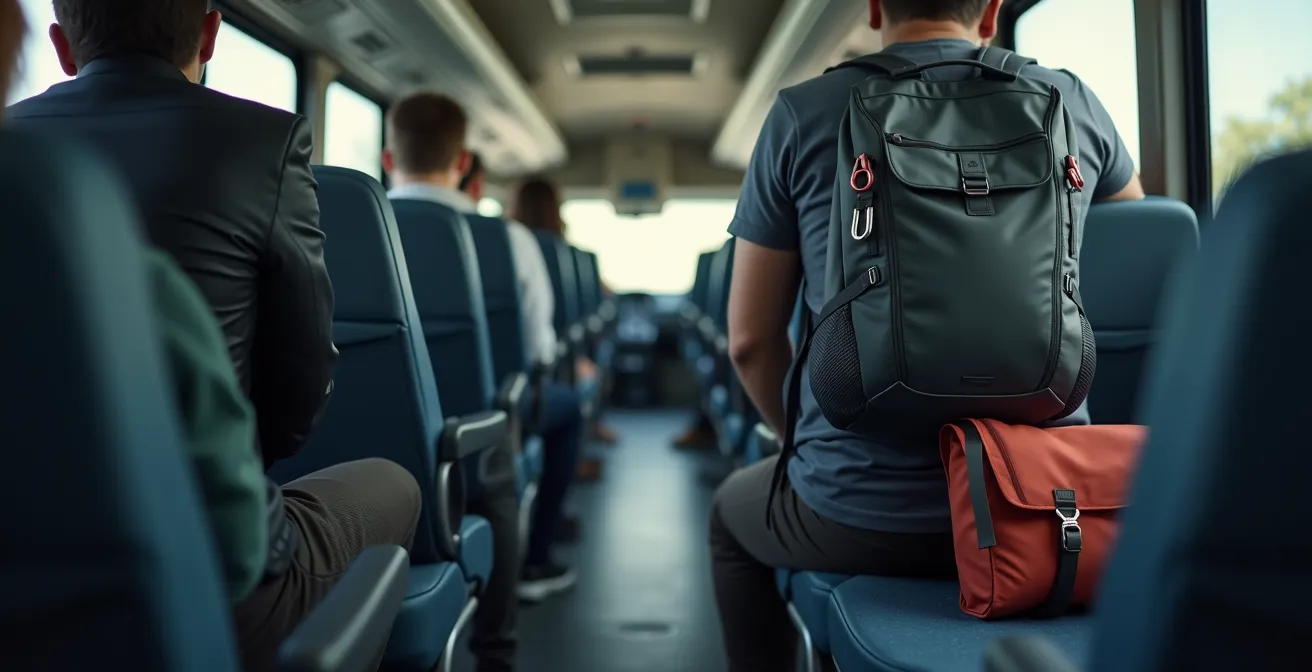
Your security strategy should be multi-layered. First, your main backpack stored in the luggage hold should be locked with a sturdy padlock. This deters casual rummaging. Second, and most importantly, is the management of your daypack containing all your valuables: passport, cash, cards, and electronics. This bag should never leave your person. When sleeping, wear it on your front. This might feel awkward at first, but it keeps your most critical items physically attached to you.
Something we came across a lot in South East Asia was backpackers getting money and possessions lifted from their bags as they slept! … When I’m sleeping, I always wear my daypack on my front and sort of crawl up into a ball.
– Third Eye Traveller
A third layer involves physically securing your bag to the bus. A simple carabiner clip can be used to attach a strap from your bag to the seat frame or even to your belt loop. It’s a small but effective deterrent. Finally, never leave valuables on the bus during a rest stop, no matter how short. Take your daypack with you every single time you disembark. This constant state of situational awareness isn’t stressful; it’s a simple, repeatable habit that becomes second nature and ultimately allows your mind to relax enough to sleep.
Flight vs Coach: is saving $200 worth the extra 12 hours of travel time?
For any backpacker planning a long-distance leg, the fundamental question arises: is the significant cost saving of a bus worth the immense time commitment compared to a flight? A $200 saving is substantial, often equivalent to several days of accommodation and food. However, it comes at the cost of 12 or more hours of your life spent in transit. This isn’t just a financial decision; it’s a value judgment on your time and comfort.
A direct comparison reveals the stark trade-offs. The bus offers a dramatically lower entry price and often has no extra fees for luggage. A flight, on the other hand, starts with a high base fare that is then inflated by baggage fees and the cost of getting to and from airports, which are typically located far from city centers. While the flight itself is quick, the total time investment including airport transit, security, and boarding can easily reach 3-4 hours. The bus journey is long, but it’s a single, continuous block of time.
The following table breaks down the typical costs and time investments, which is confirmed by a recent comparative analysis.
| Factor | Overnight Bus | Domestic Flight |
|---|---|---|
| Base Ticket Price | $50-80 | $250-300 |
| Additional Costs | Food: $15-25 None for baggage |
Baggage: $30-60 Airport transfer: $20-40 |
| Time Investment | 12-15 hours | 3-4 hours total |
| Comfort Level | Reclining seats, limited space | Standard seats, faster journey |
| Environmental Impact | Lower carbon footprint per passenger | Higher emissions per passenger |
The choice ultimately depends on your travel philosophy and budget. If money is the primary constraint and you view the journey as part of the adventure, the bus is the clear winner. The growing popularity of this mode of transport, with market research showing the intercity coach segment witnessing robust growth, indicates that many travelers are making this exact calculation and opting for the road. The key is to go in with a strategy, using the techniques in this guide to make the journey not just bearable, but a productive part of your trip.
Domestic flights or rental car: the best choice for covering 1000km+
When faced with traversing a vast distance of over 1000 kilometers, the choice often broadens beyond just the bus. Domestic flights and rental cars present themselves as viable, albeit very different, alternatives. Each option offers a unique blend of speed, cost, freedom, and experience, and the “best” choice is entirely dependent on the traveler’s priorities. The bus, as we’ve established, is the king of low-cost, point-to-point travel, a fact underscored by projections that the global long-distance bus sector will reach 540 million users by 2027.
A domestic flight is the champion of speed. It reduces a 15-hour land journey to a mere couple of hours in the air. For travelers on a tight schedule or those who simply cannot tolerate long periods of sitting, the high cost is a justifiable expense for the time saved. It’s an efficient but often sterile experience, whisking you over the landscape rather than through it. You trade the journey for the destination.
A rental car, conversely, is the champion of freedom. It is almost always the most expensive option when factoring in fuel, insurance, and the rental fee itself. However, it offers unparalleled autonomy. You can stop wherever you want, for as long as you want. You can explore hidden gems, take scenic detours, and travel on your own schedule. For travelers who see the journey *as* the destination, a rental car transforms transit into a road trip. The bus occupies a strategic middle ground—offering a ground-level view of the country like a car, but at a price point that values budget over freedom.
Key Takeaways
- Proactive Strategy Over Passive Comfort: Don’t just pack a pillow; develop a system for managing your space, temperature, power, and security.
- Master Your Microclimate: Use layers of clothing (especially a down jacket) to create a personal temperature bubble against the bus’s freezing AC.
- Become Power-Independent: Never rely on bus outlets. A 20,000+ mAh power bank is essential for a 24-hour journey.
Avoiding Driver Fatigue on the Nullarbor: The 2-Hour Rule
In Australia, there’s a famous safety principle for drivers crossing the vast, hypnotic Nullarbor Plain: the “2-Hour Rule.” It dictates that you must stop and rest for at least 15 minutes every two hours to combat fatigue. While this rule is for the person behind the wheel, it holds a powerful lesson for the passenger. What is the equivalent rule for surviving the mental and physical exhaustion of a 24-hour bus ride? The answer lies in avoiding ‘passenger fatigue’ by actively managing your body and senses.
Your body wasn’t designed to be folded into a seat for 24 hours. The risk of stiffness, cramps, and even blood clots is real. The passenger’s “2-Hour Rule” should be to move meaningfully at every opportunity. Every two hours, or whenever the bus stops, make it a priority to get out, walk around, and stretch. Even when you’re confined to your seat, you can perform a simple routine: rotate your ankles, flex and point your feet, roll your shoulders, and gently stretch your neck. This small but consistent effort keeps blood circulating and prevents your body from seizing up.
The other component of passenger fatigue is sensory overload, or what I call ‘Time Dilation’—the feeling of time becoming abstract and blurry. The constant motion, engine noise, and flickering lights can be draining.
Time has taken on a sort of abstract quality, as has the landscape. Road signs, trees and buildings blur together into strands of color and my mind enters in on itself, daydreaming its way through past conversations and future scenarios.
– Adventure.com
You must actively manage your sensory input. Use an eye mask and earplugs or noise-canceling headphones to create a cocoon of darkness and quiet. This gives your brain a chance to disengage and rest, even if you’re not fully asleep. By breaking the journey into two-hour blocks of conscious management—moving your body and controlling your senses—you can fight off the crushing fatigue and arrive feeling human.
Your next long-haul bus journey doesn’t have to be a nightmare of sleep deprivation and discomfort. By shifting from a passive passenger to a proactive strategist, you can transform the experience. Start building your ‘Controlled Discomfort’ system now and master the art of budget travel.