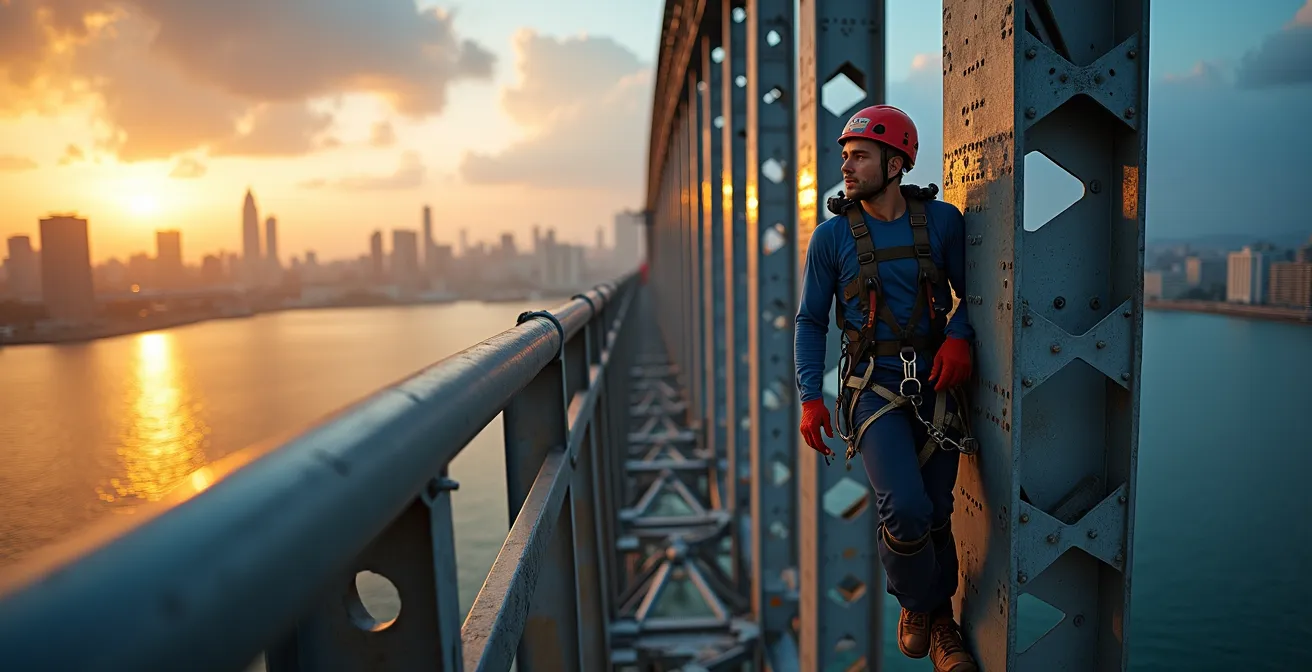
Overcoming vertigo on the Bridge Climb isn’t about sheer bravery; it’s about understanding the psychology of fear and using the climb’s own design as your toolkit.
- Your physical state (no alcohol, proper fitness) directly impacts your brain’s ability to handle height and maintain balance.
- The climb’s safety systems are not just for protection; they provide powerful sensory feedback that actively calms the brain’s fear response.
Recommendation: Start with a ground-level acclimatization plan and choose your climb time (e.g., Night vs. Twilight) as a strategic tool to control your visual exposure.
The confirmation email is in your inbox, the date is circled on your calendar, and a knot of anxiety is tightening in your stomach. You’ve booked the Sydney Bridge Climb, an iconic life achievement, but the exhilarating prospect is now overshadowed by a primal fear of heights. This feeling, often dismissed as simple vertigo, is a complex interplay between your body’s balance system and your brain’s threat-detection circuits. Many believe the only solution is to “be brave” or “just don’t look down”—advice that is as unhelpful as it is common. The anxiety you feel is not a sign of weakness; it’s a predictable physiological response.
The key isn’t to fight this feeling, but to manage it with strategy and understanding. What if the structure of the climb itself, from its rigorous safety protocols to the very steel under your feet, could be your greatest ally? This guide reframes the experience. We won’t focus on conquering fear through force of will. Instead, we will explore the climb as a perfectly controlled environment, designed to help you methodically retrain your brain’s relationship with heights. We’ll delve into the physiological preparation, the psychology of the safety systems, and the strategic choices you can make to turn a challenge you dread into a summit you’ll celebrate.
For those who prefer a visual taste of the experience, the following video offers a glimpse into the atmosphere and scale of the climb, setting the stage for the practical strategies we will discuss.
In this guide, we will break down the process into manageable steps. You will learn to prepare your body, understand the engineering of your safety, and make informed decisions that put you back in control. The following sections are designed to systematically build your confidence from the ground up.
Summary: A Strategic Approach to the Sydney Bridge Climb
- Why a 0.05% BAC limit is strictly enforced before the climb?
- 1332 steps: exercises to ensure your knees can handle the ascent
- Twilight vs Night: which climb offers the better view of the city lights?
- The latch system: why it is impossible to fall off the bridge?
- Sampler vs Summit: is the full climb worth the extra $100?
- Why Australian safety regulations for skydiving are among the strictest globally?
- Where to get the best Opera House photos without paying for a tour?
- Sydney on a Budget: How to Spend Less Than $100 a Day in the CBD?
Why a 0.05% BAC limit is strictly enforced before the climb?
The first step in managing vertigo is understanding that it begins with your internal physiology, not the external height. Your sense of balance is governed by the vestibular system in your inner ear, which works like a sensitive gyroscope. Alcohol, even in small amounts, directly interferes with this system, creating a sense of disorientation and dizziness even on solid ground. At 134 meters above the harbor, this effect is significantly amplified.
BridgeClimb’s zero-tolerance policy is not just a legal formality; it’s a critical component of your psychological toolkit. By ensuring every climber is clear-headed, the organization removes a major variable that can trigger or worsen vertigo. This is why safety protocols strictly enforce a 0.05% BAC maximum limit, with mandatory breathalyzer tests for every participant. This isn’t about punishment; it’s about setting you up for success. Knowing that your own body is in an optimal state to perceive balance correctly is the foundational layer of confidence.
Beyond alcohol, other substances can also heighten anxiety. Caffeine can increase your heart rate and trigger feelings of panic, while heavy meals can lead to nausea. The goal is to arrive at the base with your body in a calm, neutral state, ready to provide your brain with the most accurate sensory information possible. Think of it as calibrating your personal equipment before stepping onto the bridge.
1332 steps: exercises to ensure your knees can handle the ascent
While vertigo is a mental and sensory challenge, physical preparedness plays a crucial role in your psychological well-being on the bridge. The climb involves 1,332 steps and navigating steep ladders; it is a test of endurance as much as courage. When your body is fatigued—when your knees ache or your legs feel unsteady—your brain is more likely to interpret these physical signals as danger, heightening your sense of anxiety and instability.
Conversely, arriving with a body that feels strong and capable provides a powerful source of proprioceptive feedback. This is your brain’s sense of its own position and movement. Strong, stable leg muscles send clear signals to your brain that you are secure and in control, actively counteracting the disorienting visual input of the height. Building this physical confidence is a non-negotiable part of your mental preparation. It’s about ensuring your body doesn’t become another source of anxiety.
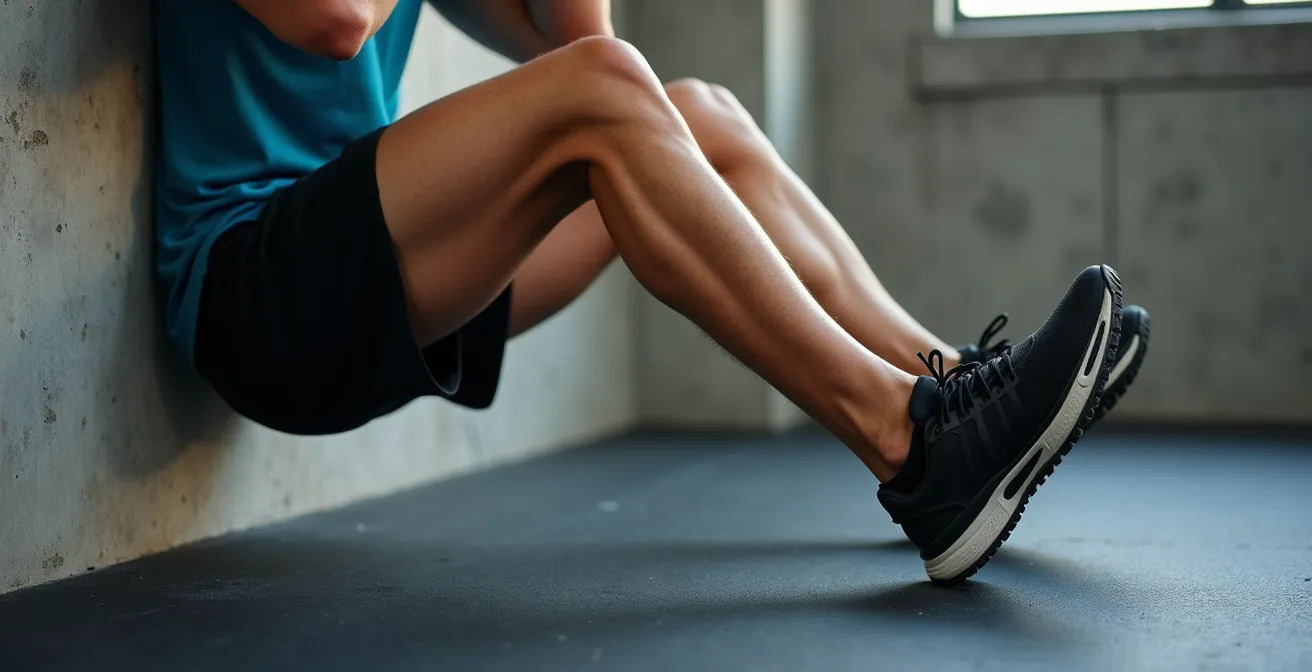
A structured training program focused on leg strength and stair-climbing endurance can make a significant difference. Strengthening your quadriceps, calves, and stabilizing muscles gives you the physical resilience to handle the ascent without distress. This allows your mind to focus on managing the psychological aspects of the climb, rather than being distracted by physical discomfort. Every step you take in preparation on the ground builds the mental fortitude you’ll need in the air.
Your 4-Week Bridge-Ready Training Program
- Weeks 1-2: Begin with 20-minute stair climbing sessions, three times per week, to build foundational cardio and leg endurance.
- Weeks 2-3: Incorporate wall sits (holding for 45-60 seconds, 3 sets) to significantly boost quadriceps strength for the inclines.
- Weeks 3-4: Add step-downs from a small step or curb (3 sets of 15 per leg) to train the eccentric muscles used during descent.
- Daily Practice: Perform calf raises (3 sets of 20) to enhance stability, which is crucial for the narrow steps on the bridge’s arch.
- Final Week: Test your progress by climbing a flight of 400 or more stairs continuously to simulate a portion of the climb and build confidence.
Twilight vs Night: which climb offers the better view of the city lights?
One of the most powerful tools you have for managing vertigo is the ability to strategically control your sensory input. The time of day you choose to climb is not just an aesthetic choice; it’s a tactical decision that directly impacts the visual triggers for your fear of heights. For those with acrophobia, the Night Climb often serves as a more manageable experience.
During the day or at twilight, the full scale of the height is visible. Your brain can clearly perceive the distance to the ground and water below, which can be overwhelming. At night, the darkness acts as a natural filter. The vast, open space is obscured, and your focus is drawn to the brilliant constellation of city lights. This creates specific, manageable points for sensory anchoring. Instead of an abyss, you see a beautiful, patterned landscape. Your brain has something concrete to lock onto, which helps override the disorienting signals of vertigo.
Case Study: The Strategic Advantage of the Night Climb
A climber with severe height anxiety reported successfully completing the Night Climb after a previous daytime attempt was cut short by a panic attack. They noted that the darkness was instrumental in reducing overwhelming visual triggers. The city lights provided beautiful, non-threatening focal points that grounded their experience. According to climb guides, this is a common strategy, with an estimated 30% of anxious climbers specifically choosing night sessions for the benefit of reduced visual exposure.
The choice between a Twilight and Night climb becomes a calculated trade-off. Twilight offers the breathtaking transition from day to night, but at the cost of maximum visual exposure during the sunset phase. The Night Climb provides a less intimidating visual field from the start. This comparison allows you to make an informed decision based on your personal anxiety level.
| Aspect | Twilight Climb | Night Climb |
|---|---|---|
| Visual Exposure Level | Maximum – full depth perception | Reduced – darkness obscures ground |
| Sensory Anchoring | Sunset horizon as visual anchor | City lights provide focal points |
| Fear Rating (1-10) | 7/10 for acrophobics | 5/10 for acrophobics |
| Price Range | $373 AUD peak | $348 AUD average |
| Duration | 3 hours (includes sunset transition) | 3 hours standard |
The latch system: why it is impossible to fall off the bridge?
The single most powerful tool for cognitive reframing on the Bridge Climb is a deep understanding of the latch system. The fear of falling is rooted in a lack of trust—in yourself and your environment. The engineering of the climb is designed to make that trust absolute and non-negotiable. You are not simply tethered by a rope; you are physically integrated into the bridge’s structure.
From the moment you leave the preparation area, a slider on your harness is locked onto a solid steel safety rail that runs the entire length of the climb. This system is not a passive safety net; it’s an active guide. It is physically impossible for you to detach from this rail until you are safely back at the base. The statistics are a testament to this flawless design: the bridge’s safety system has maintained zero falls in over 4 million climbs since its inception in 1998. This isn’t luck; it’s a result of uncompromising engineering.
This physical connection provides immense psychological relief. As one instructor explains, the system provides a level of security that transcends typical safety equipment.
The harness slider is attached to a solid steel rail and is rated to hold the weight of a small car. Think of it less like a rope and more like being a train car on its track – you literally cannot detach until back at base.
– BridgeClimb Safety Instructor, BridgeClimb Safety Briefing Documentation
This analogy is key to system trust. By visualizing yourself as part of a fixed mechanical system, you offload the responsibility for your safety from your own anxious mind to the proven, unyielding strength of steel. Your role is simply to walk; the bridge does the rest.
Sampler vs Summit: is the full climb worth the extra $100?
For those feeling particularly apprehensive, the choice between the full “Summit” climb and the shorter “Summit Insider” (often called a sampler) is another strategic decision point. It’s tempting to view the shorter option as a compromise, but it’s more productive to see it as a tool for graduated exposure—a core principle of treating anxiety and phobias.
The Summit Insider climb still takes you to the very top of the bridge, delivering the same iconic 360-degree view. However, it does so via a more direct route on the inner arch, avoiding the four sets of vertical ladders and reducing the total time and number of steps. For someone with a high level of anxiety (e.g., a 7/10 or higher), this shorter duration can be the difference between a manageable challenge and an overwhelming ordeal. It allows you to experience the summit without having to endure a prolonged period of high anxiety.
The goal is a successful and positive experience. Choosing the Sampler is not admitting defeat; it is making a smart, calculated choice to match the level of challenge to your current comfort level. It prioritizes a feeling of achievement over endurance.
| Factor | Summit (Full) | Summit Insider (Sampler) |
|---|---|---|
| Duration | 3 hours | 2.5 hours |
| Steps | 1,332 steps | 1,002 steps |
| Ladders | 4 vertical ladders up/down | No ladders required |
| Fear Commitment | Longer exposure time | Quicker turnaround option |
| Achievement Level | Maximum bragging rights | Still reaches summit |
| Best For Fear Level | 4-6/10 anxiety | 7-10/10 anxiety |
Case Study: Using the Sampler as a Stepping Stone
An internal analysis of repeat climbers reveals a fascinating trend. Approximately 40% of climbers who first choose the shorter Summit Insider option return within a year to complete the full Summit climb, often taking advantage of a returning climber discount. This “graduated exposure” approach allows them to build confidence on the first climb, transforming the initial investment in the Sampler into a strategic stepping stone for a future, more ambitious goal, rather than a final compromise.
Why Australian safety regulations for skydiving are among the strictest globally?
The profound sense of security you feel on the Bridge Climb is not an accident. It is the direct result of a deeply ingrained national safety culture that permeates Australia’s entire adventure tourism industry. This culture of “redundancy and rigor” sets a global benchmark for safety, providing a psychological safety net that is just as important as the physical one you’re latched into.
When you embark on the climb, you are entrusting your well-being not just to one company, but to an entire regulatory framework. These standards are famously stringent, often cited in the same breath as those governing aviation and skydiving. In fact, international safety assessments consistently place Australia in the top 3 globally for adventure tourism safety standards. This means that every piece of equipment, every guide’s training, and every operational procedure has been scrutinized and optimized for worst-case scenarios.
This commitment is articulated by the very bodies that enforce these rules, highlighting a philosophy of overlapping safety measures.
The same rigorous safety culture that governs Australian skydiving – with mandatory reserve systems and redundancy protocols – extends to every adventure tourism operation, including the BridgeClimb with its triple-redundant safety systems.
– Australian Adventure Tourism Safety Board, 2024 National Safety Standards Report
For an anxious climber, this knowledge is a powerful form of cognitive reframing. Your fear might tell you “what if something fails?”, but the evidence-based reality is that the system is designed with multiple layers of failure protection. You are placing your trust in a culture of excellence that is recognized and respected worldwide.
Where to get the best Opera House photos without paying for a tour?
While this question is often about photography, for an anxious climber, these free vantage points are the perfect training ground for graduated exposure. Before you even put on the harness, you can begin to acclimatize your brain to the sight and scale of the bridge, systematically reducing its intimidation factor. This pre-climb ritual is one of the most effective strategies for managing anticipatory anxiety.
The goal is to slowly and safely increase your exposure to the stimulus—the bridge itself. Starting from a comfortable distance and gradually moving closer allows your brain to process the structure without triggering a full-blown fear response. Each step of this plan lets you recalibrate your perception in a low-stakes environment where you are in complete control. You can stay as long as you like and leave whenever you want.
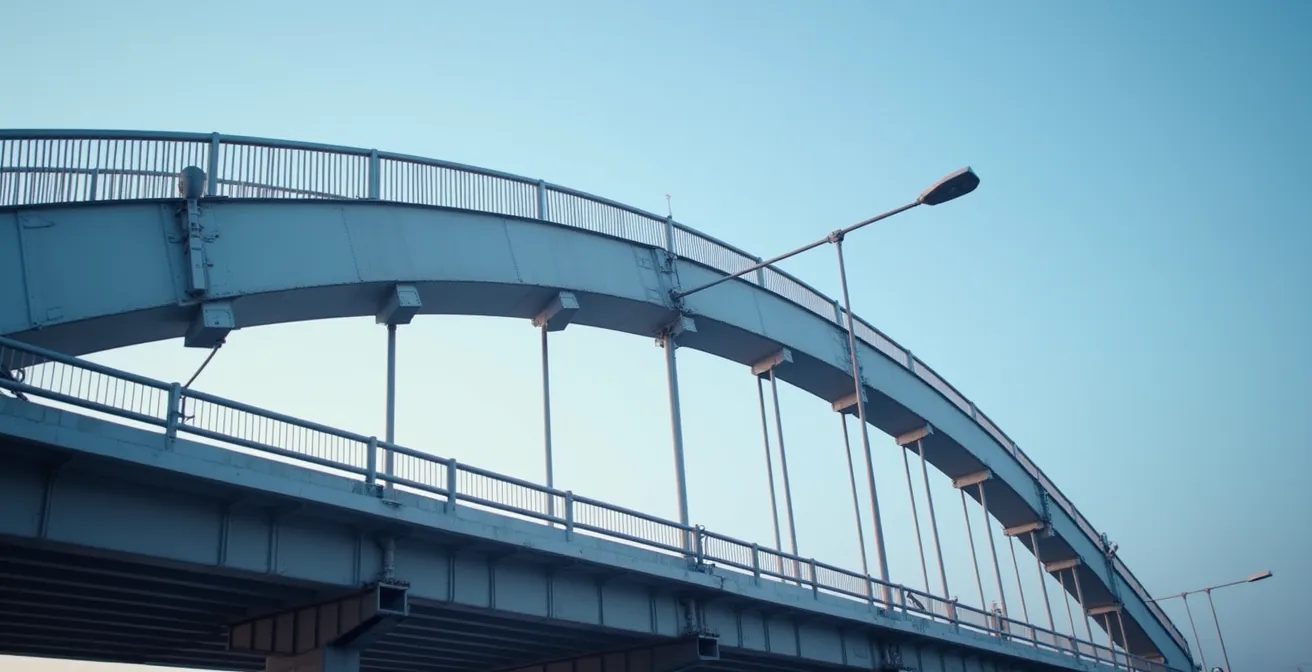
This process also helps in debunking visual myths. From certain ground-level perspectives, the bridge’s arch can appear terrifyingly steep. This is a common cognitive distortion.
Debunking the Myth of the Vertical Climb
A photographic analysis of the bridge reveals that the arch appears up to 40% steeper when viewed from the ground than it feels when you are actually climbing it. The real gradient is a surprisingly manageable incline, often compared to walking up stadium stairs, with numerous flat sections for rest. Photos from a distance can show an intimidating 50-degree angle, but climbers consistently report that the walkway feels closer to a 30-degree incline at its steepest points. Acclimatizing beforehand helps your brain understand this reality.
Your 5-Day Vertigo Acclimatization Plan
- Day 1: Distant View (Mrs Macquarie’s Chair): Start here to view the bridge from a safe, comfortable ground distance, allowing you to appreciate its scale without feeling threatened.
- Day 2: Closer Proximity (Circular Quay): Move to the bustling waterfront. Get comfortable seeing the bridge up close, with the distracting activity of ferries and people providing a sensory buffer.
- Day 3: Pedestrian Crossing: Walk across the free pedestrian pathway on the bridge’s eastern side. This is a major step: you are now *on* the structure, moving at your own pace, with the ability to stop or turn back at any time.
- Day 4: Elevated Perspective (Pylon Lookout): For a small fee, climb the Pylon Lookout. This gives you an elevated view without the full commitment and exposure of the climb, serving as a final dress rehearsal for your senses.
- Day 5: Climb Day: Arrive at the climb base feeling familiar, not intimidated. You have systematically shown your brain that the bridge is a safe and manageable environment.
Key Takeaways
- Vertigo is a manageable physiological response, not a personal failing; preparation is key.
- The climb’s safety systems (latch, guide, regulations) are designed to provide psychological reassurance through “System Trust.”
- Strategic choices like climb time (Night vs. Twilight) and duration (Sampler vs. Summit) are powerful tools to control your experience.
Sydney on a Budget: How to Spend Less Than $100 a Day in the CBD?
When you’re grappling with anxiety, the significant cost of the Bridge Climb can feel like an added pressure. It’s easy to frame it as a large sum of money for an experience you’re terrified of. However, the final step in our psychological preparation is to reframe the value of this investment. It is not just a tourist attraction; it is a structured, world-class program for overcoming a profound personal challenge.
When compared to other unique high-altitude experiences around the globe, the Bridge Climb offers remarkable value not just in height or duration, but in its comprehensive, guided nature. Unlike a brief helicopter tour or a more static observation deck, the climb is a three-hour journey of personal progression, guided by an expert trained in managing climber anxiety. You are paying for a meticulously crafted experience designed for personal achievement.
Viewing the cost in this context shifts the perspective from an expense to an investment in yourself—an investment in a lifelong memory of overcoming fear. It’s an opportunity to prove to yourself that you can manage anxiety and accomplish something extraordinary. When you stand at the summit, the monetary cost fades, replaced by an invaluable sense of accomplishment that will stay with you long after you’re back on solid ground.
| High-Altitude Experience | Location | Price (USD) | Duration | Height |
|---|---|---|---|---|
| Sydney BridgeClimb | Sydney | $190-260 | 3 hours | 134m |
| CN Tower EdgeWalk | Toronto | $195 | 1.5 hours | 116m |
| Helicopter Tour | Sydney | $250 | 20 minutes | Variable |
| Sky Tower SkyWalk | Auckland | $150 | 1 hour | 192m |
You now have the tools not just to endure the Sydney Bridge Climb, but to transform it. By preparing your body, understanding and trusting the safety systems, making strategic choices, and reframing your mindset, you are taking control of the experience. The summit is waiting, and you are more ready for it than you think.