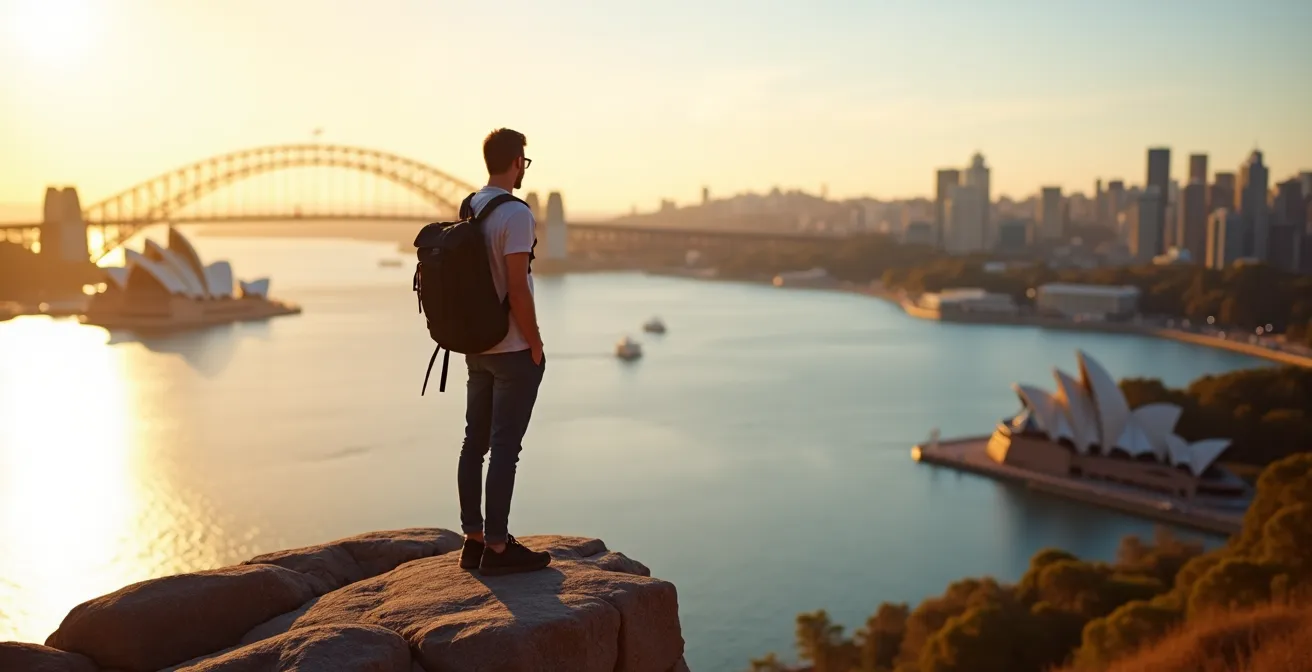
Think Sydney is too expensive for a budget trip? That’s the tourist trap. The secret to a sub-$100 day isn’t about sacrifice; it’s about gaming the system. This guide reveals how to leverage Sydney’s own transport caps, hidden food scenes, and free events like a local. It’s not about spending less, it’s about spending smarter to unlock the city’s best experiences for a fraction of the cost.
The myth of Sydney as an impossibly expensive city haunts many a backpacker’s travel plans. Faced with stories of $20 cocktails and eye-watering hotel prices, the default advice is always the same: cook your own pasta, walk until your feet ache, and stick to the free parks. While sensible, this approach of scarcity misses the point. It treats Sydney as a city to be endured on a budget, not enjoyed. What if the city itself provided all the tools to experience it richly for less?
The real key to conquering Sydney’s CBD on a shoestring isn’t about what you give up, but about the systems you choose to master. This city, for all its gloss, is riddled with loopholes and local hacks that savvy residents use every day. From a public transport network that rewards heavy users to a fine-dining food scene hidden in plain sight within bustling food courts, the opportunities are abundant for those willing to look beyond the obvious tourist trails.
This guide abandons the narrative of sacrifice. Instead, we’ll adopt the mindset of a frugal urban explorer, learning to “game” the system. We will explore how to leverage transport fare caps for epic day trips, find the perfect photo of the Opera House without paying a cent for a tour, and decide which trendy suburb offers the best “value arbitrage” for your stay. It’s time to stop just surviving Sydney and start outsmarting it.
This article will provide a clear roadmap to achieving that goal. Follow along as we break down the essential strategies for transport, food, sightseeing, and accommodation that will keep your daily spending well under the $100 mark.
Summary : A Savvy Traveler’s Guide to Conquering Sydney on a Budget
- Opal Card caps: how to travel anywhere on Sundays for a fixed low price?
- Where to get the best Opera House photos without paying for a tour?
- Food courts vs cafes: finding high-quality Asian food for under $15
- Vivid Sydney and beyond: navigating free festivals throughout the year
- Surry Hills or Newtown: which suburb offers better value for budget stays?
- Sampler vs Summit: is the full climb worth the extra $100?
- Sydney trains vs Melbourne trams: which network has fewer gaps and steps?
- Melbourne vs Sydney: Which City Fits Your Creative Style Better?
Opal Card caps: how to travel anywhere on Sundays for a fixed low price?
The single most powerful tool in your Sydney budget arsenal is the Opal card. While tourists fumble with single-trip tickets, the savvy traveler understands the system’s built-in rewards, the most glorious of which is the Sunday cap. This isn’t just a discount; it’s a golden ticket to explore the vastness of the Greater Sydney region for pocket change. On Sundays, the system is designed to be maxed out.
The magic number is the Sunday daily cap. Transport for NSW confirms there’s a $9.65 daily cap for Sunday travel on the Opal network. This means that after you spend this amount, every subsequent trip you take on a train, bus, ferry, or light rail is effectively free for the rest of the day. This simple rule transforms your Sunday from a day of rest into a day of epic, low-cost adventure.
Think about the possibilities this unlocks. You can start your day with a ferry ride from Circular Quay to Manly (a trip that normally costs close to the cap amount on its own), spend the afternoon exploring the Blue Mountains by train, and still have it all fall under one tiny flat fee. A ferry trip alone offers million-dollar views of the Harbour Bridge and Opera House. The Sunday Opal cap is the ultimate system-gaming hack, turning the city’s most expensive transport (ferries) into its best-value sightseeing tour.
To make the most of it, plan your longest and most expensive journeys for a Sunday. A trip to a far-flung beach, a visit to a distant national park, or simply a long, scenic ferry joyride become not just possible but practically mandatory for the budget-conscious explorer. This isn’t about saving a few cents; it’s about unlocking a $100+ day of exploration for less than $10.
By mastering this one rule, you’ve already fundamentally changed the economics of your Sydney visit.
Where to get the best Opera House photos without paying for a tour?
Paying for a tour to get a good photo of the Sydney Opera House is a classic tourist mistake. The city’s geography offers a multitude of world-class vantage points for free, you just need to know where and when to go. Getting that iconic shot is a matter of strategy, not spending. It requires an early alarm, a bit of walking, and an understanding of the sun’s path.
The best views are often from across the water or from elevated positions. Places like Mrs Macquarie’s Chair offer the postcard-perfect composition of both the Opera House and the Harbour Bridge, especially during the “golden hour” just after sunrise or before sunset. The key is to see the harbour as a natural amphitheater, with the main attractions on stage and free “seating” all around.
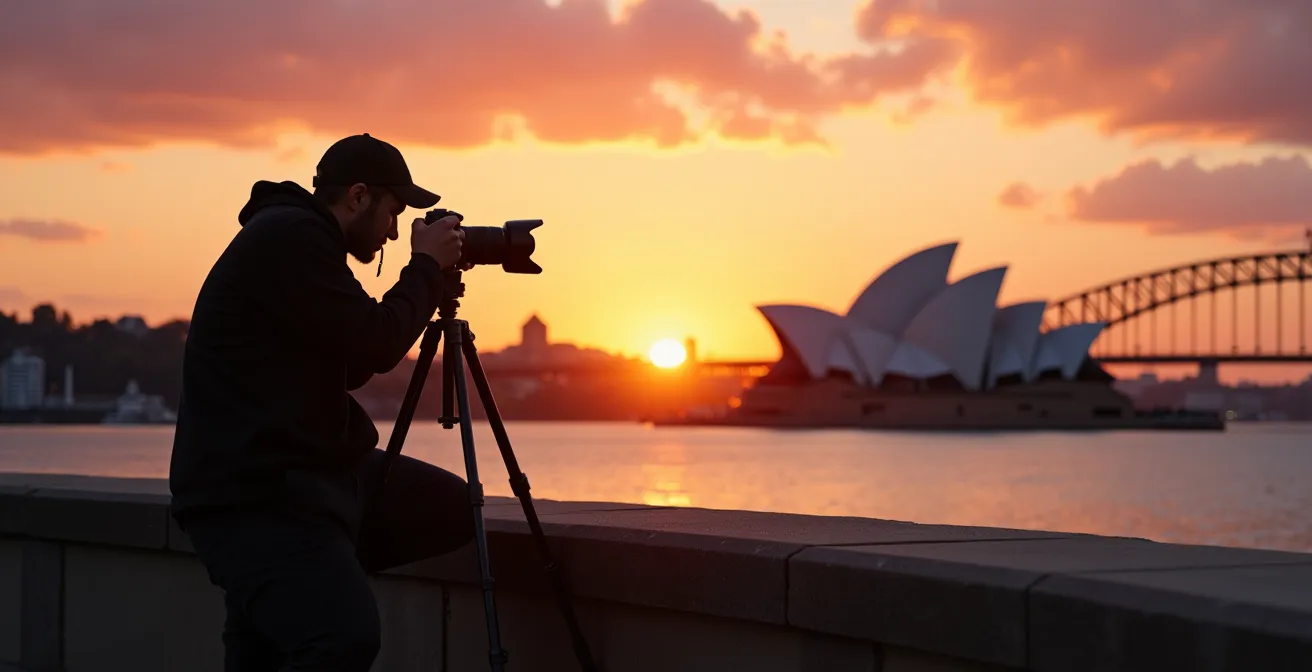
This image captures the essence of the free photo mission: dedication and positioning trump a paid ticket every time. Other prime locations include the pedestrian walkway on the Cahill Expressway for a unique top-down perspective, or from the ferry itself (using your Sunday-capped Opal card, of course). For a classic head-on shot, Milsons Point on the north shore frames the Opera House perfectly under the arch of the Harbour Bridge.
The Perfect Free Photo Day
A local photographer shared their tested schedule for capturing the Opera House in its best light. The day starts at 5:30 AM at Milsons Point to catch the structure silhouetted against the pink dawn sky. By midday, a walk along the Cahill Expressway pedestrian path provides unique aerial perspectives in the harsh-but-interesting noon light. The afternoon involves setting up at Mrs Macquarie’s Chair around 4 PM to capture the iconic golden hour light on the sails. The day concludes at 6 PM at Hickson Road Reserve, capturing the “blue hour” as the city lights begin to sparkle behind the icon.
This schedule demonstrates that capturing the Opera House isn’t a single event but a process. By treating it as a photographic scavenger hunt, you not only get a diverse range of incredible, professional-looking photos for free but also experience the city’s stunning harbour from multiple angles throughout the day.
Your Instagram feed will thank you, and your wallet will remain untouched.
Food courts vs cafes: finding high-quality Asian food for under $15
In Sydney’s CBD, the line between a quick, cheap meal and a genuinely delicious one is often found by heading downstairs or upstairs, away from street-level cafes. While a standard cafe lunch can easily push $25, the city’s network of bustling Asian food courts offers a superior culinary experience for under $15. This isn’t about settling for fast food; it’s about tapping into a parallel dining universe where authenticity and value reign supreme.
Forget the greasy, generic offerings you might associate with the term “food court.” In Sydney, places like Regent Place, Hunter Connection, or the basement of The Galeries are culinary destinations. Here you’ll find specialists who have perfected a single dish over decades, from fragrant bowls of laksa to hand-pulled noodles and perfectly crisp Hainanese chicken rice. The rent is cheaper off the main drag, and those savings are passed directly to you in the form of high-quality ingredients and low prices.
The key is learning to spot the gems among the myriad of options. A long queue of office workers at lunchtime is the most reliable indicator of quality. Another is a menu that proudly features its native language alongside English. These are not tourist traps; they are a vital part of the city’s daily life, providing fuel for its workforce. For the budget traveler, they are a gateway to authentic flavors that would cost three times as much in a formal restaurant setting.
Don’t be afraid of the chaotic atmosphere. The noise and bustle are part of the experience. Find a picture on the menu, point, and prepare for a meal that satisfies both your hunger and your budget. This is the ultimate food hack: eating better food for less money, simply by changing your elevation.
Your Authenticity Checklist: How to Spot a Genuine Cheap Eat
- Menu Language: Check if the menu has dishes written in the native language alongside English.
- Local Queues: Look for long queues of local office workers during lunch hours (12 PM – 2 PM).
- Hidden Location: Find restaurants located down alleys or on upper floors, not prime street level.
- Signage: Avoid places with flashy, English-only signage or generic tourist menu photos.
- Staff Communication: Notice if the staff are speaking the cuisine’s native language among themselves.
This approach allows you to eat like a king on a pauper’s budget, turning a daily necessity into a culinary adventure.
Vivid Sydney and beyond: navigating free festivals throughout the year
One of Sydney’s most incredible and often overlooked budget advantages is its relentless calendar of world-class free events. While Vivid Sydney is the most famous, the city’s commitment to public festivals provides a year-round source of free, high-quality entertainment. Tapping into this calendar is a cornerstone of the sub-$100-a-day strategy, offering unforgettable nights out for the cost of a train fare.
Vivid Sydney, held annually in May and June, is the crown jewel. It transforms the city into a vast outdoor art gallery with light installations, projections, and music performances. The scale is immense, and according to the NSW Government’s official announcements, 75% of Vivid’s massive program is completely free to the public. You can spend several nights exploring the light walk from Circular Quay to Darling Harbour without spending a single dollar on admission.
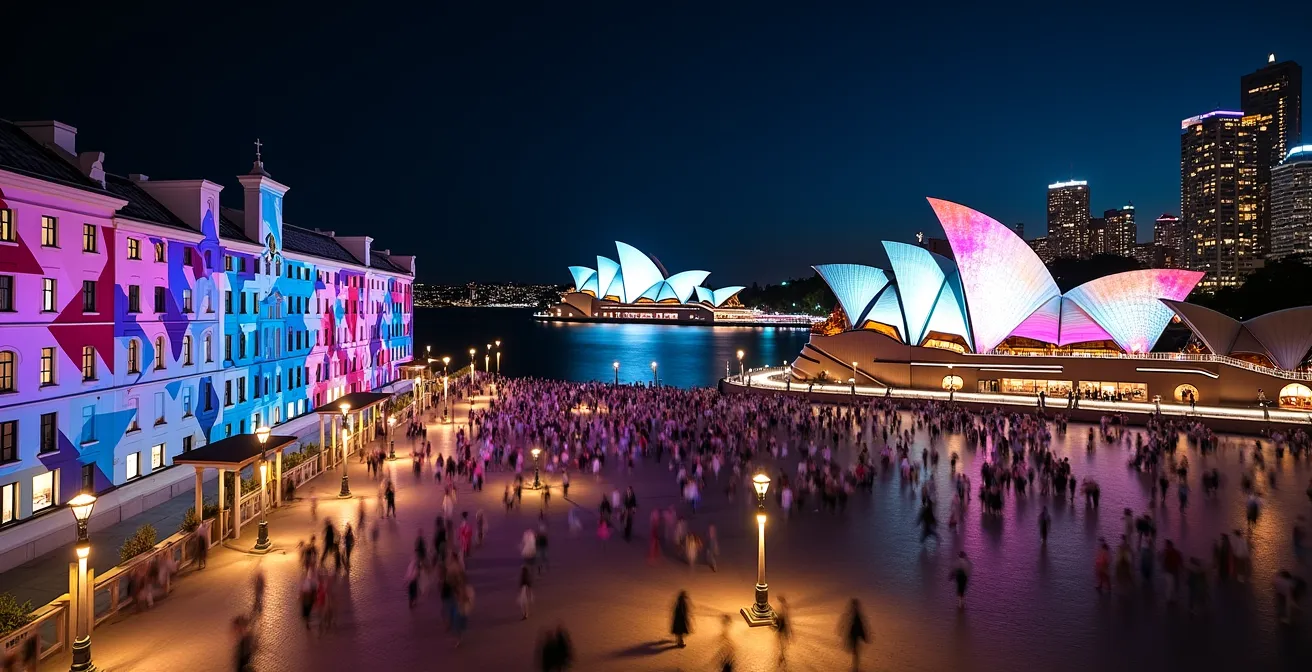
The key to enjoying these massive events is to go with a plan. For Vivid, this means starting early in the evening to beat the worst of the crowds, or visiting on a weeknight. But the festival spirit isn’t confined to winter. The year is packed with other major free events, from the Sydney Festival’s free concerts in January to the spectacular dragon parades of Chinese New Year in February and the colourful Festival of the Winds kite festival at Bondi in September.
These events are not just “free things to do”; they are core to the city’s identity and offer a profound sense of community and spectacle. For the budget traveler, they are a gift. By aligning your visit with one of these festivals, you replace expensive nights at bars or cinemas with dazzling, large-scale cultural experiences. All it requires is a quick search on the “What’s On Sydney” website to see what’s happening during your stay.
This is how you experience the vibrant soul of Sydney without your wallet ever noticing.
Surry Hills or Newtown: which suburb offers better value for budget stays?
Choosing your home base is one of the most critical decisions for a budget trip to Sydney. While the CBD offers proximity, its prices are prohibitive. The real debate for the savvy traveler lies between two inner-city titans: the trendy, inner-east hub of Surry Hills and the bohemian, inner-west heartland of Newtown. At first glance, Newtown seems the obvious winner with cheaper hostel beds and food. However, a deeper analysis reveals a more complex picture of “value arbitrage.”
The core of the decision comes down to a trade-off between accommodation cost and transport cost. Newtown’s hostels are consistently cheaper, but its location requires a daily train ride into the CBD to see the main sights. Surry Hills, while having slightly pricier beds, is largely within walking distance of the CBD, Central Station, and many key attractions. This walkability factor is the hidden variable that can flip the budget equation on its head.
This is where the concept of total daily cost becomes crucial. A cheaper bed in Newtown is easily offset by the daily return train fare and, just as importantly, the time spent commuting. Let’s look at the numbers.
The following table breaks down the typical daily expenses, showing how a small saving on accommodation can be quickly eroded by other costs. While Surry Hills appears more expensive on paper for lodging and food, the complete lack of transport costs makes it surprisingly competitive.
| Expense Category | Surry Hills | Newtown | Difference |
|---|---|---|---|
| Average Hostel Bed | $55/night | $45/night | +$10 |
| Flat White Coffee | $5.50 | $4.50 | +$1 |
| Craft Beer | $12 | $10 | +$2 |
| Cheap Meal | $18 | $15 | +$3 |
| Transport to CBD | Walk (0 min) | Train ($4.80, 15 min) | Save $4.80/day |
| Total Daily Budget | $90 | $85 | +$5 |
| Note: Surry Hills saves on transport but costs more for accommodation and dining | |||
The Walkability Factor Analysis
A 7-day comparison revealed that staying in Surry Hills, despite higher room rates ($10 more per night), actually saved budget travelers $28 per week overall. The key factor: complete walkability to CBD attractions eliminated daily transport costs, which can add up to over $67. The analysis also highlighted an average of 2 hours saved daily on commuting. This saved time allowed travelers to explore more free attractions and have the flexibility to walk to better, cheaper food deals outside of peak hours.
Ultimately, the choice depends on your travel style. If your entire trip revolves around the CBD, Surry Hills offers better value. If you’d rather immerse yourself in the unique culture of the inner west, the extra transport cost for Newtown might be worth it.
Sampler vs Summit: is the full climb worth the extra $100?
The Sydney Harbour BridgeClimb is an iconic, world-famous experience with a price tag to match, often starting at over $300. For any budget traveler, this is a massive, if not trip-busting, expense. The company offers a cheaper “Sampler” climb that goes part-way up, but the real question for the savvy explorer is: is any part of it worth it? The answer is an emphatic “no,” because a far superior experience exists for a fraction of the cost.
The secret that most tourists miss is the Pylon Lookout. Located in the south-east pylon of the bridge, this unassuming museum and viewing platform offers arguably 80% of the view for less than 10% of the price of the full climb. For a modest entry fee of around $25, you can climb the 200 stairs to an open-air platform at the same height as the roadway, offering breathtaking panoramic views of the harbour, the city, and the Opera House.
The value proposition is undeniable, especially when you consider the BridgeClimb’s strict no-camera policy. At the Pylon Lookout, you are free to bring your own camera and stay as long as you like, capturing the changing light on the harbour. As one travel blogger notes, the freedom combined with the view makes it a clear winner.
The Pylon Lookout offers 80% of the view for less than 10% of the price, with the freedom to bring your own camera and stay as long as you like
– Sydney travel blogger, Sydney Expert travel guide
When you compare the Pylon Lookout not just to the BridgeClimb but to other “iconic” Sydney experiences, its value becomes even clearer. You could enjoy the Pylon Lookout, take a high-speed jet boat tour of the harbour, and still have spent less than half the cost of the cheapest BridgeClimb ticket.
| Experience | Price | Duration | Unique Factor | Value Score |
|---|---|---|---|---|
| BridgeClimb Summit | $300+ | 3.5 hours | Top of arch access, guided stories | 7/10 |
| Pylon Lookout | $25 | Unlimited | 200 stairs, museum, own camera allowed | 9/10 |
| Seaplane Flight | $250 | 15 minutes | Aerial harbour views, water landing | 8/10 |
| Jet Boat Tour | $85 | 30 minutes | High-speed thrills, harbour tour | 8/10 |
Don’t pay for the brand name; pay for the experience. The Pylon Lookout delivers the view and the photos you want, leaving over $275 in your pocket for other adventures.
Sydney trains vs Melbourne trams: which network has fewer gaps and steps?
The classic Sydney vs. Melbourne rivalry extends deep into their public transport networks. While Melbourne is famous for its charming trams crisscrossing the CBD grid, Sydney’s heavy rail network offers a different, more powerful advantage for the budget explorer: immense reach. When it comes to “gaps and steps,” the crucial factor isn’t the physical space between platform and carriage, but the network’s ability to bridge the gap between the city center and far-flung, affordable adventures.
Melbourne’s tram network is brilliant for its central, flat “Free Tram Zone,” making short hops around the CBD effortless. However, its reach is limited. Sydney’s double-decker train system, by contrast, is a sprawling beast. It’s less about elegant inner-city transit and more about mass movement across a vast metropolitan area. For a traveler looking to maximize their experience per dollar, this is a huge advantage.
The power of the Sydney train network is its scale. Transport NSW data shows you can travel within a 150km radius for less than $10 on a single off-peak ticket. This opens up a world of possibilities that are simply out of reach on Melbourne’s tram system. You can take a day trip to the stunning coastline of Kiama, the surf beaches of Newcastle, or the majestic Blue Mountains, all accessible on the standard train network and all covered by the Opal fare caps.
While some of Sydney’s older stations can be a maze of stairs, major hubs like Circular Quay and Town Hall offer excellent step-free access. The real “gap” Sydney’s network closes is the one between the expensive CBD and the wealth of natural beauty that surrounds it. Melbourne’s trams might be more convenient for a laneway coffee crawl, but Sydney’s trains are your ticket to epic, diverse landscapes on a backpacker’s budget. The network’s strength isn’t in its intricate city coverage, but in its extraordinary regional reach.
For the budget traveler focused on seeing more than just the inner city, Sydney’s train network, despite its occasional rough edges, is the undisputed champion of value.
Key takeaways
- Master the Opal card system, especially the fixed-price Sunday cap, to unlock unlimited travel for a minimal cost.
- Choose accommodation based on “value arbitrage”: a slightly more expensive, walkable location like Surry Hills can eliminate daily transport costs and save money overall.
- Experience iconic landmarks through high-value alternatives. The Pylon Lookout offers 80% of the BridgeClimb view for less than 10% of the price.
Melbourne vs Sydney: Which City Fits Your Creative Style Better?
The well-worn stereotype paints Melbourne as the moody, artistic soul of Australia, with its graffiti-laden laneways and vibrant live music scene, while Sydney is cast as its sunny, superficial sibling, more concerned with surf than substance. For the creative budget traveler, however, the reality is far more nuanced. The choice between them isn’t about which is “more creative,” but which city’s creative ecosystem better aligns with your style and budget.
Melbourne’s creative energy is undeniably concentrated and accessible. The CBD is a walkable grid of street art, independent galleries, and basement bars. A creative day can be easily stitched together by wandering from Hosier Lane to a gig at a local pub. This centralisation makes it easy to immerse yourself, and as the cost index shows, daily expenses for a creative lifestyle are generally lower.
Sydney’s creativity, in contrast, is more dispersed and often tied to its stunning natural environment. While it has its own pockets of urban grit in Newtown and Marrickville, its unique creative offering is the fusion of city and nature. The Bondi to Bronte coastal walk is not just exercise; for many local artists, it’s a 6km stretch of free, dynamic inspiration that Melbourne’s urban landscape cannot replicate. This “hidden” creative scene is often found in converted warehouses in suburbs like Marrickville or through artist-run initiatives in Chippendale, requiring more effort to uncover but offering a different kind of reward.
The best city for you depends on what fuels your creativity. Do you thrive on the dense, gritty, and centralized energy of a European-style city? Or are you inspired by expansive ocean views, brilliant light, and a creative scene that you have to explore to discover?
| Creative Expense | Sydney | Melbourne | Winner |
|---|---|---|---|
| Laneway cafe coffee | $5.50 | $4.50 | Melbourne |
| Independent gallery entry | Free (most) | Free (most) | Tie |
| Local band gig ticket | $25-35 | $20-30 | Melbourne |
| Art supply store (basic set) | $45 | $40 | Melbourne |
| Coastal walk inspiration | Free (Bondi-Bronte) | Limited | Sydney |
| Street art districts | Newtown (limited) | Hosier Lane (extensive) | Melbourne |
Armed with these strategies, you’re now ready to plan your own budget-savvy Sydney adventure, confident that you can experience the best of the city without breaking the bank.