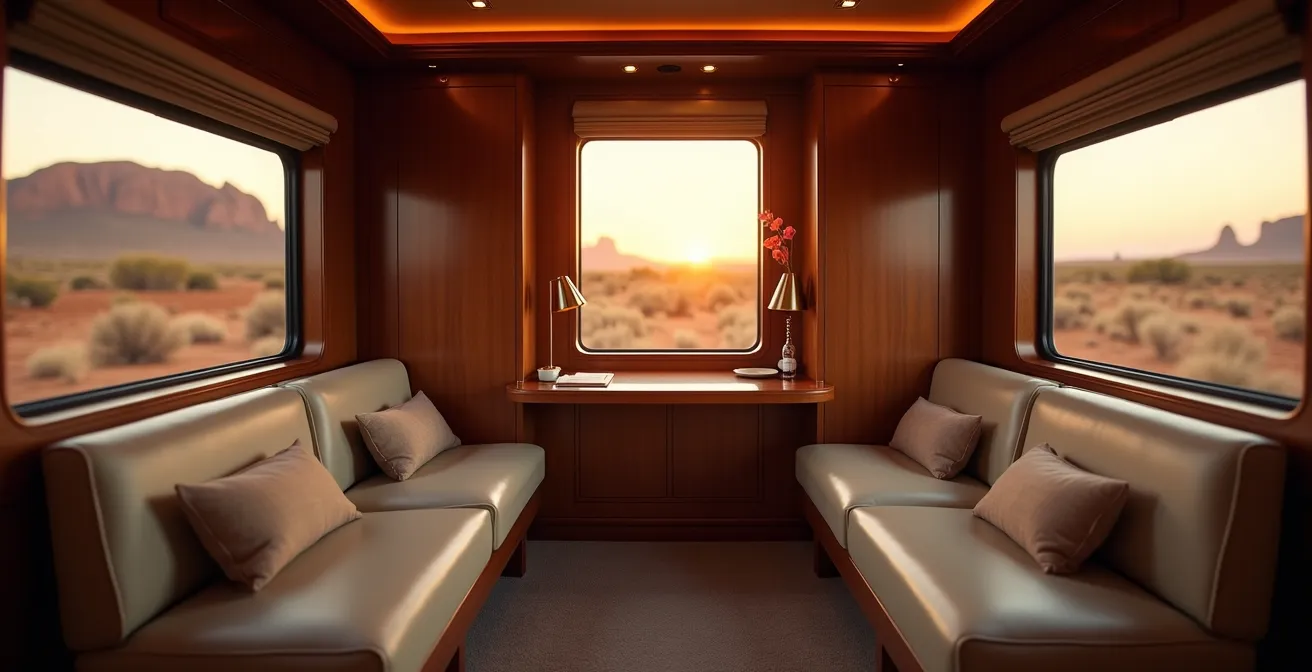
The $1000+ upgrade to Gold Class on The Ghan is less about overt luxury and more about strategically eliminating the inherent frictions of long-distance rail travel.
- Private ensuites and generous luggage allowances resolve the two biggest practical hassles of the journey.
- While the dining experience is a significant upgrade, the included off-train excursions can still feel crowded rather than exclusive.
Recommendation: For a special occasion, the premium is justified if you value seamless comfort, privacy, and the removal of minor travel inconveniences over a more communal, rugged adventure.
The legendary Ghan, slicing through the ochre heart of Australia from Adelaide to Darwin, is more than a train journey; it’s a pilgrimage through an ancient landscape. For couples planning this special occasion trip, the pivotal question isn’t whether to go, but how. The decision often hinges on a single, significant number: the thousand-dollar-plus price gap between a standard sleeper and the acclaimed Gold Class. Is it merely a ticket to a slightly larger room, or does it unlock a fundamentally different experience?
Many reviews offer generic praise, speaking of “all-inclusive luxury” and “comfortable cabins.” But to truly assess the value, one must adopt a more forensic approach. This review moves beyond the brochures to dissect the tangible benefits and drawbacks. We will analyze the “value delta”—the real-world return on your investment—by examining the specific friction points of train travel that Gold Class aims to solve. From the practicality of an ensuite bathroom on a moving train to the reality of the food and tours, we break down precisely what that extra $1000 buys you on this iconic 3-day, 2-night expedition. The answer isn’t about extravagance; it’s about whether the seamless comfort offered is worth the premium for you.
For those who prefer a visual summary, the following video offers an immersive look into the first-class experience aboard The Ghan, perfectly complementing the detailed analysis in this guide.
To provide a clear and structured answer, this analysis breaks down the Gold Class experience into its most critical components. The following summary outlines the key areas we will investigate to determine if the upgrade delivers a tangible return on investment, moving from the privacy of your cabin to the quality of the shared experiences.
Summary: A Forensic Look at The Ghan’s Gold Class Value
- Ensuite vs shared bathroom: the reality of showering on a moving train
- Soft bags only: why your hard-shell suitcase won’t fit in the cabin?
- Katherine Gorge cruise: is the included tour crowded or exclusive?
- Queen Adelaide Restaurant: how does the food compare to a city restaurant?
- Summer heat vs Winter clear skies: when is the view from the window best?
- Farm to table: does the remoteness of the lodge compromise food quality?
- Flight vs Coach: is saving $200 worth the extra 12 hours of travel time?
- Are Australian Luxury Lodges Worth the $2,000 Nightly Rate?
Ensuite vs shared bathroom: the reality of showering on a moving train
The most significant “friction point” of any multi-day train journey is often the bathroom situation. The standard sleeper class involves a shared toilet and shower at the end of the carriage. This means navigating a potentially swaying corridor with your toiletries, waiting your turn, and a general lack of privacy that can detract from a premium experience. Gold Class completely eliminates this inconvenience. The primary justification for its higher price is the inclusion of a private ensuite bathroom with a toilet, sink, and shower in your cabin.
While compact, this private space is a game-changer. There’s no need to dress just to use the facilities in the middle of the night. The shower itself is an engineering marvel, designed to function effectively within a confined, moving space. As one passenger noted, it’s “an experience in itself.” For those concerned about size, it’s a functional and well-designed unit; a detailed review confirmed even a 183 cm frame fits comfortably. This isn’t just a luxury; it’s a practical solution that buys you privacy, convenience, and a sense of personal space, which is invaluable over a three-day journey.
Soft bags only: why your hard-shell suitcase won’t fit in the cabin?
The Ghan’s luggage policy, particularly the preference for soft bags in cabins, can seem perplexing. However, this rule is born from a simple, unchangeable reality: limited space. Unlike a hotel room, Gold Class cabins are masterpieces of compact design where every square inch is maximized. There are no large closets or open floor spaces to accommodate a rigid, hard-shell suitcase. This is a critical detail where Gold Class’s design dictates practicality.
Case Study: The Reality of Cabin Storage
An in-depth look at the Gold Twin cabins reveals just how crucial soft baggage is. Storage is primarily limited to a small, narrow shelf and a compact cupboard for a few hanging items. One traveller noted that, unlike a river cruise cabin, fully unpacking is not a viable option. Your cabin bag, if it’s a pliable duffel or soft-sided case, can be stowed under the lower bunk or on the overhead shelf. A hard-shell case simply won’t fit in these designated spaces, forcing it to be checked in and leaving you to live out of a small carry-on for three days.
The image below clearly illustrates where a soft bag can be tucked away, a feat impossible for its rigid counterpart. This constraint underscores the “practical luxury” ethos; the rules are there to ensure your limited space remains as livable as possible.
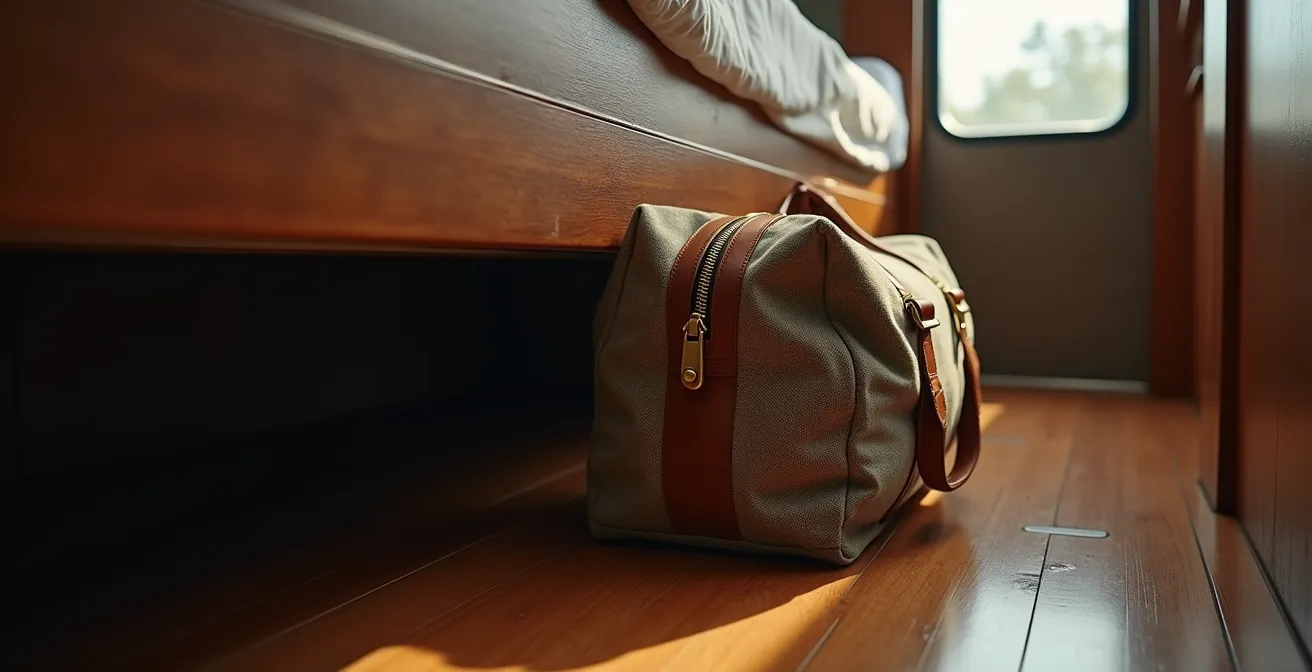
While Gold Service offers a generous checked luggage allowance, having a well-packed soft overnight bag is essential for a comfortable cabin experience. The official allowances differ slightly across service levels, highlighting the premium placed on efficient storage.
This table, based on data from Aussie Trains, outlines the specific luggage rules you’ll need to follow.
| Service Class | Cabin Luggage | Checked Luggage |
|---|---|---|
| Gold Single | 1 hand luggage + garment bag (105cm linear) | 60kg (2 x 30kg bags) |
| Gold Twin | 1 hand luggage + garment bag per person | 60kg (2 x 30kg bags) |
| Gold Premium | 1 hand luggage + garment bag per person | 75kg (3 x 25kg bags) |
| Platinum | In-cabin luggage | 90kg (3 x 30kg bags) |
Katherine Gorge cruise: is the included tour crowded or exclusive?
The off-train excursions are a cornerstone of The Ghan experience, promising immersive encounters with the Outback’s iconic landmarks. A key stop is the magnificent Nitmiluk (Katherine) Gorge. While the excursion is seamlessly organized for Gold Class passengers, the expectation of a private, exclusive tour may need to be tempered. The reality is that The Ghan transports a large number of guests, and this scale is reflected in the execution of the tours.
The experience is less of an intimate expedition and more of a well-oiled group operation. As one passenger on a Ghan-organized tour reported, the group was large enough to require multiple vessels. This is a key point where the “value delta” of Gold Class is less about exclusivity and more about convenience.
It was quite a different tour in that there were so many passengers we filled 3 or 4 boats and, because it was about 40C we left at 10.45am, we were told we would only be doing one gorge. I suspect this was more down to the age profile of The Ghan passengers and not normal practice for the cruise operators.
– Traveller Review, TripAdvisor
This isn’t necessarily a negative, but it’s a crucial detail for managing expectations. The benefit of Gold Class here is not a private guide but the hassle-free logistics: you are chauffeured directly from the train to the activity without any need for personal planning. The tour is curated for the group, which can sometimes mean modifications based on weather or passenger demographics. You are buying seamlessness, not seclusion. For couples seeking a truly private experience, it may be worth investigating separate, smaller tour operators at the destination, though this would forfeit the convenience included in the Gold Class fare.
Queen Adelaide Restaurant: how does the food compare to a city restaurant?
Dining is central to the Gold Class identity, and it all happens in the charming Queen Adelaide Restaurant car. With its art-deco-inspired details and classic white-linen service, the ambiance immediately elevates the experience beyond simple sustenance. This is where the social aspect of the journey comes alive, as couples and fellow travellers share stories over regionally inspired meals. The question remains: is the food as good as the setting?
The culinary offering is ambitious, especially given the logistical challenges of a kitchen on wheels traversing one of the world’s most remote regions. The menus are designed to reflect the journey, often featuring ingredients from the areas the train passes through, such as barramundi in the Top End or native herbs. The fare is generous and included in the price; according to a breakdown of the service, the offering includes a hearty two-course breakfast, two-course lunch, and three-course dinner, with all-inclusive beer, wine, and non-alcoholic beverages. For dinner, a “smart casual” dress code is encouraged, adding to the sense of occasion.
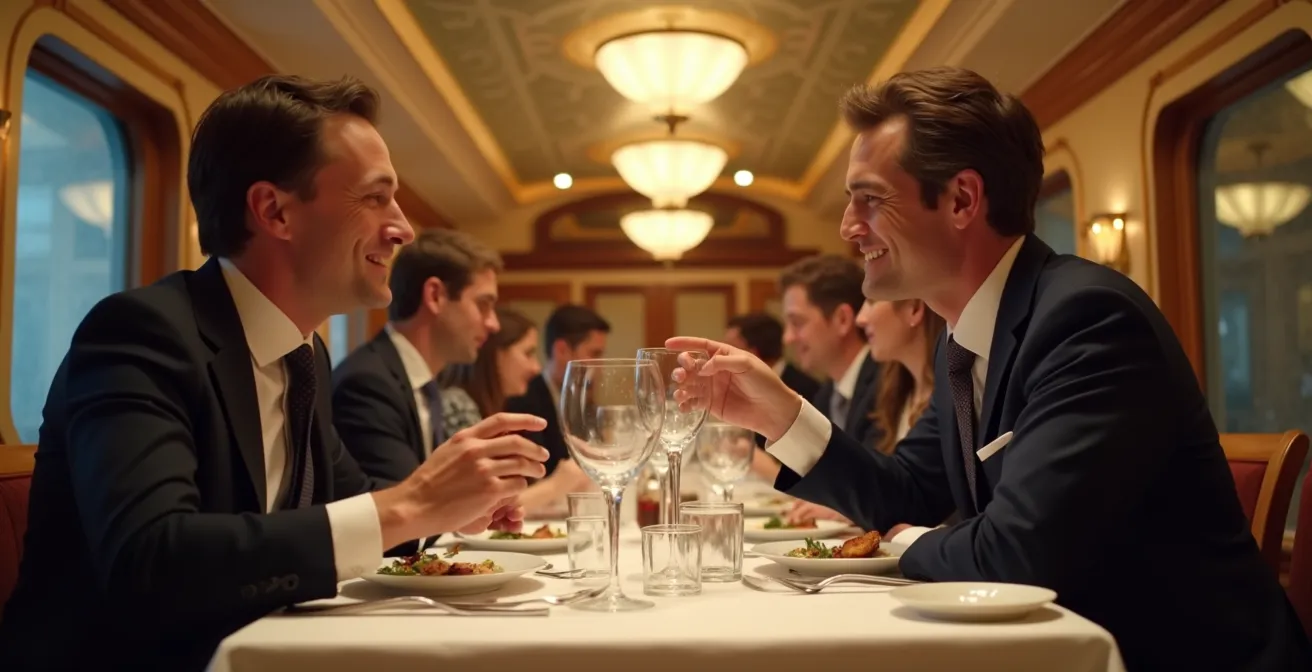
However, it’s important to set realistic expectations. As one reviewer aptly put it, the quality is high, but it’s best compared to a quality bistro rather than a hatted city restaurant.
The food was excellent, although I don’t expect the train to earn a Michelin star anytime soon. It was certainly better than your average fare.
– Valentina, The Sun Papers Travel Review
The value here is in the total package: good quality food, a beautiful setting, and the complete absence of a bill at the end of the meal. It’s a significant and enjoyable part of the Gold Class offering, delivering consistent quality rather than gastronomic revelation.
Summer heat vs Winter clear skies: when is the view from the window best?
The Ghan journey is a visual feast, but the quality of that feast is deeply influenced by the time of year you travel. The Australian Outback is a land of extremes, and choosing the right season can be the difference between a comfortable adventure and a challenging one. The two main seasons, the ‘Wet’ (summer) and the ‘Dry’ (winter), present vastly different experiences.
Travelling during the summer months (December-February) means contending with intense heat and humidity, especially in the Top End. This isn’t just a matter of in-cabin comfort; it directly impacts the flagship off-train excursions. For example, extreme temperatures can lead to tour modifications for safety. Passenger reports confirm that when temperatures hit 40°C, the Katherine Gorge tour was shortened, significantly altering a key part of the itinerary. While the train itself is air-conditioned, the view from the window might be through a heat-haze, and your time outdoors will be limited.
In contrast, the dry season offers a far more pleasant and visually rewarding experience. This period is widely considered the best time to undertake the journey. The weather is more cooperative, the landscapes are vibrant, and the conditions are ideal for both sightseeing from the train and participating fully in excursions. Here are the key advantages of a dry season trip:
- Optimal Travel Time: The best time to visit is during the dry season, which runs from April to October.
- Comfortable Temperatures: Daytime temperatures during the peak months average a much more manageable 29-30°C.
- Abundant Wildlife: Wildlife is more active and easier to spot during the dry season as animals congregate around water sources.
- Clear Skies: Winter brings clear, crisp skies, which are perfect for photography during the day and incredible for stargazing in the light-pollution-free environment of the Outback at night.
Farm to table: does the remoteness of the lodge compromise food quality?
While the title references a lodge, the principle applies directly to the Queen Adelaide Restaurant: how does a luxury operator maintain high-quality dining in one of the most isolated environments on Earth? The idea of a “farm to table” experience seems impossible. Yet, the quality achieved is a testament to incredible logistical planning and a clever culinary strategy that turns remoteness into a feature.
The key is not to fight the isolation, but to embrace it. The menus are meticulously planned months in advance, and the train is provisioned at major hubs like Adelaide and Darwin with high-quality produce. However, the real magic lies in the regional sourcing philosophy. Wherever possible, the menu incorporates hero ingredients from the territories the train traverses. You might find yourself enjoying saltwater barramundi as you cross into the Northern Territory or sampling beef from South Australian producers. This approach provides a genuine sense of place on a plate.
This logistical feat ensures that food quality is not compromised. Instead of relying on delicate ingredients that travel poorly, the chefs build their menus around robust, flavourful produce that can be stored and prepared to a high standard on board. The result is a dining experience that feels both luxurious and authentic to the journey. The “farm” may be hundreds of kilometres away, but through careful curation, its best products are brought “to the table” in the middle of the desert.
Flight vs Coach: is saving $200 worth the extra 12 hours of travel time?
The question posed—comparing a flight to a coach—can be reframed to the core of The Ghan’s value proposition: is slow travel worth the significant premium over simply flying from Adelaide to Darwin? A flight takes a few hours; The Ghan takes three days. The cost difference is not $200, but thousands. The error is in viewing The Ghan as a mode of transport. It is not. The Ghan is the destination.
You are not paying for transit; you are paying for an experience. The “extra time” is the product itself. It’s the time spent watching the vast, empty desert morph into tropical woodland, the time sharing a bottle of wine with new friends in the dining car, and the time disconnecting from the world as the landscape scrolls by your window. To compare it to the cost and speed of a budget airline is to fundamentally misunderstand its purpose. This journey appeals to a specific mindset, one that values the journey over the arrival.
Deciding if this “slow luxury” is right for you requires introspection about your travel style. Is the process of travel a joy for you, or a hurdle to be overcome as quickly as possible? This checklist can help you evaluate if the investment aligns with your personal travel philosophy.
Action Plan: Is Slow Luxury Travel Right for You?
- Assess Your Priorities: Do you value the experience of the journey itself, or is the destination your primary focus?
- Evaluate Your Pace: Are you looking for an opportunity to disconnect and unwind, or do you prefer a fast-paced, packed itinerary?
- Consider Your Social Style: Do you enjoy communal dining and meeting fellow travellers, or do you prefer more solitary experiences?
- Review the Inclusions: How much value do you place on all-inclusive dining, beverages, and curated (though not private) excursions?
- Analyze the “Unseen” Value: Are you willing to pay a premium for seamless logistics, comfort, and the removal of travel-related stress?
The choice isn’t about saving time or money in the traditional sense. It’s about deciding to invest in a unique and immersive experience that cannot be replicated by any other means of travel.
Key Takeaways
- The Gold Class upgrade is primarily an investment in comfort and convenience, solving practical issues like shared bathrooms and luggage storage.
- Dining is a high-quality, all-inclusive highlight, but off-train excursions are well-organized group tours, not exclusive private experiences.
- The best value is achieved by travelling in the dry season (April-October) to avoid extreme heat impacting the itinerary.
Are Australian Luxury Lodges Worth the $2,000 Nightly Rate?
After analyzing the value proposition of luxury on rails, a natural next question for many travellers is how it compares to luxury on land. An experience on The Ghan might lead one to consider staying at one of Australia’s famed luxury lodges, which often command rates of $2,000 or more per night. Is this level of investment justified, and what does it deliver that The Ghan doesn’t?
The value of a top-tier luxury lodge lies in a different kind of immersion. While The Ghan provides a stunning, ever-changing overview of a vast country, a luxury lodge offers a deep, focused dive into a single, unique location. The nightly rate typically includes not just accommodation and all meals, but a full program of exclusive, expertly guided activities. This is a key differentiator: where The Ghan’s excursions are for a large group, a lodge’s activities (like guided hikes, wildlife safaris, or snorkeling trips) are often for very small, intimate groups or even private parties. This delivers a level of personalization and exclusivity that a train journey cannot match.
Furthermore, these lodges are destinations in themselves, often set in extraordinarily remote and pristine environments with unparalleled access to nature. The $2,000 rate buys you seclusion, expert knowledge, and experiences that would be difficult or impossible to arrange independently. Just as with The Ghan’s Gold Class, you are paying a premium to have all friction points removed, but on a more intimate and localized scale. The decision to invest in either comes back to your ultimate travel goal: do you want to see the breadth of a landscape in seamless comfort, or do you want to explore one spectacular corner of it in depth?
Ultimately, whether on rail or at a remote lodge, the true value of Australian luxury travel is found by applying this same detailed analysis. By looking past the price tag and dissecting what you receive in terms of comfort, access, and experience, you can confidently decide which journey is the right investment for you.