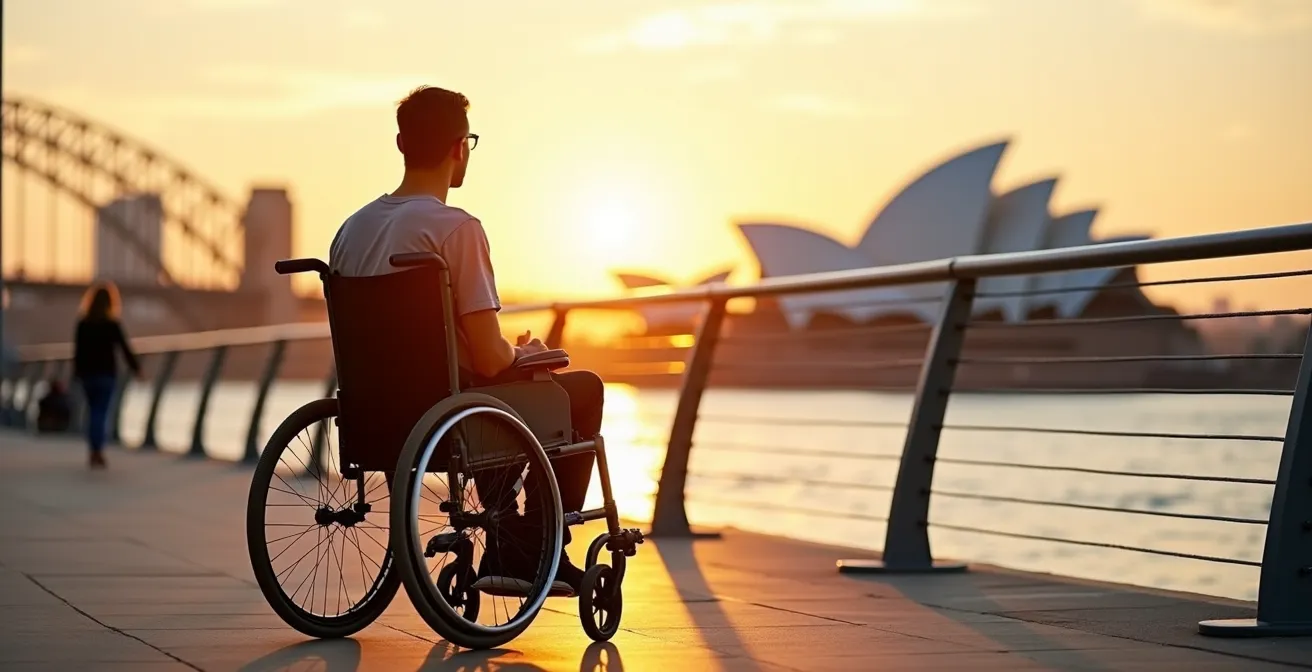
Planning an accessible trip to Australia often hits a wall of vague promises and hidden obstacles. The key to a successful journey isn’t finding a single “most accessible” city, but mastering the specific systems and verification methods required to navigate the country’s real-world infrastructure. This guide provides the factual, unvarnished details you need—from airline policies and specialized car rentals to the truth about “accessible” hotel rooms—empowering you to travel with confidence.
The dream of exploring Australia—from its vibrant cityscapes to its unique natural wonders—is a powerful one. For travelers who use a wheelchair, however, that dream is often accompanied by a layer of uncertainty and logistical complexity. Standard travel guides may offer broad assurances of “accessibility,” but the reality on the ground is far more nuanced. A ramp that is too steep, a transport gap that is too wide, or a hotel room that is “accessible” in name only can quickly derail an entire itinerary.
The common advice to “plan ahead” is true, but it’s incomplete. True preparedness isn’t just about booking flights and accommodation; it’s about deeply understanding the specific systems you’ll be interacting with. It means knowing the exact dimensions your airline will accept, the fine print in your rental car insurance, and the practical difference between Sydney’s train network and Melbourne’s tram system. It’s about moving from hope to verification.
This guide changes the question from “Which city is most accessible?” to “How can I master the systems to make any city accessible?” We will deconstruct the critical logistical hurdles one by one, providing the data, strategies, and verification methods you need. By focusing on proactive documentation, system knowledge, and anticipating the “accessibility gap” between what is promised and what is delivered, you can build a robust and flexible travel plan that puts you in control.
This article breaks down the essential components of accessible travel in Australia, giving you a clear roadmap for planning your trip. Below is a summary of the key areas we will cover, from the moment you book your flight to navigating the expenses of your journey.
Summary: A Practical Guide to Accessible Travel in Australia
- Wheelchair dimensions: avoiding the ‘it won’t fit in the hold’ disaster
- Hand controls and ramps: how far in advance must you book specialized rental cars?
- Sydney trains vs Melbourne trams: which network has fewer gaps and steps?
- The trail rider chairs: where can you rent all-terrain wheelchairs for national parks?
- Roll-in showers: why ‘accessible’ doesn’t always mean a hob-free shower?
- Opal Card caps: how to travel anywhere on Sundays for a fixed low price?
- Why standard insurance won’t cover underbody damage on unsealed roads?
- How to Plan a 3-Week Australia Trip from Scratch Without Overspending?
Wheelchair dimensions: avoiding the ‘it won’t fit in the hold’ disaster
Your journey begins long before you reach the airport. The single most common point of failure for wheelchair users is air travel, where inconsistent policies and poor handling can lead to stress, damage, or even being denied boarding. The experience for many is far from seamless; in fact, the majority of disabled travelers rate their experience as ‘poor’ or ‘very poor’, highlighting the systemic issues. The primary challenge is navigating the varying restrictions on wheelchair weight, dimensions, and battery types imposed by different airlines.
Each Australian airline has its own set of rules, which can be a minefield for the unprepared. While most have a standard weight limit for mobility aids, the procedures for heavier chairs or those with lithium batteries differ significantly. Understanding these nuances is non-negotiable for a smooth check-in process.
| Airline | Max Wheelchair Weight | Battery Policy | Advance Notice Required | User Experience Rating |
|---|---|---|---|---|
| Qantas | 32kg standard (higher on request) | Lithium batteries require 5-day approval | 48 hours | Best overall service |
| Virgin Australia | 32kg (2 aids allowed) | Clear battery guidelines | 48 hours | Good consistency |
| Jetstar | 32kg | Limited assistance | At booking | Basic service, max 2 wheelchairs per flight |
To mitigate these risks, the most effective strategy is pre-emptive documentation. Do not assume baggage handlers will know how to safely stow your specific device. Providing them with clear, concise instructions and having all your chair’s specifications confirmed in writing is the best defense against damage or refusal. This proactive approach shifts the burden of knowledge from airline staff to a clear, verifiable process you control.
Hand controls and ramps: how far in advance must you book specialized rental cars?
Once you’ve landed, securing appropriate ground transportation is the next critical challenge. While standard rental cars are plentiful, vehicles modified with hand controls, ramps, or hoists are a scarce resource across Australia. This limited supply means that spontaneity is not an option; meticulous advance planning is essential. For travel during peak seasons (like summer or school holidays), accessibility experts recommend booking specialized vehicles at least six months in advance.
Companies like Wheelaway specialize in this niche, offering a fleet of adapted vehicles nationwide. However, the operational logistics of these companies dictate a specific travel style. Because they often require vehicles to be returned to the same location, a cross-country road trip becomes impractical. This limitation makes the “Hub and Spoke” travel model the most effective strategy. This involves basing yourself in a major city (the hub), exploring the surrounding region, and then flying to the next hub to pick up another vehicle, rather than driving between them.
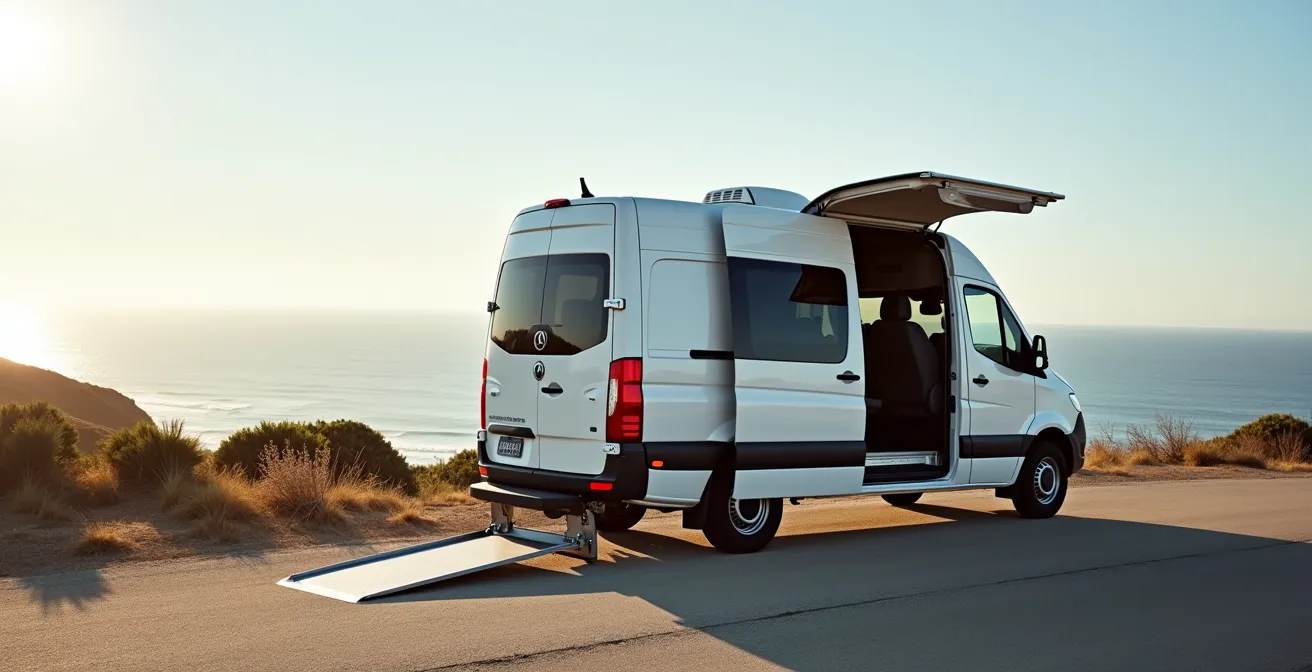
Adopting this model allows you to access different parts of the country without the logistical nightmare of a one-way rental. It requires coordinating flights with vehicle availability, but it unlocks a far greater range of travel possibilities. This strategic approach to vehicle rental is fundamental to a multi-city accessible Australian itinerary.
Sydney trains vs Melbourne trams: which network has fewer gaps and steps?
For navigating the urban cores of Australia’s largest cities, public transport is often the most efficient option. However, the accessibility of these networks varies dramatically. Sydney and Melbourne, while both offering extensive systems, present different sets of challenges and advantages for wheelchair users. The choice between them often comes down to a trade-off between network coverage and the smoothness of the boarding process.
Sydney’s train network is extensive, with most stations equipped with lifts for platform access. The primary issue, however, is the significant platform gap at many older stations, which can be a major barrier. Melbourne’s iconic tram network, on the other hand, offers seamless level boarding on its modern, low-floor trams, but only a fraction of its stops have been upgraded to fully accessible “superstops.”
| Feature | Sydney Trains | Melbourne Trams |
|---|---|---|
| Platform Access | Mostly level platforms with lifts | 28% stops are accessible ‘superstops’ |
| Gap Issues | Significant platform gaps at many stations | Level boarding on modern low-floor trams |
| Real-time Apps | TripView with accessibility filters | PTV app with low-floor tram tracking |
| Staff Support | Available at major stations | Travellers Aid at key stations |
Technology is your best ally in navigating these complexities. Both cities offer real-time transport apps (TripView for Sydney, PTV for Melbourne) that are indispensable for accessible travel. These apps allow you to filter for step-free routes, check the operational status of lifts in real-time, and track the arrival of low-floor vehicles. Mastering these tools before your trip is crucial for efficient and stress-free city exploration. Key functions to learn include:
- Enabling accessibility filters to show only step-free station access.
- Checking for real-time lift and escalator outages before starting your journey.
- Using live tracking in Melbourne to identify which upcoming trams are the accessible low-floor models.
- Setting service alerts for your planned routes to be notified of disruptions.
The trail rider chairs: where can you rent all-terrain wheelchairs for national parks?
Australia’s breathtaking national parks and coastlines are a major draw, but accessing them can seem daunting. Standard wheelchairs are often unsuitable for unpaved trails or sandy beaches. Fortunately, innovative rental programs for all-terrain wheelchairs are making these wild places more accessible than ever before. These specialized chairs, like the TrailRider and beach wheelchairs, are game-changers for outdoor enthusiasts.
A pioneering example is the program run by Parks Victoria, which offers free rentals of TrailRider chairs in several national parks, including the spectacular Grampians and Wilsons Promontory. These chairs feature a single large wheel and a sturdy frame, designed to handle rough terrain with the help of two assistants (or “sherpas”). Booking is essential and should be done directly with the park’s visitor center a few weeks in advance, as supply is limited. This initiative opens up hiking trails that were previously inaccessible.

A similar system exists for coastal exploration. Many beaches around Australia offer beach wheelchair rentals, often managed by local Surf Life Saving Clubs. These chairs have large, inflatable wheels that glide over sand. To access one, you typically need to contact the local club directly to book ahead, especially during the busy summer months. This simple planning step can transform a coastal visit from a viewpoint stop into an immersive beach experience.
Roll-in showers: why ‘accessible’ doesn’t always mean a hob-free shower?
Of all the potential accessibility challenges, accommodation presents one of the most frequent and frustrating “gaps” between promise and reality. The term “accessible room” is not legally standardized in Australia, leading to vast inconsistencies. A room might be listed as accessible but feature a small, raised lip (a hob) at the shower entrance, rendering it unusable for many wheelchair users who require a true roll-in shower.
This discrepancy is why you must move beyond simply asking “Is the room accessible?” to a strategy of active verification. While some hotel chains, like Meriton Suites, have a reputation for providing consistently high standards—including hob-free showers, correctly placed grab rails, and emergency cords—they are the exception, not the rule. Relying on a booking website’s filter is a gamble.
The most reliable method is to “photo-proof” your booking. This involves a direct line of communication with the hotel to obtain photographic evidence of the room’s features before your cancellation period expires. This process empowers you to make an informed decision and avoid a stressful surprise upon arrival. It turns an uncertain booking into a confirmed, suitable space.
Your Action Plan: The Photo-Proof Booking Method
- Initial Booking: Secure your room through your preferred booking channel to lock in the rate and dates.
- Direct Contact: Within 24 hours, call the hotel directly. Do not use the central reservations line. Ask to speak with the on-site accessibility coordinator or front office manager.
- Specific Photo Request: Clearly request they email you specific photos of the exact room you might be assigned. Key shots needed are: the shower entrance (to verify it’s hob-free), the positioning of grab rails around the toilet and shower, the toilet height, and the width of the bathroom and main doorways.
- Visual Verification: Ask the staff member to include the room number in one of the photos (e.g., on a piece of paper) to confirm the images are of a currently available accessible room.
- Decision Point: If the photos show the room is unsuitable, request an alternative accessible room and repeat the process. If none are suitable, cancel your booking before any penalty period begins.
Opal Card caps: how to travel anywhere on Sundays for a fixed low price?
Budgeting is a major component of any trip, and savvy travelers know how to leverage local deals. In Sydney, the Opal card public transport system offers a significant cost-saving opportunity that doubles as a strategic accessibility tool. The Sunday travel cap is a standout feature, as Sydney’s Opal Sunday cap offers exceptional value, allowing for unlimited travel across the entire network—trains, buses, light rail, and ferries—for a low, fixed price of just over $8 AUD.
For most tourists, this is a fantastic way to see the sights on a budget. For the accessible traveler, however, its value is even greater. It provides a low-cost, low-risk opportunity for “accessibility reconnaissance.” A prime example is testing the Sydney Ferries. While the ferries themselves are accessible, the ramp gradient at the wharves can change dramatically with the tide. A ramp that is perfectly manageable at high tide can become dangerously steep at low tide.
Instead of discovering this on a day you have a time-sensitive plan, you can use a cheap Sunday cap day to your advantage. Take multiple ferry trips at different times of the day to Circular Quay or Manly. This allows you to experience the ramp conditions at both high and low tides firsthand. You can determine your personal comfort level and identify which wharves and tide times work best for you, all without spending a fortune. This transforms a simple budget tip into a powerful strategic tool for confident travel.
Why standard insurance won’t cover underbody damage on unsealed roads?
A critical but often overlooked aspect of planning is travel and vehicle insurance. Many travelers assume their comprehensive rental insurance covers all eventualities, but there is a near-universal exclusion in Australian policies: damage to the underbody of the vehicle. This clause becomes particularly relevant when venturing beyond city limits into national parks and regional areas.
The reason for this exclusion is simple risk management. Unsealed (gravel or dirt) roads pose a much higher risk of damage from rocks and uneven surfaces. Since many of Australia’s most beautiful natural attractions are accessed via such roads, this creates a significant financial risk for the renter. In fact, accessibility data shows that most national park trails with accessible features require at least some travel on unsealed roads to reach the trailhead.
This means that if you hit a rock and damage the underside of your rental car—even a specialized accessible van—on the way to a designated accessible lookout, the repair costs will not be covered by standard insurance. You will be personally liable for the full amount. Some rental companies offer specific “unsealed road” insurance packages at an additional cost, but these are rare and must be explicitly requested and confirmed in writing. Ignoring this fine print can lead to a holiday ending with an unexpected bill for thousands of dollars.
Key Takeaways
- Success in accessible travel in Australia comes from mastering systems, not just picking destinations.
- Proactive verification, such as requesting photos of hotel rooms, is more reliable than taking “accessible” labels at face value.
- The “Hub-and-Spoke” model is the most effective strategy for multi-city travel involving specialized vehicle rentals.
How to Plan a 3-Week Australia Trip from Scratch Without Overspending?
Bringing all these elements together into a cohesive and affordable three-week itinerary requires a strategic mindset. The final piece of the puzzle is budgeting, and it’s essential to be realistic about the “accessibility tax”—the additional costs often associated with accessible travel. These aren’t always obvious and can quickly inflate a budget if not anticipated.

As the data shows, renting an accessible vehicle can be more than double the cost of a standard car, and accessible hotel rooms often come at a premium. These are the hidden costs of accessible travel that must be factored into your budget from day one. However, there are also savings to be found, such as the Australian Companion Card, which provides free entry for a carer at many attractions.
| Category | Standard Cost | Accessible Cost | Additional % |
|---|---|---|---|
| Car Rental (per week) | $350 AUD | $875 AUD | +150% |
| Hotel Room (per night) | $150 AUD | $195 AUD | +30% |
| Equipment Rental | N/A | $50/day | New cost |
| Companion Ticket Savings | $0 | -$40/attraction | -50% with card |
The key to managing these costs is to leverage the knowledge you’ve gained. By using the “Hub and Spoke” model, photo-proofing hotels, and utilizing public transport strategically, you can mitigate expenses. Your most powerful tools will be the wealth of information provided by local disability and travel communities. Arming yourself with these resources is the final step in your planning.
- National Public Toilet Map (toiletmap.gov.au): An essential government-run tool for finding accessible public restrooms, including those requiring an MLAK key.
- Travellers Aid: Provides practical support, equipment hire, and rest areas at major transport hubs like Southern Cross Station in Melbourne and Central Station in Sydney.
- Have Wheelchair Will Travel blog: An invaluable resource with detailed, first-hand reviews of destinations, accommodations, and attractions across Australia.
- Companion Card: A national program that provides a free ticket for a companion or carer at participating venues and attractions. Check eligibility requirements for international visitors.
- MLAK Key: A master key that unlocks dedicated accessible facilities, including restrooms and Liberty Swings, across Australia. Inquire about obtaining a temporary key for your visit.
Now, you can begin planning your Australian adventure not by asking “where can I go?”, but by confidently building the systems and a robust, verified itinerary that will empower you to go anywhere you choose.