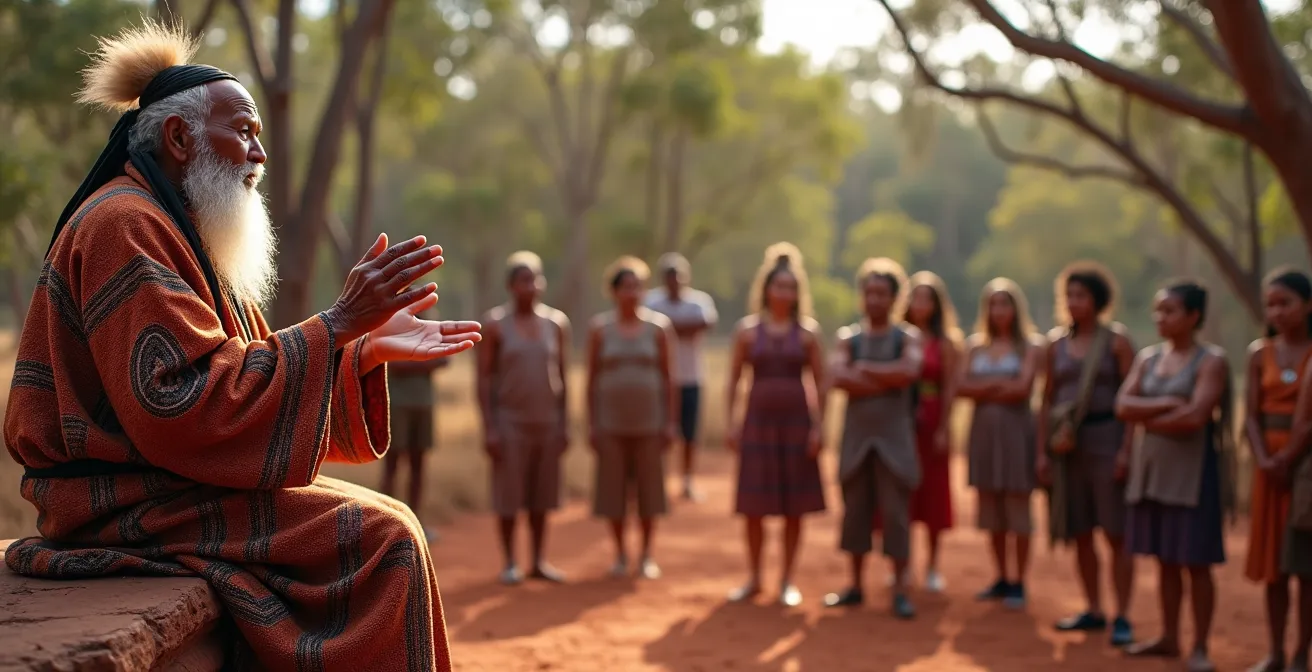
The distinction between a Welcome to Country and an Acknowledgement of Country is a common point of confusion. A Welcome to Country is a formal ceremony performed exclusively by a Traditional Custodian to welcome people to their ancestral lands. An Acknowledgement of Country, conversely, is a statement of respect that can and should be delivered by anyone, Indigenous or non-Indigenous, to recognise the Traditional Owners of the land on which an event is taking place. Understanding this difference is the first step in demonstrating genuine cultural respect and competence.
At conferences, public events, and even in email signatures across Australia, the phrases “Welcome to Country” and “Acknowledgement of Country” are increasingly common. For many attendees and visitors, the distinction between these two important protocols can be unclear, leading to confusion about their purpose and significance. While both are acts of respect towards Aboriginal and Torres Strait Islander peoples, they are fundamentally different in their meaning, delivery, and the authority they represent.
The most direct distinction lies in who is permitted to perform each. A Welcome to Country is a right reserved for Aboriginal and Torres Strait Islander Elders or Traditional Custodians of a specific area. It is a cultural ceremony that welcomes visitors onto their ancestral land, or “Country.” An Acknowledgement of Country, however, can be given by anyone and serves as a verbal recognition of the Traditional Custodians of that same land. But this simple definition only scratches the surface. The distinction is more than semantic; it is a foundational pillar of cultural protocol that acknowledges unceded sovereignty and the ongoing, living connection of First Peoples to their land.
This guide moves beyond basic definitions to provide formal clarity on these protocols. It outlines not only the differences but also the practical responsibilities and steps required for any individual or organisation to engage respectfully. By understanding the ‘why’ behind the ‘what’, one can ensure that these acts are meaningful gestures of reconciliation, not perfunctory formalities.
Summary: Welcome to Country vs Acknowledgement: What Is the Difference?
- Map of Indigenous Australia: how to find out whose country you are standing on?
- Supply Nation: using the directory to find businesses owned by traditional custodians
- Access rights: can traditional custodians close a beach to the public?
- Volunteer programs: how to help custodians with land management during your trip?
- Campground closures: what to do when an area is closed for mourning rituals?
- Ownership verification: ensuring your tour operator is endorsed by the local mob
- Why “Country” means more than just land in Aboriginal culture?
- How to Ask Cultural Questions Without Being Offensive?
Map of Indigenous Australia: how to find out whose country you are standing on?
A meaningful Acknowledgement of Country begins with a non-negotiable first step: correctly identifying the Traditional Custodians of the land you are on. A generic acknowledgement is better than none, but a specific one demonstrates genuine effort and respect. The primary resource for this is the AIATSIS Map of Indigenous Australia, which provides a visual representation of the different language and social groupings. However, this map is not definitive and is best used as a starting point for further local consultation.
Boundaries can be complex, overlapping, or contested. In the Greater Brisbane area, for instance, the Queensland Government advises consulting with each Traditional Owner Group independently due to cultural sensitivities. Where such complexities exist, a broader Acknowledgement of Country is often recommended, coupled with engagement of a local Aboriginal and Torres Strait Islander group for cultural expression. Therefore, your research should not stop at a single map but should involve contacting the appropriate local bodies for confirmation.
Your Action Plan: Identifying Traditional Owners
- Visit the AIATSIS Map of Indigenous Australia to identify the language group of your location.
- Contact your local Aboriginal Land Council or Native Title representative body for detailed, specific information.
- Check with local visitor centres or Aboriginal corporations when offline or in areas with contested boundaries.
- Learn correct pronunciation by searching for audio resources from local language centres or cultural organisations.
- Document the confirmed Traditional Owner group name for future acknowledgements and planning.
This due diligence is a critical component of the protocol. It transforms the act of acknowledgement from a passive statement into an active process of learning and recognition, forming the bedrock of respectful engagement.
Supply Nation: using the directory to find businesses owned by traditional custodians
Extending respect beyond words and into action is a crucial aspect of genuine reconciliation. One of the most impactful ways to do this is by supporting the economic sovereignty of First Nations communities. When planning events or travel, actively seeking out and procuring services from businesses owned by Traditional Custodians or other Aboriginal and Torres Strait Islander peoples ensures that your engagement provides tangible benefits to the community.
The foremost tool for this is the Supply Nation directory, Australia’s largest database of verified Indigenous businesses. Being listed in this directory signifies that a business has met stringent criteria confirming its ownership structure. However, it is also important to be aware of the practice of “black cladding,” where non-Indigenous companies falsely market themselves as Indigenous-owned to win contracts. A discerning approach is required to differentiate authentic enterprises from those engaging in tokenistic practices. Genuine businesses will often have clear community connections and long-term Indigenous staff from the local area.
This comparative table provides clear indicators to help verify the authenticity of an Indigenous business, a crucial step in ensuring your support is directed appropriately. As confirmed by Welcome to Country’s guide on the topic, genuine community connection is key.
| Genuine Indigenous Business Indicators | Potential ‘Black Cladding’ Red Flags |
|---|---|
| Listed in Supply Nation directory with certification | Vague references to ‘supporting’ Indigenous communities |
| Clear identification of Traditional Owner connections | Use of generic Indigenous imagery without specific attribution |
| Evidence of profit-sharing with local communities | No named Indigenous partners or community connections |
| Long-term Indigenous staff from local area | Token Indigenous involvement in marketing only |
| Connection to Aboriginal Art Centres for products | Mass-produced items with ‘Aboriginal-inspired’ designs |
By channelling expenditure towards verified Indigenous businesses, you participate in a form of economic reconciliation that empowers communities and respects their role as the continuous custodians of the land.
Access rights: can traditional custodians close a beach to the public?
The concept of unceded sovereignty has tangible, practical implications for land access. While much of Australia’s coastline and national parks are considered public land, Traditional Custodians may hold specific rights, including the authority to restrict access to certain areas, permanently or temporarily. This authority can stem from Native Title determinations or, just as importantly, from deep-seated cultural law and protocol.
A closure may be enacted for a variety of reasons that are integral to cultural practice: to conduct ceremonies, to allow for the mourning of a community member, to protect a sacred site, or for land management purposes. For a visitor, it is imperative to understand that these closures are not inconveniences but are acts of cultural sovereignty. Questioning or disrespecting a closure is a profound sign of disrespect to the Traditional Custodians and their living culture. Both legally enforced closures and cultural requests for non-entry must be honoured without question.
A responsible traveller or event organiser should always anticipate the possibility of such closures, particularly in remote areas. This involves researching alternative sites in advance and maintaining a flexible itinerary. The correct response to a closure is to respect it, leave the area, and use it as an opportunity to learn more about the local culture and its deep connection to Country. The guiding principles for visitors are clear:
- Understand that closures may be for ceremony, mourning, or land management.
- View closures as acts of cultural sovereignty rather than personal inconveniences.
- Respect both legal closures and cultural requests for non-entry.
- Research alternative sites in advance when traveling to remote areas.
- Never attempt to enter closed areas or question the authority of Traditional Custodians.
Honouring these protocols demonstrates a true understanding of what it means to be a welcome visitor on someone else’s Country.
Volunteer programs: how to help custodians with land management during your trip?
A desire to “help” or “give back” during a trip can be well-intentioned, but it requires careful and respectful execution to avoid the pitfalls of “voluntourism.” The principle of reciprocity is key: genuine support must be based on needs identified by the community itself, not on what a visitor assumes is needed. Just as inviting an Elder to perform a Welcome to Country is a paid service recognising their expertise, any contribution to land management must respect the knowledge and authority of Traditional Custodians.
True community-led initiatives are not about providing free labour. They involve proper compensation and the recognition of Traditional Custodian expertise as a professional skill. Proposing solutions or offering unsolicited help can be perceived as arrogant and unhelpful. Instead, the most ethical way to contribute is often financial. By paying for Indigenous-led tours, you directly support Ranger programs and community employment. Direct donations to Aboriginal Land Councils or Prescribed Body Corporates (PBCs) also ensure that funds are allocated according to community-defined priorities.
If you possess professional skills you believe may be useful, the correct protocol is to offer them only if a specific request has been made by the community. The most valuable action is often to listen first. The following are ethical ways to offer support:
- Pay for Indigenous-led tours to support Ranger programs financially.
- Donate directly to Aboriginal Land Councils or Prescribed Body Corporates.
- Offer professional skills only if specifically requested by the community.
- Purchase from Indigenous-owned businesses to support economic sustainability.
- Listen to community needs before proposing any solutions.
This approach shifts the dynamic from one of charity to one of partnership and respect, ensuring that any support offered is genuinely beneficial and empowering for the community.
Campground closures: what to do when an area is closed for mourning rituals?
A particularly significant reason for the closure of an area is “Sorry Business.” This is a period of mourning observed following the death of a community member. Sorry Business is a deep and complex cultural protocol that involves a range of community obligations and restrictions. For visitors, the most visible aspect may be the temporary closure of a campground, park, or sacred site. It is critical to understand that this is not merely a sign of respect for the grieving family, but a recognition that the Country itself participates in the mourning process.

From an Aboriginal perspective, the land is a living entity, interwoven with the spirit of its people. During Sorry Business, the Country requires a period of quiet and stillness to allow for healing and for the spirit of the deceased to make its journey. As a study on the topic notes, inviting an Elder to perform a Welcome is a way to recognise unceded Aboriginal sovereignty of ancestral lands. This same sovereignty is exercised when closing areas for Sorry Business. The presence of visitors, noise, and regular activity can disrupt this spiritual process.
If you encounter an area closed for Sorry Business, the only appropriate response is to leave immediately and without complaint. There is no timeframe to be expected, and it is highly inappropriate to ask when the area will reopen. The community will decide when the period of mourning is over. The correct protocol is to find an alternative location and allow the community the privacy and peace it requires. This act of quiet withdrawal is one of the most profound ways a visitor can show respect for the living culture and laws of the land.
Ownership verification: ensuring your tour operator is endorsed by the local mob
The responsibility for respectful engagement extends to the commercial choices one makes as a traveller. Selecting a tour operator is not merely a logistical decision; it is a choice that can either support or undermine Traditional Custodians. It is essential to ensure that any tour operator claiming to offer an “Indigenous experience” is genuinely endorsed by the local “mob” (a colloquial term for a person’s community or people).
Authentic operators will have deep, long-term relationships with the community. They will often name specific family groups or Traditional Owner partners, not just generic language groups. This reflects the complex social structures within Aboriginal Australia. As Google Arts & Culture explains in an exhibition, Aboriginal Australia is made up of more than 250 Aboriginal and Torres Strait Islander language groups, each with clear, traditional boundaries.
Despite the absence of formal fences or visible borders, Aboriginal peoples have clear boundaries separating their Country from that of other groups.
– Google Arts & Culture, Welcome to Country vs. Acknowledgement of Country exhibition
An endorsed operator respects these boundaries and has been given permission to share specific stories and bring visitors onto Country. Verification involves cross-referencing claims with the websites of Local Aboriginal Land Councils or Prescribed Body Corporates (PBCs), which may list endorsed ventures. Be wary of operators with no named Indigenous staff or vague statements about community benefits. Transparency about profit-sharing arrangements is another strong indicator of a genuine partnership.
| Genuine Endorsement Indicators | How to Verify |
|---|---|
| Uses specific family names, not just language groups | Cross-reference with Local Aboriginal Land Council listings |
| Evidence of profit-sharing arrangements | Check for transparent community benefit statements |
| Long-term local Indigenous staff | Look for named staff members with community connections |
| Listed by regional PBC or Land Council | Visit Prescribed Body Corporate websites for endorsed ventures |
| Specific Traditional Owner partnerships named | Verify names match local Traditional Owner groups |
Choosing a community-endorsed operator ensures your visit is respectful and contributes positively to the local Indigenous economy.
Key takeaways
- The core distinction is authority: A Welcome is given by a Traditional Custodian with permission to speak for Country; an Acknowledgement is a statement of respect anyone can make.
- Meaningful acknowledgement requires action: This includes correctly identifying Traditional Owners, supporting Indigenous-owned businesses, and respecting land closures.
- Sovereignty is a living concept: Traditional Custodians retain cultural authority over their Country, which must be respected by all visitors regardless of formal land tenure.
Why “Country” means more than just land in Aboriginal culture?
Underpinning all these protocols is a concept that is often misunderstood by non-Indigenous people: the meaning of “Country.” In Aboriginal culture, Country is not simply a synonym for land, a plot of earth, or a scenic landscape. It is a holistic concept that encompasses land, waterways, sea, sky, and everything within it. It is a living entity, imbued with spirituality, history, and law. This is a profound worldview, where people do not own Country, but rather belong to it.

This relationship is one of deep, reciprocal responsibility. The Country cares for its people by providing sustenance and spiritual connection, and in return, the people have a sacred duty to care for Country through ceremony, land management, and the passing down of knowledge. Songlines, or Dreaming tracks, crisscross the continent, mapping out the creation journeys of ancestral beings and encoding vital information about navigation, resources, and cultural law. As The Conversation highlights, learning these traditional names and stories is an opportunity for a deeper connection.
By learning traditional place names, you unlock important information about the character or features of that place.
– The Conversation, What is an Acknowledgement of Country and how is it different to a Welcome to Country?
To begin seeing Country as a living entity, one can practice observing the landscape through a different lens. This exercise can help shift perspective from a visitor viewing a place, to a guest interacting with a living system:
- Focus on water sources and their connections across the landscape.
- Observe ecological relationships between plants, animals, and seasons.
- Learn one traditional place name and its meaning each visit.
- Notice natural boundaries and transitions between different areas.
- Consider the reciprocal relationship of care between people and Country.
Understanding this concept is the key to understanding why a Welcome or Acknowledgement is not just a formality, but a recognition of a profound, ancient, and ongoing relationship.
How to Ask Cultural Questions Without Being Offensive?
As one’s understanding of these protocols deepens, questions will naturally arise. The desire to learn more is positive, but it is crucial to approach cultural inquiry with humility and respect. Asking questions is not inherently offensive, but the manner and context in which they are asked are paramount. The principle, as outlined in UNSW’s resources on the topic, is that meaningful and genuine interactions are always more powerful than perfunctory ones. This applies equally to asking questions.
The “Permission to Ask Framework” provides a respectful structure for inquiry. It acknowledges the other person’s right not to answer and places the onus of politeness on the questioner. It is vital to recognise that some knowledge is restricted and cannot be shared, whether due to gender, initiation status, or other cultural protocols. An answer of “I cannot share that” must be accepted gracefully and without probing further. The context also matters greatly; a paid Indigenous guide is in a formal role to share knowledge, whereas a casual conversation with a community member may not be an appropriate setting for deep cultural questions.
The following framework can guide respectful questioning:
- Preface with: ‘I hope you don’t mind me asking, and please feel free not to answer…’
- Transform closed questions (e.g., ‘Is this a sacred site?’) into open-ended invitations for stories (‘Are there any stories about this place you are able to share?’).
- Respect that some knowledge is restricted by gender or initiation status.
- Differentiate between appropriate contexts (e.g., a paid tour guide vs. a casual conversation).
- Accept ‘I cannot share that’ as a complete and respectful answer.
By framing questions with respect and being prepared to accept any response, you can continue your learning journey without causing offence or placing an undue burden on Aboriginal and Torres Strait Islander people.
Ultimately, the protocols of Welcome and Acknowledgement are invitations to a deeper relationship with the land and its First Peoples. By committing to understanding these distinctions, verifying information, supporting communities, and engaging with genuine humility, every visitor can ensure their presence on Country is a respectful and positive one. Begin today by integrating these principles into your personal and professional practices.