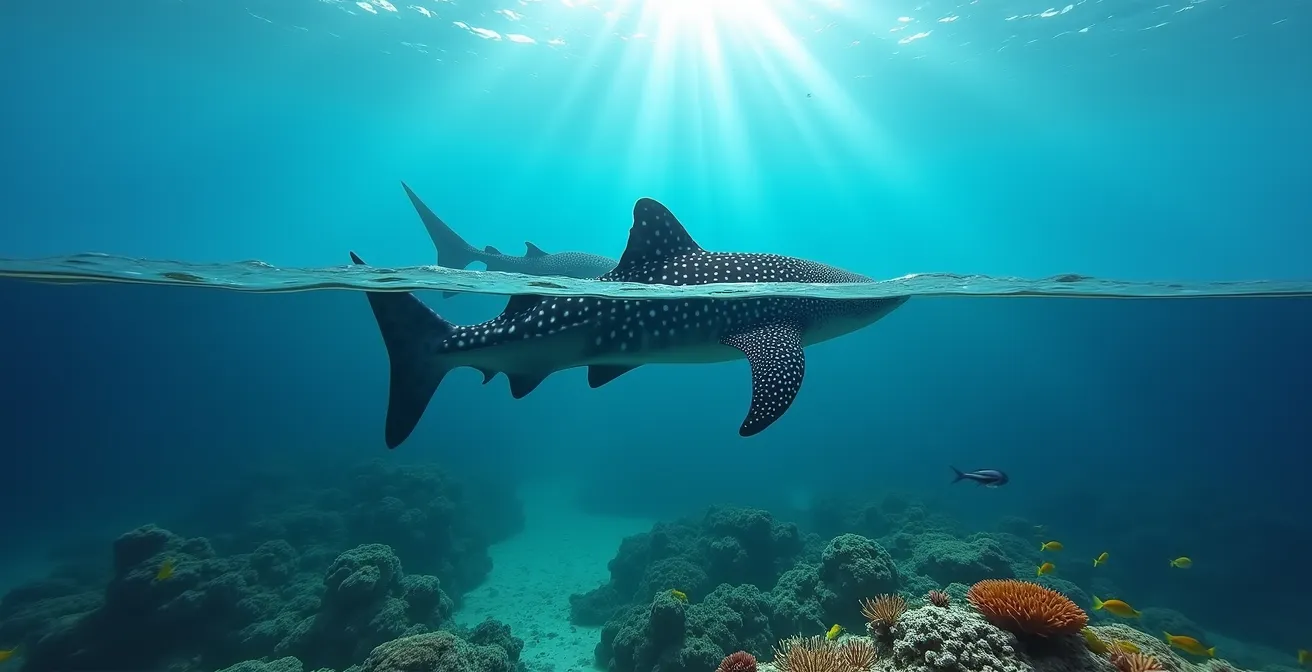
For a truly world-class whale shark expedition, Ningaloo Reef offers a far more reliable and valuable encounter than the Great Barrier Reef due to superior logistics and a specialized focus on megafauna.
- Higher sighting success rates (over 95%) are virtually guaranteed at Ningaloo thanks to dedicated spotter planes.
- Smaller, strictly regulated tour groups mean more personal, higher-quality in-water time with the animals.
- Shorter travel times to the outer reef and significantly fewer tourists create a more exclusive and less stressful experience.
Recommendation: If swimming with the ocean’s biggest fish is your primary goal, prioritize Western Australia’s Ningaloo Reef for an efficient, predictable, and unforgettable adventure.
The dream for any ocean enthusiast is the same: to float weightlessly in an endless blue expanse as a creature of impossible scale glides past. In Australia, the giant, gentle whale shark is the ultimate prize. This quest inevitably leads divers and snorkelers to a critical decision point: head east to the world-famous Great Barrier Reef near Cairns, or venture west to the remote Ningaloo Reef off Exmouth? Many assume the larger, more iconic reef must be the superior choice for all marine encounters.
Conventional wisdom focuses on the sheer size of the Great Barrier Reef and its vibrant coral ecosystems. While undeniably spectacular, this perspective often overlooks the crucial operational details that define the quality of a megafauna encounter. The choice isn’t merely about which reef is “better,” but about which location’s logistical model is purpose-built to deliver a successful and profound experience with large marine animals. It’s a matter of predictability, efficiency, and the return on your investment in adventure.
This guide moves beyond the surface-level comparison. We will dissect the key factors that separate a hopeful day trip from a near-guaranteed expedition. We will analyze the timing, the in-water protocols, the value proposition, and the unique environmental advantages that make one coast the undisputed champion for those whose primary mission is to swim alongside the giants of the deep. Forget what you think you know about Australia’s reefs; the real story is in the details of the chase.
This article will guide you through every critical aspect of planning your whale shark expedition, comparing the two destinations on the metrics that truly matter to adventurers. Let’s dive into the specifics.
Summary: Whale Shark Encounters: Ningaloo vs. The Great Barrier Reef
- March to July: ensuring you book your trip during peak whale shark numbers
- The 3-meter rule: how to swim alongside a giant without touching it?
- Exmouth vs Cairns: which location offers better value for marine megafauna tours?
- The outer reef chop: how to prevent nausea on small boat charters?
- The “Big Three”: can you see sharks, rays, and whales in a single trip?
- Maori Wrasse or Parrotfish: identifying the giants of the reef
- South of the border: driving 20 minutes to find empty peaks near Cabarita
- Where to Find Snorkeling Spots with 20+ Meter Visibility for Beginners?
March to July: ensuring you book your trip during peak whale shark numbers
Timing an expedition is everything. For whale shark encounters at Ningaloo Reef, the season running from March to late July/early August is not just a suggestion; it’s a finely-tuned biological window. This period is dictated by the annual coral spawning event that occurs after the full moons in March and April. This mass spawning creates vast plankton blooms, turning the clear waters into a nutrient-rich soup that attracts whale sharks in high concentrations. It’s this predictable food source that underpins the entire industry.
Booking within this window is critical, as operators at Ningaloo report a staggering 95% sighting success rate during this peak season. However, savvy travelers can optimize their trip even further. The period from April to May offers the absolute highest density of whale sharks. For those seeking to balance incredible sightings with fewer crowds, booking in May or early June, avoiding the school holidays, is the strategic choice. This level of seasonal predictability is a stark contrast to the Great Barrier Reef, where whale shark sightings are far more opportunistic and sporadic, often requiring expensive, multi-day liveaboard trips with no guarantee of success.
Furthermore, many Ningaloo operators have a ‘no sighting’ policy, offering a free repeat tour on the next available day. Booking your tour at the very beginning of your holiday in Exmouth provides a crucial buffer, ensuring you have the flexibility to take advantage of this policy and maximize your chances of an unforgettable encounter. This system transforms the experience from a gamble into a calculated, high-probability adventure.
The 3-meter rule: how to swim alongside a giant without touching it?
Swimming with the world’s largest fish is a privilege, and at Ningaloo Reef, it’s governed by a strict and elegant system designed for the safety of both the animal and the swimmer. The cardinal rule is clear: you must maintain a minimum distance of 3 meters from the side of the whale shark and 4 meters from its powerful tail. Touching the animal is strictly forbidden. This isn’t just a guideline; it’s a licensed code of conduct that ensures the encounters are sustainable and non-intrusive. But how is this enforced in the open ocean?
The answer lies in the highly organized “zipper formation” system. According to a case study on the area’s tour operations, boats accommodate a maximum of 20 guests, but only 10 swimmers are allowed in the water at any one time. Each group is led by a professional dive master. When a whale shark is located by the spotter plane, the guide directs the group to enter the water ahead of the shark’s path. Swimmers then form two parallel lines on one side of the animal, and as the shark swims past, the guide uses hand signals to manage positioning, ensuring everyone maintains the correct distance while getting an incredible view.
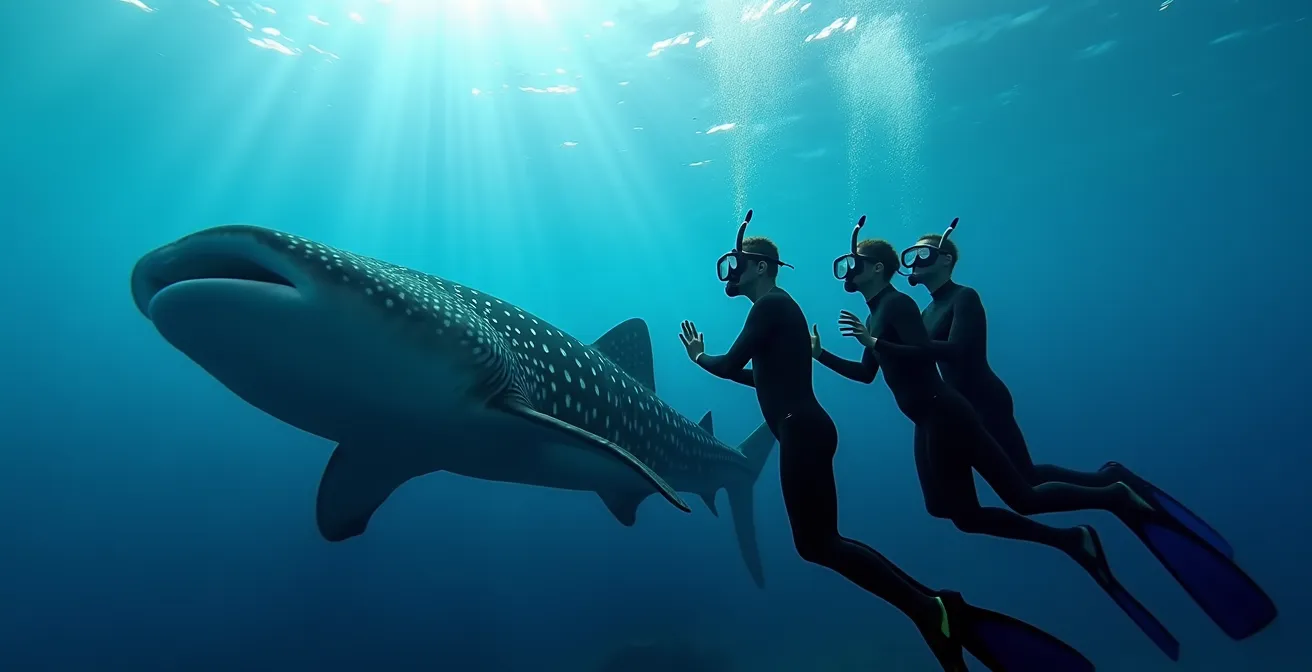
As you can see in this depiction of an ideal encounter, this system turns potential chaos into a graceful, coordinated ballet. The guide acts as a conductor, and the swimmers “zip” along beside the shark in an orderly fashion. This method not only guarantees safety but also maximizes the quality of the swim for everyone involved, preventing swimmers from crowding the animal or obstructing each other’s views. It’s a testament to a well-regulated industry focused on long-term sustainability over short-term thrills.
Exmouth vs Cairns: which location offers better value for marine megafauna tours?
When comparing Exmouth (Ningaloo) and Cairns (Great Barrier Reef) for megafauna encounters, “value” extends far beyond the initial ticket price. It’s about the return on your investment: the likelihood, quality, and efficiency of the encounter. While a basic GBR reef tour from Cairns might appear cheaper, the quest for whale sharks there is a high-cost, low-probability gamble. At Ningaloo, the entire operation is a well-oiled machine purpose-built for finding these giants, and the value proposition is overwhelmingly superior for the dedicated megafauna seeker.
The key difference is the use of spotter planes at Ningaloo. These small aircraft patrol the reef, locating whale sharks and radioing their positions to the tour boats below. This single logistical advantage eliminates hours of fruitless searching and is the primary driver behind the 95% success rate. The geography of the GBR makes this approach unfeasible. Furthermore, the visitor numbers highlight the difference in experience; in 2024, a record 40,717 people swam with whale sharks at Ningaloo, a testament to its reliability, yet this is a fraction of the GBR’s millions of visitors, ensuring a less crowded environment.
This comparative analysis from a recent report clearly illustrates Ningaloo’s superior value proposition for whale shark encounters.
| Factor | Ningaloo (Exmouth) | Great Barrier Reef (Cairns) |
|---|---|---|
| Whale Shark Success Rate | 95% during peak season | Hit-or-miss, requires expensive liveaboard |
| Tour Cost | $375-575 USD | $250 USD (basic reef tour) |
| Annual Visitors | 150,000 | 2+ million |
| Spotter Plane Advantage | Yes – ensures efficient encounters | No – geography makes it unfeasible |
| Maximum Group Size | 20 swimmers (10 in water at once) | Varies, often larger groups |
As the data clearly shows, while the upfront cost for a dedicated Ningaloo tour is higher, the near-certainty of the encounter, the smaller group sizes, and the overall efficiency provide unparalleled value for any adventurer whose primary goal is to swim with a whale shark.
The outer reef chop: how to prevent nausea on small boat charters?
Even the most thrilling wildlife expedition can be ruined by one persistent foe: seasickness. The journey out to the deeper waters where whale sharks feed often involves navigating the “outer reef chop,” an area of open-ocean swell that can challenge even seasoned sailors. While the Great Barrier Reef requires long 1-2 hour open ocean crossings to reach prime locations, Ningaloo’s geography as a fringing reef offers a distinct advantage, with much shorter boat rides to the outer edge. Nevertheless, being prepared for nausea is a non-negotiable part of expedition planning.
Beyond standard medication, there are several pro-level strategies to keep your stomach settled and your focus on the adventure. The type of vessel matters immensely. As one experienced visitor noted, a catamaran provides a significantly more stable platform in swells compared to a monohull, drastically reducing the rolling motion that often triggers nausea.
We chose the tour operator because of the boat, a roughly 15m catamaran. Cats are better in rough and swelly sea conditions, meaning a more stable platform. A stable vessel and Travacalm tablets meant we could easily go from vessel to water and back four times without feeling nauseous.
– Ningaloo Discovery Tour Testimonial
This expert testimony highlights the importance of vessel choice. Combining this with specific on-board behaviors can make all the difference, turning a potentially miserable day into a triumphant one. The key is to manage both physical and psychological factors before you even feel the first hint of queasiness.
Action Plan: Pro-Level Seasickness Prevention
- Vessel Selection: Actively choose a tour operator that uses a catamaran over a monohull for superior stability in ocean swells.
- On-board Positioning: Position yourself low, in the center of the boat, and facing forward to minimize motion sickness.
- Acclimatization: Start the day with calm snorkeling in the lagoon to get your “sea legs” before heading to the more exposed outer reef.
- Horizon Focus: Actively scan the horizon for wildlife. This keeps your brain’s visual input aligned with your inner ear’s sense of balance and provides a psychological distraction.
- Geographic Advantage: Capitalize on Ningaloo’s fringing reef by booking tours there, inherently involving shorter open-ocean crossings compared to the GBR.
The “Big Three”: can you see sharks, rays, and whales in a single trip?
For many marine adventurers, the whale shark is the main event, but Ningaloo Reef offers the tantalizing prospect of a “grand slam” of megafauna. This is the “Big Three”: swimming with whale sharks, witnessing the acrobatic grace of manta rays, and observing the colossal migration of humpback whales. While seeing any one of these is a life-altering experience, the possibility of encountering all three in a single trip elevates Ningaloo to a legendary status in the world of wildlife tourism.
This incredible opportunity is not a year-round phenomenon but is concentrated in a specific, magical window. The prime time for the legendary ‘Big Three’ overlap occurs for about six weeks annually, from late July through September. During this period, the last of the whale sharks are still feeding in the area just as the vanguard of the 35,000-strong humpback whale migration arrives from Antarctica. Manta rays, which can be found year-round, are also particularly active during this time.
This unique convergence of migration patterns and feeding opportunities creates an ecological spectacle unmatched almost anywhere on the planet. As one authoritative report on marine encounters states, this brief window makes the region a global hotspot.
Ningaloo becomes Earth’s only location where whale sharks, humpback whales, and manta rays reliably overlap.
– Travel Report, Journee Mondiale Marine Encounters Report
While the Great Barrier Reef also hosts humpbacks and manta rays, the opportunity to reliably see them in conjunction with whale sharks is virtually non-existent. This “Big Three” trifecta is a unique selling proposition for Ningaloo, offering expeditioners the chance to tick off multiple bucket-list encounters in a single, well-timed journey.
Maori Wrasse or Parrotfish: identifying the giants of the reef
When discussing “giants” of the reef, perspective is everything. On the Great Barrier Reef, a snorkeler’s most impressive encounter might be with a Humphead Maori Wrasse. These magnificent fish, with their distinctive forehead humps and intricate patterns, are true giants of the coral ecosystem. They can reach up to 2 meters in length and are a genuinely awe-inspiring sight for any diver. However, the scale of a “reef giant” pales in comparison to the “ocean giants” that define the Ningaloo experience.
The Maori Wrasse is a resident of the reef; it lives its life within the coral gardens. The whale shark is a pelagic, oceanic wanderer that merely visits the reef to feed. Comparing them puts the sheer magnitude of a Ningaloo encounter into stark relief. After swimming with a creature the size of a school bus, even the most impressive reef fish can feel like part of the supporting cast—a spectacular supporting cast, but a supporting cast nonetheless. As one account of a Ningaloo trip notes, even after the main event, the reef itself delivers world-class snorkeling with abundant fish and pristine coral in the shallow inner reef waters.
The following comparison breaks down the immense difference in scale between the GBR’s resident giant and Ningaloo’s main attraction.
| Feature | Maori Wrasse (GBR Giant) | Whale Shark (Ocean Giant) |
|---|---|---|
| Maximum Size | 2m length | 12m+ length (average at Ningaloo) |
| Weight | 190kg | 20 tonnes |
| Habitat | Lives on the reef | Oceanic pelagic |
| Encounter Type | Reef diving/snorkeling | Open water swimming |
| Scale of Awe | Impressive reef fish | World’s largest fish |
This isn’t to diminish the wonder of the Great Barrier Reef’s biodiversity. It’s to clarify the mission. If your goal is to immerse yourself in a complex coral city, the GBR is unparalleled. But if your goal is to be humbled by a creature of truly oceanic proportions, the metrics point decisively west. Understanding this distinction is key to aligning your expectations with your destination.
South of the border: driving 20 minutes to find empty peaks near Cabarita
While the title might bring to mind surf trips down the Gold Coast, for the megafauna enthusiast, the phrase “south of the border” is a powerful metaphor for a crucial expedition tactic: escaping the crowds. The question of visitor density is a critical factor in the Ningaloo vs. GBR debate, directly impacting the quality and intimacy of your experience. Finding your own “empty peak” in the water, free from the throngs of other snorkelers, is the ultimate luxury.
The numbers are stark. The Great Barrier Reef welcomes over 2 million visitors annually, concentrated in accessible hubs like Cairns. Ningaloo sees a mere 150,000. This results in Ningaloo having an astonishing 13 times fewer people per square mile. This statistic alone speaks volumes about the type of experience you can expect. However, even within these less-crowded destinations, there are strategies to find even more solitude.
- At Ningaloo: While Exmouth is the main hub, basing yourself in the more laid-back town of Coral Bay offers world-class manta ray swims and a different vibe. From Exmouth, simply driving south along the coast opens up numerous less-visited snorkel spots accessible directly from the beach.
- At the Great Barrier Reef: To escape the Cairns day-tripper crowds, you must invest more significantly. This means booking a multi-day liveaboard to the remote northern Ribbon Reefs or basing yourself in the more upscale Port Douglas to access the less-frequented Agincourt Reef.
- For both locations: Traveling in the shoulder seasons—like March or late July for Ningaloo—is a classic strategy for securing better prices and finding fewer tourists on the boats and in the water.
Ultimately, achieving a sense of wilderness and solitude is far more accessible and requires less investment at Ningaloo. The reef’s proximity to the shore and lower overall visitor numbers mean that a quiet, personal encounter with marine life is the norm, not the exception.
Key takeaways
- Ningaloo’s whale shark season (Mar-Jul) is driven by predictable coral spawning, leading to a 95% sighting success rate.
- Strict 3-meter distance rules and a “zipper formation” for swimmers ensure safe, respectful, and high-quality encounters.
- Despite a higher ticket price, Ningaloo offers better value due to spotter planes, smaller groups, and a near-guaranteed megafauna sighting.
Where to Find Snorkeling Spots with 20+ Meter Visibility for Beginners?
For any underwater encounter, whether you’re a seasoned diver or a first-time snorkeler, visibility is the final, crucial variable that determines the quality of the experience. Murky water can turn a magical moment into a frustrating glimpse. When it comes to finding consistently crystal-clear conditions, Ningaloo’s unique oceanography gives it a significant and reliable edge, making it exceptionally friendly for beginners.
The reef’s secret lies in its geography. As a marine biology report explains, Ningaloo’s proximity to the deep, clear Indian Ocean and the influence of the powerful, nutrient-poor Leeuwin Current are the primary factors. This constant flushing with oceanic water prevents the buildup of coastal sediment and runoff that can often plague other reef systems.
Ningaloo’s proximity to the deep, clear Indian Ocean and the Leeuwin Current often provides exceptional visibility.
– Marine Biology Report, Voyatlas Dive Guide 2026
This natural advantage means that while conditions on the Great Barrier Reef can be variable depending on weather and tides, Ningaloo often achieves a spectacular 25-30+ meters of visibility. For a beginner, this is a game-changer. It reduces anxiety and allows you to see the magnificent whale shark in its entirety from a safe and comfortable distance, appreciating its full scale and beauty. This clarity turns a good view into a breathtaking, high-definition memory.
In conclusion, the choice is clear. While the Great Barrier Reef is a world wonder of biodiversity, for the specific mission of a predictable, high-quality, and awe-inspiring encounter with whale sharks, Ningaloo Reef stands alone. From its guaranteed sightings and strict conservation-focused protocols to its lower crowd density and superior visibility, every logistical element is optimized for the megafauna expeditioner. It delivers not just a tour, but a true adventure with a guaranteed return on your investment.
The next logical step for any adventurer convinced by this evidence is to begin planning the expedition. Start by researching accredited tour operators in Exmouth or Coral Bay that align with these best practices for a journey you will never forget.
Frequently Asked Questions About Swimming with Whale Sharks
Is it safe to swim with whale sharks?
Yes, it is extremely safe. Whale sharks are gentle, filter-feeding fish and pose no threat to humans. At Ningaloo Reef, strict regulations, including the 3-meter distance rule and the presence of professional guides in the water with you, ensure all encounters are conducted with the utmost safety for both swimmers and the animals.
Can you see whale sharks on the Great Barrier Reef?
While sightings do occur on the Great Barrier Reef, they are rare, unpredictable, and generally happen in the remote outer reefs. Unlike Ningaloo’s dedicated season, there is no reliable period or location, often requiring expensive, multi-day liveaboard trips with a low probability of success.
How much does it cost to swim with whale sharks in Australia?
At Ningaloo Reef, a dedicated full-day whale shark tour typically costs between $375 and $575 USD per person. While a standard day trip to the Great Barrier Reef may be cheaper (around $250 USD), it does not typically include a dedicated whale shark search, making the Ningaloo tour a much higher value proposition for a guaranteed encounter.