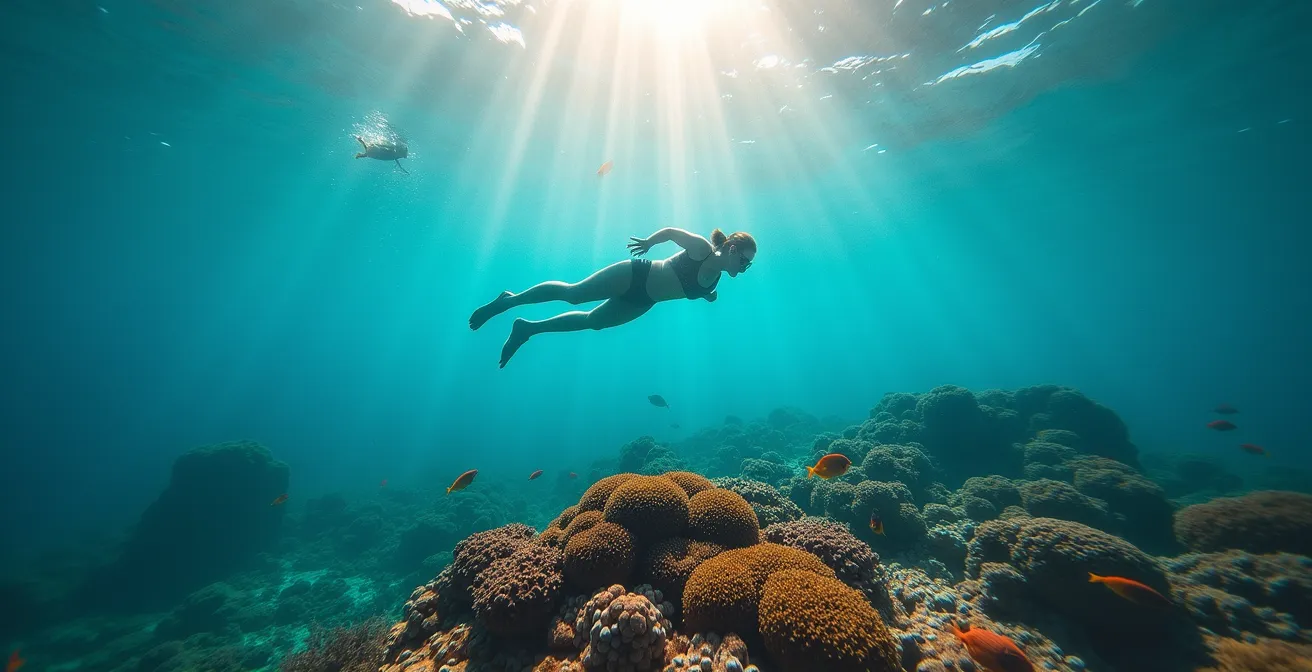
Finding crystal-clear snorkeling spots is one thing, but truly enjoying them as a beginner requires mastering your confidence, not just choosing a famous location.
- Your mask is your window to the underwater world; a perfect, fog-free fit is non-negotiable to prevent discomfort and panic.
- Prioritize shore-access spots like Ningaloo Reef to build comfort at your own pace, without the pressure of a boat trip.
Recommendation: The key is to transform the vast ocean into your own ‘personal aquarium’ by focusing on buoyancy control and calm breathing.
The dream for any aspiring snorkeler is that postcard image: floating effortlessly in calm, turquoise water so clear you can see the vibrant coral and schools of fish dozens of meters away. The promise of 20, or even 30-meter visibility is a powerful lure. But as a diving instructor for beginners, I know that for families and less confident swimmers, exceptional clarity can sometimes feel more intimidating than inviting. When you can see the deep blue stretching out below, a little bit of anxiety can quickly creep in. Many guides focus on simply listing exotic destinations, but they miss the most crucial point.
The secret to enjoying these spectacular underwater landscapes isn’t about bravely confronting the vastness of the ocean. It’s about learning to create your own confidence bubble, a small, manageable space where you feel completely in control. It starts with your gear, specifically your mask, and extends to your breathing and your position in the water. By mastering your immediate environment, you transform that clear water from a daunting void into your own private, ‘personal aquarium’. The goal is to shift from nervously looking into the distance to becoming a calm, ‘intentional observer’ of the wonders right in front of you.
This guide is designed to give you that control. We’ll move beyond just a list of places and focus on the skills and knowledge that build true water confidence. From ensuring your gear works for you, not against you, to understanding the marine life and choosing the right experience, you’ll learn how to make your first high-visibility snorkeling adventure a memory of pure joy, not quiet apprehension.
To help you prepare for this incredible experience, this article breaks down everything a beginner needs to know. You’ll find practical advice on gear, techniques for introducing children to the water, safety awareness, and how to be a responsible visitor to these fragile ecosystems.
Summary: Finding and Enjoying the Clearest Snorkeling Waters
- Why a properly fitted mask prevents fogging and panic in open water?
- Ningaloo or Great Barrier Reef: which allows snorkeling right off the sand?
- How to introduce kids to snorkeling using a flotation vest and view bucket?
- Stonefish and Cone Snails: the seabed hazards you must never touch
- Morning or afternoon: when is fish activity at its peak on the reef?
- Little Salmon Bay: following the underwater trail without a boat
- The outer reef chop: how to prevent nausea on small boat charters?
- How to Visit the Great Barrier Reef Sustainably Before It Changes?
Why a properly fitted mask prevents fogging and panic in open water?
Your mask is not just a piece of equipment; it’s your window to the underwater world. If that window is constantly fogging up or leaking, your snorkeling experience will be one of frustration, not wonder. For a beginner, a poorly fitting mask is the number one cause of anxiety and can even lead to panic. A slow, constant trickle of water is distracting and forces you to stop, tread water, and clear it, breaking your rhythm and focus. This constant interruption erodes your confidence bubble. A mask that fogs over instantly blinds you, which can be disorienting in open water.
The goal is to find a mask that feels like an extension of your own face. The seal, created by the soft silicone skirt, should be perfect. When you achieve this, you forget you’re even wearing it. This allows you to focus on the two most important things: your breathing and the incredible marine life around you. Don’t ever compromise on mask fit; a cheap, ill-fitting mask is the fastest way to ruin your day. Taking ten minutes to test a mask properly in a store is the best investment you can make for your trip.
To ensure you get a perfect seal, follow this simple in-store test:
- Step 1: Hold the mask to your face without using the strap. Inhale gently through your nose. The mask should create a seal and stay on your face without you holding it.
- Step 2: While it’s sealed, press gently on your nose bridge. You shouldn’t feel any uncomfortable pressure points.
- Step 3: Check the seal on your upper lip area. For men with mustaches, this is a common leaking point; a little Vaseline can sometimes help, but a good fit is better.
- Step 4: Look around. Check your peripheral vision and ensure the nose pocket doesn’t obstruct your view downwards.
- Step 5: Compare single-lens (uninterrupted view) versus double-lens (often lower volume and easier to clear) options to see which feels more comfortable for your field of view.
Once you have your mask, practice breathing with it and the snorkel at home or in a pool. Getting comfortable with the gear on dry land makes entering the ocean far less daunting.
Ningaloo or Great Barrier Reef: which allows snorkeling right off the sand?
Once you have confidence in your gear, the next question is where to go. Australia’s Ningaloo Reef and the Great Barrier Reef (GBR) are both world-class destinations with incredible visibility. But for a beginner or a family with young children, there’s a critical difference: shore access. The ability to walk into calm, clear water from a sandy beach is a game-changer. It removes the pressure of a boat schedule and allows you to go at your own pace, building confidence in shallow water before venturing further out.
Ningaloo Reef, in Western Australia, is famous for this. In places like Turquoise Bay, the reef is literally steps from the beach. You can put your gear on, walk into knee-deep water, and immediately be surrounded by coral and fish. The GBR, being much larger and further offshore in many areas, often requires a boat trip to reach the best spots. While islands like Green Island or Fitzroy Island offer some shore-based snorkeling, Ningaloo’s accessibility is generally unparalleled for beginners wanting to stay independent.
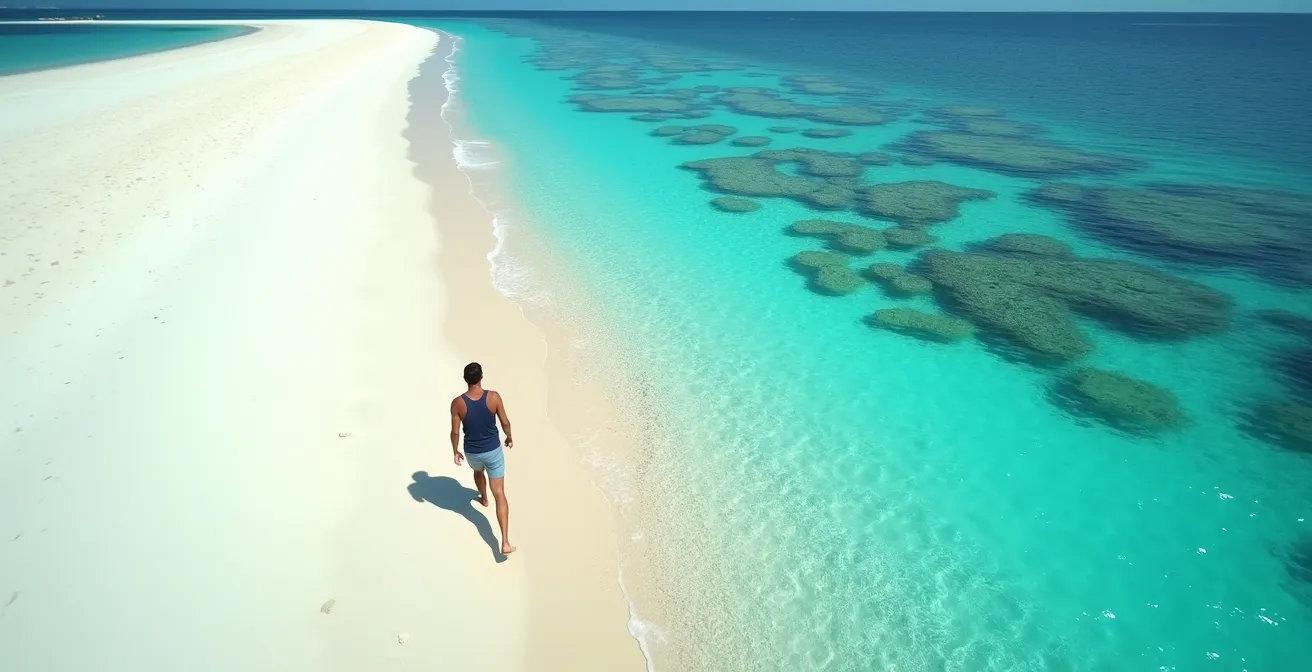
This table gives a simple scorecard for beginners comparing the two locations based on shore accessibility. As the aerial view of Turquoise Bay shows, being able to simply walk in makes all the difference.
| Criteria | Ningaloo Reef | Great Barrier Reef |
|---|---|---|
| Proximity to Shore | 0-100 meters at Turquoise Bay | Variable; Green Island/Fitzroy better |
| Water Depth Gradient | Gradual slope | Varies by location |
| Current Strength | Mild drift at Turquoise Bay | Generally calm in protected areas |
| Ease of Entry | Sandy beaches | Mix of sandy and rocky |
Ultimately, choosing a location with easy shore entry like Ningaloo allows you to control the experience completely, which is the cornerstone of building lasting snorkeling confidence.
How to introduce kids to snorkeling using a flotation vest and view bucket?
Introducing children—or any non-swimming adult—to snorkeling should be a slow, positive, and playful process. The goal is not to get them snorkeling on day one, but to make them feel safe and curious about the underwater world. Pushing them too fast can create a fear that lasts a lifetime. The two best tools for this are a comfortable, well-fitting flotation vest and a simple view bucket or “glass-bottom bucket.” The vest provides buoyancy, removing any fear of sinking and allowing them to float effortlessly. The view bucket lets them see underwater without the sensory challenge of a mask and snorkel.
The “Floating Starfish” technique is a fantastic, step-by-step method I use to build a child’s confidence in the water. It’s all about comfort and play. Only when a child is completely happy floating and observing from the surface should you even consider introducing a mask, which you can present as a “magic window” they can wear. This approach also works wonderfully for adults who are not confident swimmers. The key is to empower them by letting them lead the pace of discovery.
Your Action Plan: The Floating Starfish Technique for Children
- Float First: Have the child wear their flotation vest in shallow, calm water. Let them get used to the feeling of floating on their back and tummy without any other gear.
- Become a Starfish: Teach them to relax completely while floating face-down, with their arms and legs spread out like a starfish. This is a very stable position.
- Practice Breathing: Encourage them to practice relaxed, natural breathing while in the starfish position, with their face still above the water. Make it a game.
- Introduce the View: Once they are comfortable floating, give them the view bucket. Let them drift in the starfish position, looking through the bucket to see the fish and sand below.
- Transition to Mask: After they show excitement and curiosity with the bucket, you can introduce the mask. Describe it as their own personal ‘magic window’ to the sea.
Remember, the goal is fun and comfort. If they only spend 30 minutes looking through a bucket with a huge smile, that’s a massive success. The mask and snorkel can wait for the next day.
Stonefish and Cone Snails: the seabed hazards you must never touch
One of the biggest anxieties for beginners is the “what if” of dangerous creatures. It’s important to be aware, but not alarmed. The most potent marine toxins are defensive, not offensive. Animals like stonefish and cone snails don’t hunt humans; they use their venom to protect themselves when threatened or stepped on. The number one, unbreakable rule of snorkeling is therefore simple: never, ever touch anything. Not the coral, not the rocks, not the sand, and certainly not any creature.
A stonefish, as the image below shows, is a master of camouflage. You could swim right past one and never know it was there. This is why the second most important safety skill, after not touching, is mastering buoyancy control. By learning to float horizontally and effortlessly a meter or two above the reef, you remove any possibility of accidental contact. Your fins are for gentle propulsion, not for pushing off the bottom. Think of yourself as a blimp floating over a city, observing from a safe distance.
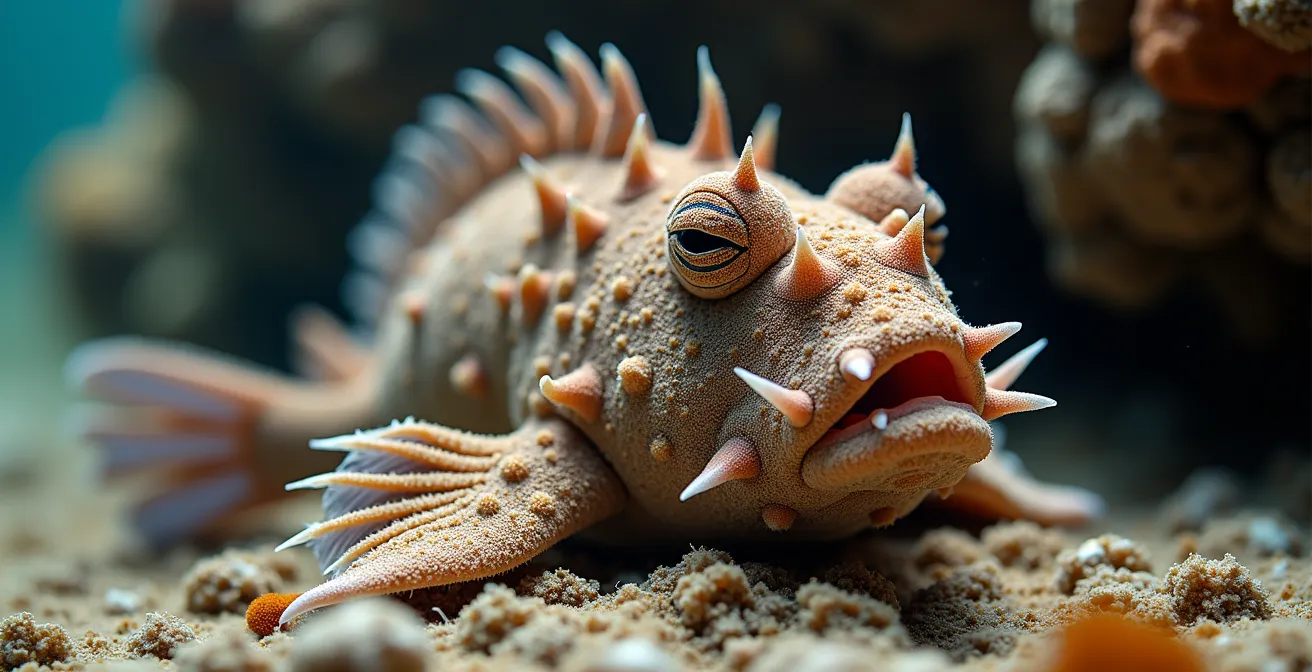
This matrix helps put the risk into perspective. While a stonefish is highly toxic, the likelihood of an encounter where it can harm you is very low if you follow the rules. Fire coral, on the other hand, is much more common and can give you a painful rash, reinforcing the no-touch rule for everything.
The key to safety is maintaining a slight positive buoyancy. As an official partner, the diving organization SSI has excellent resources showing that with the right technique, you should slowly rise if you stop all movement. This is your safety net. Practice this: take a breath, relax completely, and ensure you gently float upwards, away from the seabed. This skill is the foundation of your ‘personal aquarium’.
By combining buoyancy control with the no-touch rule, you can explore the reef with confidence, knowing you are a respectful and safe observer.
Morning or afternoon: when is fish activity at its peak on the reef?
You’ve found the perfect spot with crystal-clear water. Now, when is the best time to get in? While great visibility is a prerequisite, the magic of snorkeling is in watching the reef come alive. Fish activity isn’t constant throughout the day; it follows distinct patterns. The most active periods are often during crepuscular hours—that is, at dawn and dusk. During these times of changing light, many fish are either starting their day of feeding or returning to the shelter of the reef for the night. This is also when you might see predators being more active.
However, there’s a trade-off for beginners. While fish activity might be higher early in the morning or late in the afternoon, water visibility is often at its absolute best during the middle of the day when the sun is directly overhead. In the right conditions, midday visibility can reach up to 40 meters, as the high sun illuminates the entire water column. For a beginner focused on comfort, the calmer winds and warmer temperatures of late morning to early afternoon often present the ideal conditions.
So what’s the best advice? For your very first time, aim for a late morning snorkel. You’ll get the benefit of excellent light and visibility, which builds confidence, and the reef will still be very active. As you become more comfortable over several days, you might try an early morning or late afternoon session to witness the unique behaviors during those crepuscular peaks. For example, in the Maldives, snorkelers aiming to see whale sharks and manta rays often find the best encounters happen when visibility is at its peak. This is because, according to a guide on the world’s best snorkeling destinations, the dry season offers clarity greater than 30 meters, making it easier to spot these gentle giants from the surface.
Ultimately, any time you can get in the water on a calm day is a good time. But understanding these daily rhythms elevates your experience from simply swimming to truly observing an ecosystem at work.
Little Salmon Bay: following the underwater trail without a boat
Once you are comfortable in the water, the idea of exploring a little further becomes exciting. But you don’t always need a boat. Some of the best-designed beginner experiences are underwater snorkel trails, accessible right from the shore. These are like nature walks, but underwater. Locations like Little Salmon Bay on Rottnest Island, Australia, have marked trails that guide snorkelers along the reef, with underwater plaques identifying different corals and marine life. This is a brilliant way to explore with purpose and confidence.
Even without marked plaques, you can learn to follow your own trail using natural navigation cues. This is a key skill for “intentional observation.” Instead of just swimming randomly, you learn to read the reef. This not only keeps you from getting disoriented but also helps you notice more, as you’re actively engaged with your surroundings. It’s a skill that turns a simple swim into a real exploration.
Here are some natural navigation cues you can use to follow an underwater route:
- The Reef Edge: The easiest method. Decide to keep the main reef wall or edge consistently on your right side on the way out, and on your left side on the way back.
- Sun and Shadows: Use the sun’s position. The shadows cast by coral formations will all point in a consistent direction, giving you a natural compass.
- Distinctive Waypoints: Note unique features as you go, like a particularly large brain coral, a patch of brightly colored anemones, or a specific rock formation. Use these as mental breadcrumbs.
- Depth Contours: Try to follow a consistent depth. Most snorkel trails stay in relatively shallow water, so if you find yourself getting significantly deeper or shallower, you may have strayed.
Some of the world’s most pristine snorkeling, such as in Raja Ampat, requires liveaboard boats, but many archipelagos offer incredible trails right off the beach. As noted by the Oceanic Society, even in remote locations, many world-class sites can be accessed just off the sand of picturesque islands, allowing for independent exploration.
By practicing this, you transition from being a passive passenger to an active explorer of your own personal aquarium.
The outer reef chop: how to prevent nausea on small boat charters?
While shore snorkeling is ideal for building initial confidence, many of the most spectacular outer reefs are only accessible by boat. For many people, especially those not used to the ocean, the journey out can be the most challenging part of the day due to motion sickness. There’s nothing worse than arriving at a stunning reef with 30-meter visibility and feeling too nauseous to get in the water. Prevention is key, and it starts 24 hours before you even step on the boat.
The type of boat matters. Catamarans (twin-hulled boats) are significantly more stable and experience less side-to-side roll than single-hull boats. If you know you are prone to motion sickness, always try to book a tour that uses a larger catamaran. When you board, choose a seat in the center of the boat and towards the back, where the motion is least pronounced. Avoid sitting right at the front or on the upper deck if you’re feeling sensitive.
Beyond boat choice, your own preparation is critical. What you eat and drink can have a huge impact. Focus on light, bland foods and stay well-hydrated with water. And most importantly, during the journey, keep your eyes on the horizon. This helps your brain reconcile the motion your inner ear is feeling with the stability of the fixed horizon line. Avoid reading a book or looking at your phone.
Follow this pre-trip protocol to give yourself the best chance of a nausea-free day:
- 24 Hours Before: Avoid greasy or heavy foods, excessive caffeine, and alcohol.
- Morning Of: Eat a light breakfast of bland carbohydrates, like crackers or toast.
- 1 Hour Before: Drink some ginger tea or chew on crystallized ginger. Many over-the-counter medications are also very effective but may cause drowsiness, so read the label.
- During Transit: Sit in a stable part of the boat, get fresh air if possible, and practice steady horizon gazing.
Don’t let the fear of seasickness prevent you from experiencing the magic of an outer reef. A little preparation goes a very long way.
Key Takeaways
- A perfectly fitted mask is the foundation of a confident snorkeling experience; test it in-store before you buy.
- For beginners, shore-accessible reefs like Ningaloo offer more control and flexibility than boat-dependent trips to the Great Barrier Reef.
- The key to safety is buoyancy control and the “no-touch” rule; most marine hazards are defensive and easily avoided by staying off the seabed.
How to Visit the Great Barrier Reef Sustainably Before It Changes?
Visiting a natural wonder like the Great Barrier Reef is a privilege, and with that comes a responsibility. These ecosystems are incredibly fragile and facing threats from climate change, such as coral bleaching. As a visitor, you have the power to make a positive impact by choosing to travel sustainably. This ensures that the beauty you experience will be there for future generations to enjoy. Being a sustainable snorkeler isn’t difficult; it just requires a little bit of “intentional observation” before you even book your trip.
Your most significant choice is your tour operator. A responsible operator does more than just take you to a pretty spot; they are stewards of the reef. They actively work to minimize their environmental footprint and contribute to conservation efforts. Don’t be afraid to ask them questions before you book. A truly sustainable company will be proud to tell you about their policies. Look for official certifications like those from Ecotourism Australia, as this provides third-party verification of their commitment.
You can even become an active participant in conservation through “citizen science.” Some operators have programs where you can contribute to reef health monitoring or help identify marine life. For example, your photos of manta rays or whale sharks can be used by researchers to track populations. If you photograph a new individual, you might even get to name it! This transforms your holiday into a meaningful contribution.
When choosing an operator, use this simple checklist:
- Ask about their carbon policy: Do they have a program to offset the carbon footprint of their tours?
- Verify their certification: Are they eco-certified by a recognized marine tourism organization?
- Check their sunscreen policy: Do they provide or require guests to use reef-safe sunscreen, which is free of oxybenzone and octinoxate?
- Confirm wildlife interaction rules: What is their policy on maintaining a safe and respectful distance from marine animals like turtles and dolphins?
- Inquire about contributions: How do they support local reef conservation and research programs?
Your visit is a powerful vote for the kind of tourism you want to support. Choose operators who are dedicated to protecting the very ecosystem that provides such incredible experiences. Start today by researching and selecting a tour that aligns with these sustainable principles.