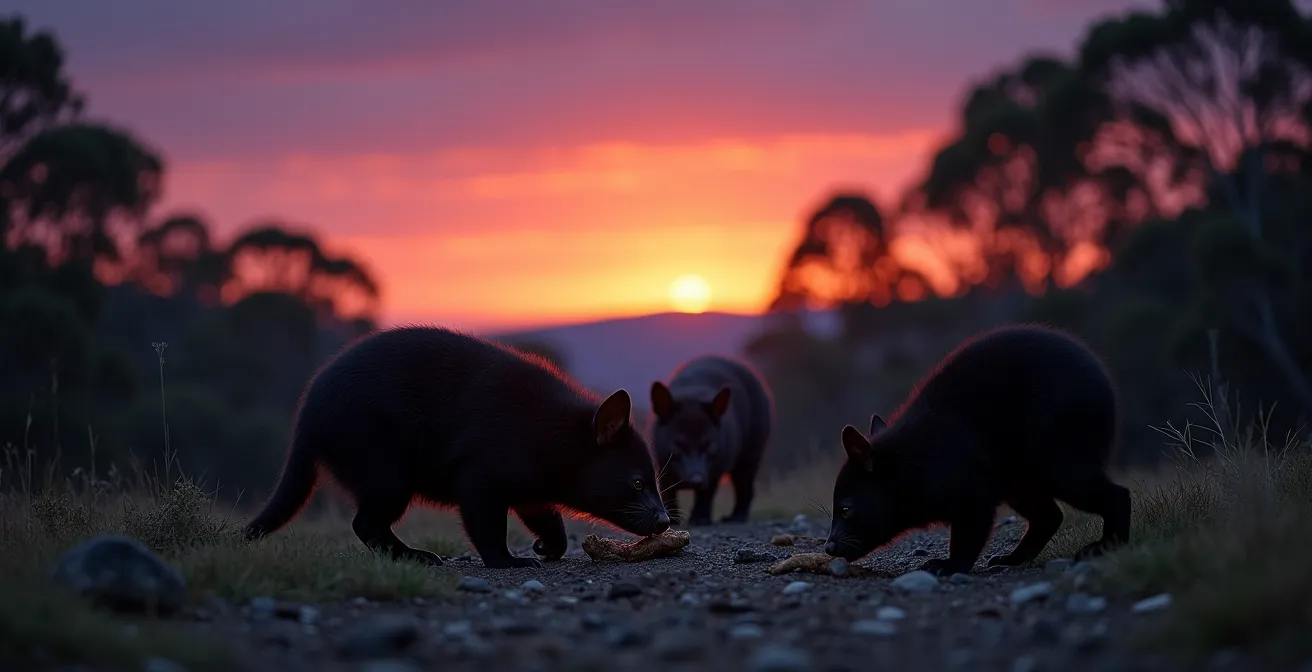
The most impactful Tasmanian devil feeding experience isn’t defined by the spectacle, but by the conservation purpose behind it.
- Sanctuaries act as critical ‘insurance populations’ to save the species from the Devil Facial Tumour Disease (DFTD).
- Your visit supports diverse conservation philosophies, from hands-on breeding programs to revolutionary ‘cage-free’ habitats.
Recommendation: Choose the sanctuary whose mission resonates most with you, turning your visit from passive viewing into an active contribution to saving an icon.
The sound is what most people come for: a cacophony of guttural growls, menacing screeches, and the unmistakable crunch of bone. The Tasmanian devil feeding is an iconic, visceral wildlife spectacle. Many tourists simply check the feeding times at the nearest sanctuary, eager to witness this famous frenzy. It’s an unforgettable show of raw power, a glimpse into the wild heart of Tasmania’s most famous marsupial.
But what if the “best” experience goes deeper than the volume of the snarls? The confronting reality is that you are watching this display within a sanctuary for a grim reason: the Devil Facial Tumour Disease (DFTD), a contagious cancer that has decimated the wild population. This context transforms the experience. It’s no longer just a tourist attraction; it’s a front-row seat to a critical conservation battle. The real question for the thoughtful traveller becomes: which sanctuary offers the most meaningful connection to this fight for survival?
This guide moves beyond a simple list of feeding times. We will compare the different philosophies and experiences offered by Tasmania’s leading sanctuaries. By understanding their unique roles in the species’ recovery, you can choose an encounter that not only thrills you but also allows you to become part of the solution. Your visit is a vote, and this guide will help you cast it wisely.
To help you decide which devil encounter is right for you, we’ve broken down the key aspects of the sanctuary experience. From understanding their vital conservation role to knowing the best times to visit, this structure will guide you toward a truly unforgettable and impactful wildlife adventure.
Summary: A Guide to Choosing Your Tasmanian Devil Encounter
- Why sanctuaries are critical insurance populations for the species’ survival?
- Dusk or feeding time: when are devils most active and vocal?
- Devil Ark tours: seeing how devils are prepared for release back into the wild
- No cages: how the Unzoo concept changes the way you interact with wildlife?
- Virtual adoption: how to continue supporting the species after your holiday ends?
- Why fenced sanctuaries are your best chance of seeing a bettong in the wild?
- Museum hopping: escaping the rain in MONA and the TMAG
- Camping at Wilsons Promontory: How to Secure a Spot Near Wombats?
Why sanctuaries are critical insurance populations for the species’ survival?
To understand the role of sanctuaries, you must first understand the crisis. The Devil Facial Tumour Disease (DFTD) is an aggressive, transmissible cancer that has been a wrecking ball for the species. Since its discovery in 1996, the disease has been relentless. In fact, the wild population has suffered a catastrophic decline, dropping from over 150,000 in 1996 to as few as 10,000-25,000 adults in just over a decade. This staggering loss pushed the Tasmanian devil onto the endangered species list and to the brink of extinction.
In the face of this threat, sanctuaries shifted from being simple tourist attractions to becoming vital arks. Their primary mission is to establish and maintain ‘insurance populations’ – groups of healthy, genetically diverse devils kept in safe, isolated environments, completely protected from the disease. These populations are the species’ lifeline. If the worst happens and wild populations collapse entirely, these healthy devils hold the key to the future.
Case Study: Aussie Ark’s Breeding Program Success
The success of this strategy is tangible. For example, Aussie Ark founded its Tasmanian devil breeding program in 2011 with just 44 individuals. Through meticulous care and a science-backed breeding strategy, that small group has flourished. Today, the facility is home to more than 200 devils, which represents about half of the entire captive insurance population on mainland Australia. This demonstrates the powerful role sanctuaries play not just in protecting, but in actively rebuilding the numbers of this iconic species.
Therefore, when you visit a sanctuary, you are seeing more than just an animal in an enclosure; you are witnessing a living, breathing genetic bank, a crucial buffer against total extinction. Your entry fee directly funds this critical work.
Dusk or feeding time: when are devils most active and vocal?
While the conservation story is paramount, the thrill of seeing devils at their most active is a major draw. Tasmanian devils are naturally crepuscular, meaning they are most active at dawn and dusk. In the wild, these cooler, low-light hours are their prime time for hunting and scavenging. Sanctuaries structure their tours to align with these natural rhythms, giving you the best chance to see dynamic behavior.
Feeding presentations are the highlight for many visitors. This is when you’ll witness the famous social dynamics, the jostling for position, and the powerful jaw strength that gives the devil its name. The vocalizations, from low growls to high-pitched screeches, are most pronounced during these communal feeding events.
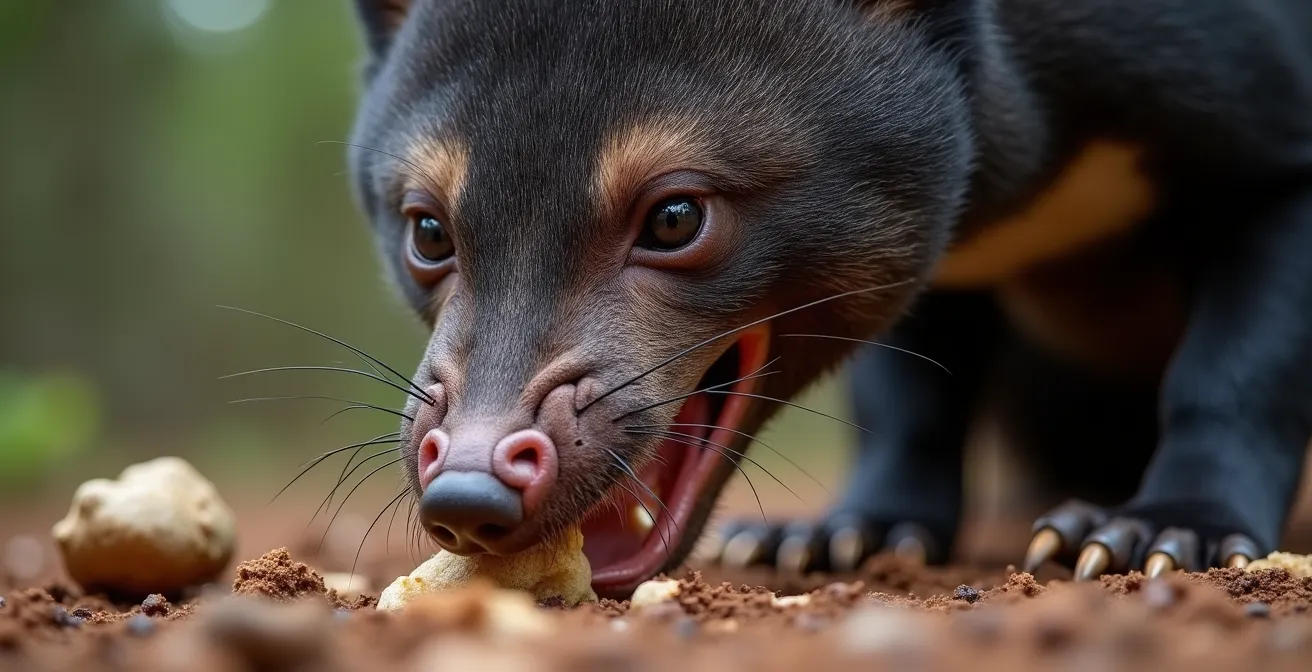
To maximize your experience, it’s worth planning your visit around the specific tours offered. Most sanctuaries have a varied schedule that allows you to see different facets of devil behavior beyond just the main feeding frenzy. Choosing the right tour can dramatically change your experience from a quick viewing to an in-depth encounter.
Here are some typical tour options you might find, based on schedules like the one at Devils @ Cradle:
- Day Keeper Tour (e.g., 10:30am & 3:00pm): Excellent for educational content, where keepers share detailed insights about the animals and conservation efforts in a calmer setting.
- Day Feeding Tour (e.g., 1:00pm): This is the classic, high-action feeding event, perfect for seeing their competitive nature and raw power.
- Joey Encounter (e.g., 12:00pm & 4:00pm): A more intimate and gentle experience, often allowing for close-up views of the youngest generation of devils (seasonally dependent).
- After Dark Feeding Tour (e.g., 5:30pm): This aligns perfectly with their natural crepuscular activity. Observing a feeding as dusk settles provides a more authentic, atmospheric experience.
- Late Evening Tour (e.g., 8:30pm, seasonal): In the quiet of the night, vocalizations can be even more pronounced, offering a completely different sensory experience.
Devil Ark tours: seeing how devils are prepared for release back into the wild
The ultimate goal of an insurance population is not just to exist, but to one day return animals to the wild. This is where the story moves from preservation to active restoration. Programs like those at Aussie Ark (the mainland branch of the Tasmanian devil conservation effort) are at the forefront of preparing devils for this monumental step.
These tours offer a unique, behind-the-scenes look at what it takes to ‘rewild’ a species. It’s a far more complex process than simply opening a cage. The devils are raised in large, semi-wild enclosures that mimic natural bushland, encouraging them to retain their wild instincts. They learn to compete for food, find shelter, and interact as they would in a natural environment. This “wild-proofing” is essential for their survival post-release.
The results of this meticulous preparation are historic. In a landmark project, 26 devils were successfully reintroduced to a large sanctuary on mainland Australia, marking their return after an absence of 3,000 years. This is conservation in action, and a tour at such a facility allows you to witness the science and dedication behind such a milestone.
The work doesn’t stop once the devils are released. The animals are closely monitored through regular surveys, radio collars fit with transmitters, and camera traps. This technology allows researchers to track their movements, understand their diet, observe their breeding success, and learn how they adapt to their new territory. This data is invaluable, informing future reintroduction efforts and providing a real-time report card on the project’s success.
No cages: how the Unzoo concept changes the way you interact with wildlife?
While many sanctuaries operate on a model of safe, high-welfare enclosures, the Tasmanian Devil Unzoo on the Tasman Peninsula offers a radically different philosophy. It aims to deconstruct the very idea of a traditional zoo. The Unzoo is designed as a ‘wildlife-without-cages’ experience, where the barriers between visitor and animal are removed wherever safely possible, fostering a more natural and immersive encounter.
This pioneering approach was lauded by international zoo designer Jon Coe, who saw it as the blueprint for a new kind of wildlife park. He noted it would be a leading example of the future:
To my knowledge you will be the first to test and develop a fully-functioning example of what I believe will become the zoo, or ‘unzoo’ of the future
– Jon Coe, International zoo designer
The Unzoo concept is built around inviting wildlife into a shared space rather than containing it. The property is not fenced, allowing wild animals to come and go as they please. Visitors explore the native bushland habitat on elevated walkways, observing the resident devils and other wildlife as they roam freely in an environment that is, for all intents and purposes, their own. This changes the dynamic entirely: you are a guest in their world, not the other way around.
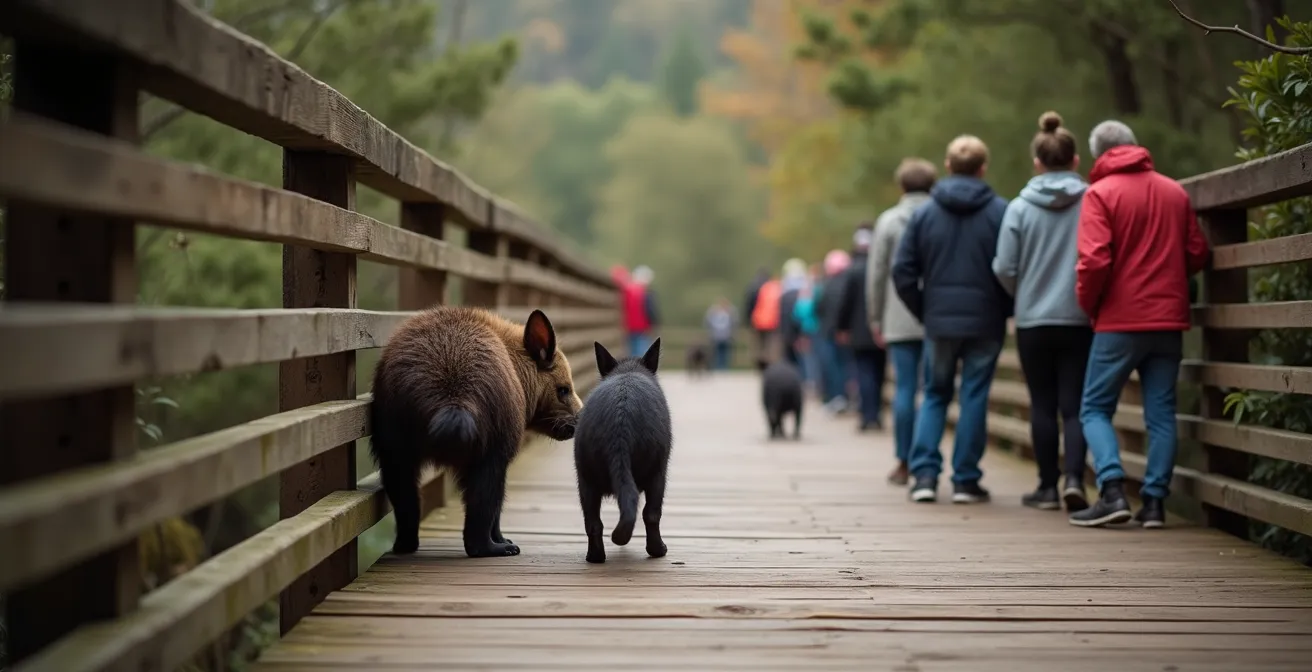
This philosophy fosters a deeper respect for the animals’ autonomy and natural behavior. The experience is less about a guaranteed, on-demand spectacle and more about the quiet thrill of a genuine encounter in a naturalistic setting. It’s a powerful statement about co-existence and a compelling alternative for visitors seeking an experience that feels less like a zoo and more like a walk in the wild.
Virtual adoption: how to continue supporting the species after your holiday ends?
A visit to a Tasmanian devil sanctuary can be a profound experience, and for many, it sparks a desire to contribute long after their holiday is over. The scale of the conservation effort is immense; for instance, the breeding programs are a continuous cycle of care, with facilities like Aussie Ark having successfully bred and raised over 390 devils. This ongoing work relies heavily on public support.
Fortunately, sanctuaries have made it easy for visitors to stay involved and become long-term advocates for the species. These programs not only provide crucial funding but also keep you connected to the animals you met and the mission you supported. Your one-day visit can evolve into a lasting relationship with the conservation program.
If you’re inspired to continue your support, you have several direct and impactful options available. These channels ensure that your contribution goes straight to the front lines of the conservation battle, funding everything from food and veterinary care to research and habitat restoration.
Your Action Plan: Supporting Devil Conservation Post-Visit
- Adopt a Devil: Most sanctuaries offer virtual adoption programs. For a recurring donation, you receive regular updates, photos, and stories about your specific devil, creating a personal connection to the cause.
- Join Citizen Science: Use apps like the Road-kill TAS app to report sightings of roadkill. This data is vital for researchers to understand devil mortality rates and identify hotspot areas for mitigation measures.
- Donate Directly: Support the official Save the Tasmanian Devil Program or your chosen sanctuary through one-off or recurring financial donations.
- Spread the Word: Use your social media to share photos from your visit along with the conservation messages you learned. Raising awareness is a powerful, free way to contribute.
- Plan a Return Visit: Your tourism dollars are a sustainable source of funding. Visiting during different seasons can offer new experiences and continue your direct support.
Why fenced sanctuaries are your best chance of seeing a bettong in the wild?
Beyond the iconic devil, Tasmania’s sanctuaries are crucial havens for other unique and threatened species, such as the Eastern Bettong. For wildlife enthusiasts, these fenced sanctuaries offer the absolute best, and often only, chance of seeing one of these elusive creatures.
Bettongs, also known as rat-kangaroos, are small, nocturnal, and incredibly shy. In unfenced wilderness, their natural camouflage and preference for foraging under the cover of darkness make them exceptionally difficult to spot. More importantly, they are highly vulnerable to predation by feral cats and foxes, which have decimated their populations in many areas. Their survival in the wild is a constant struggle.
This is why predator-proof fenced sanctuaries are so vital. Within these protected zones, two things happen. First, the primary threats to their existence are eliminated, allowing their populations to stabilize and grow without pressure from introduced predators. Second, this creates a higher density of bettongs in a defined area. For visitors on a guided night tour, this concentration dramatically increases the likelihood of a successful and memorable sighting. You can observe their natural foraging and digging behaviors in a safe, controlled environment, an opportunity that is virtually impossible to come by in the vast, unprotected bush.
Museum hopping: escaping the rain in MONA and the TMAG
Even the most dedicated wildlife enthusiast has to contend with Tasmania’s famously fickle weather. When a rainy day puts your outdoor plans on hold, the island offers world-class cultural alternatives that provide a different kind of immersive experience. Hobart, in particular, is home to two contrasting institutions: the provocative MONA and the historic TMAG.
Choosing between them is a matter of taste. A visit to MONA (Museum of Old and New Art) is a deep dive into the avant-garde. Housed in a stunning subterranean structure, its collection is designed to challenge, provoke, and entertain. Exploring MONA is an experience in itself, with its interactive “O” device guiding you through themes of sex, death, and radical creativity. It’s an adult-oriented, world-renowned institution that is as much about the architecture and atmosphere as it is about the art. It is the perfect choice for those seeking a modern, edgy, and unforgettable cultural jolt.
In contrast, the TMAG (Tasmanian Museum and Art Gallery) offers a more traditional but equally fascinating journey through Tasmania’s natural and cultural history. Here you can explore colonial art, delve into the island’s unique geology, and see haunting exhibits on the extinct Tasmanian Tiger (Thylacine). TMAG is family-friendly, comprehensive, and provides deep context to the island you are exploring. It’s the ideal choice for history buffs or anyone wanting to ground their travel experiences with a richer understanding of Tasmania’s past and its unique place in the world.
Key Takeaways
- Sanctuaries are vital arks providing an ‘insurance policy’ against the devastating Devil Facial Tumour Disease (DFTD).
- The ‘best’ visitor experience balances the spectacle of feeding with a deep understanding of the underlying conservation mission.
- Your tourism choice directly funds different recovery strategies, from hands-on breeding programs to innovative rewilding efforts.
Camping at Wilsons Promontory: How to Secure a Spot Near Wombats?
While discussing iconic Australian wildlife, it’s worth clarifying a common point of confusion. Wilsons Promontory in Victoria is indeed a legendary destination for seeing wombats up close, especially around the Tidal River campground. However, for those on a Tasmanian adventure, you don’t need to cross the Bass Strait! Tasmania has its own world-class wombat-spotting locations.
Two of the best are Cradle Mountain-Lake St Clair National Park and Maria Island National Park. At Cradle Mountain, wombats are a common sight, often grazing placidly on the grassy plains in the late afternoon. Securing a spot at the park’s campgrounds or nearby caravan parks often requires booking many months in advance, especially during peak season, due to its immense popularity.
Maria Island offers an even more immersive experience. This vehicle-free island is a true sanctuary where wombats are abundant and remarkably unfazed by human presence. To camp here, you must book a ferry pass, which includes your national park entry, and then secure a spot at the basic but beautifully located campground. Just like choosing the right devil sanctuary, selecting the right wombat location is key to a successful encounter. It’s about being in the right place at the right time.
Ultimately, whether you’re watching a devil feeding, seeking out a wombat, or exploring a museum, a trip to Tasmania is a series of choices. The most rewarding journey comes from understanding the story behind what you’re seeing. The devil feeding is not just a spectacle; it’s a symbol of a desperate fight for survival, and your presence can be a genuine contribution to that fight.
Now that you understand the different conservation philosophies, explore the official sanctuary websites and choose the experience that connects with you. Your visit is more than a holiday photo; it’s a lifeline for an Australian icon.