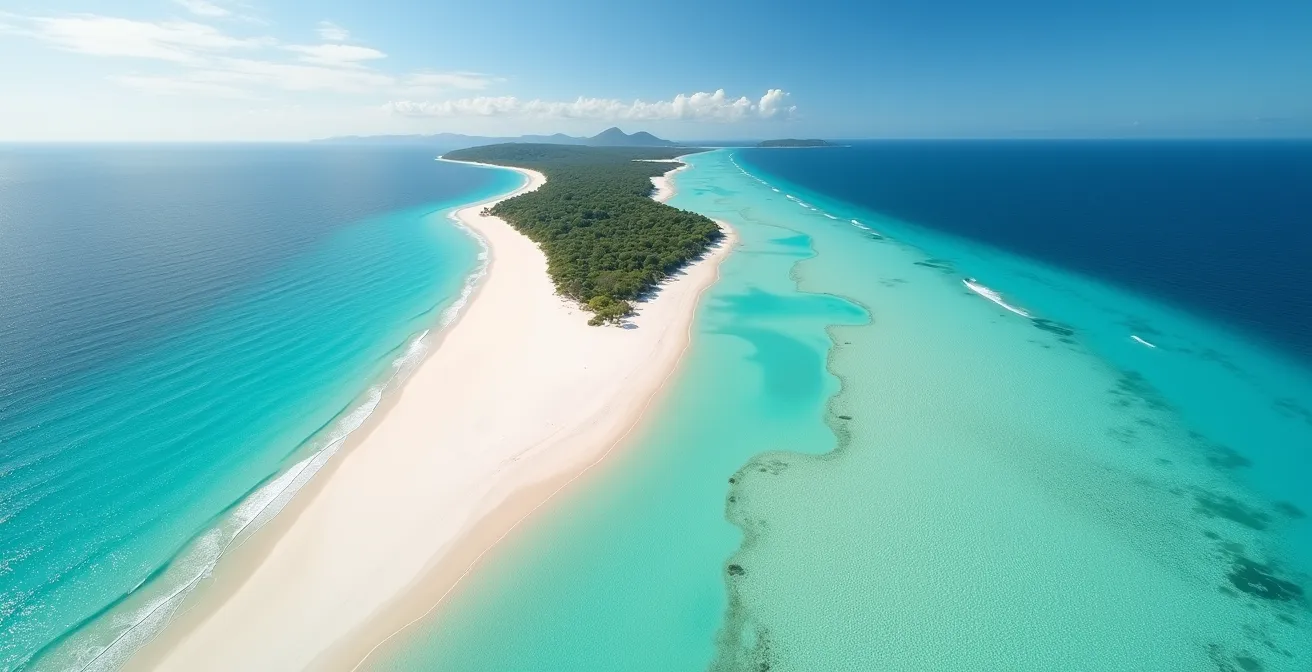
The $150 seaplane flight is a worthwhile investment, not for the flight itself, but for buying strategic access to a crowd-free beach and optimal tidal conditions that most boat tours cannot guarantee.
- The seaplane offers superior “time arbitrage,” landing during midday lulls when boat passengers are elsewhere, effectively securing a private beach experience.
- It guarantees an aerial view of Hill Inlet’s iconic swirling sands, regardless of the tide that constrains boat-based lookout hikes.
Recommendation: For travellers who value photographic opportunities and solitude over budget, the seaplane delivers a higher “Experience ROI” by mitigating the biggest variables: crowds and tides.
The question hangs over every Whitsundays itinerary: is the seaplane flight to Whitehaven Beach—often priced around $150 more than a standard boat trip—truly worth the splurge? Most will tell you the views are breathtaking or that it’s a “once-in-a-lifetime” moment. While true, these emotional justifications miss the core of the value proposition. The usual advice pits time-saving against budget, a simplistic trade-off that fails to capture the strategic advantages one option holds over the other.
This isn’t just about getting there faster. The real debate is about resource management. On any given day, Whitehaven has two scarce resources: crowd-free space on its seven-kilometre shoreline and the narrow tidal window where Hill Inlet’s magic is at its peak. Choosing between a seaplane and a boat is a decision about which of these resources you want to control. A boat tour sells you a seat; a seaplane tour sells you tactical superiority over the elements and the crowds.
But is this strategic advantage worth the significant price difference? To answer that, we must move beyond the surface-level benefits and conduct a critical, value-oriented analysis. This review dissects the physics of the sand, the logistics of packing, the science of seasickness, and the economics of booking. It’s a verdict based not on sentiment, but on a clear-eyed assessment of what you’re actually buying for that extra $150.
This article provides a comprehensive breakdown to help you make an informed decision. We will explore the unique properties of Whitehaven’s sand, essential packing tips, strategies for optimal viewing and solitude, and a hard look at which travel method offers the best value for your specific needs.
Summary: A Critical Guide to the Whitehaven Beach Day Trip
- Why silica sand stays cool underfoot even in 30°C tropical heat?
- The essential items to bring to Whitehaven where there are no shops
- Hill Inlet lookout: timing your hike to see the swirling sand patterns
- The timing strategy to have Whitehaven Beach almost to yourself
- Catamaran or high-speed raft: which vessel minimizes sea sickness?
- The outer reef chop: how to prevent nausea on small boat charters?
- Lord Howe Island cap: why you need to book accommodation 12 months out?
- Package Deals vs DIY Booking: Which Saves More for Families?
Why silica sand stays cool underfoot even in 30°C tropical heat?
The first sensation upon stepping onto Whitehaven Beach isn’t just the softness; it’s the surprising coolness of the sand, even under the full force of a tropical sun. This isn’t magic, but pure physics. The sand is composed of 98.9% pure silica, a crystalline structure that gives it unique thermal properties. Unlike darker, volcanic sands that absorb solar radiation and can reach scalding temperatures, silica reflects the majority of the sun’s heat.
A 2025 study in Scientific Reports highlighted that quartz, the mineral form of silica, has one of the highest thermal conductivities among soil minerals. This means it is incredibly efficient at dissipating heat rather than storing it. While other beaches might become unbearable, Whitehaven’s surface rarely exceeds comfortable temperatures, allowing you to walk barefoot at midday without a second thought. This small detail has a significant impact on the quality of your experience, transforming the entire 7km stretch of beach into a usable, comfortable space at all hours.
This unique geological feature means you spend less time hopping between towels and more time enjoying the environment. It’s a foundational element of the beach’s luxury appeal—a natural comfort that no man-made amenity can replicate. It ensures that the entire expanse of the beach is your playground, not just the sliver of shade at the tree line.
The essential items to bring to Whitehaven where there are no shops
Whitehaven’s pristine nature is its greatest asset, but it comes with a logistical challenge: there are absolutely no facilities. No shops, no cafes, no rental huts. You must be entirely self-sufficient. Packing correctly is not a suggestion; it’s a prerequisite for a successful day trip. Beyond the obvious sunscreen and water, a few specialist items can dramatically elevate your experience, particularly when it comes to photography and protecting your gear.
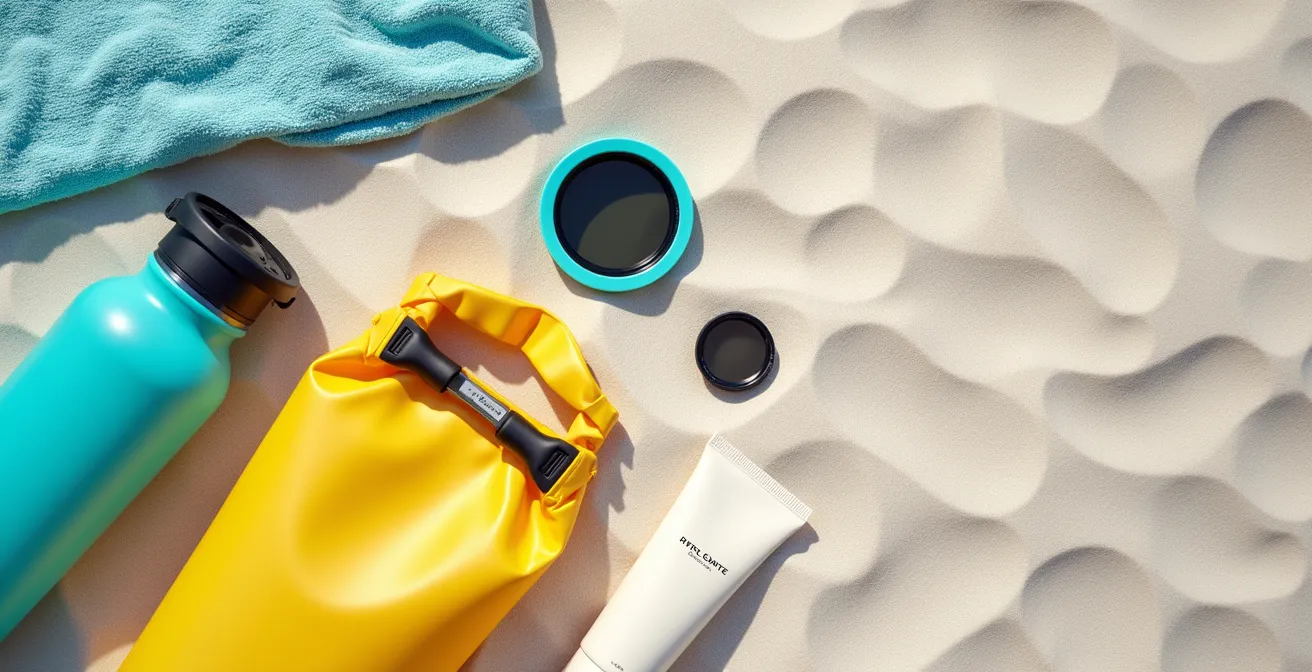
The ultra-fine silica sand, while beautiful, is the natural enemy of electronics. A high-quality waterproof phone pouch is non-negotiable. Similarly, the intense glare off the water and white sand can wash out photos. A polarizing filter for your camera is the single most important accessory for capturing the vibrant turquoise hues of the Coral Sea. It works by cutting through the surface glare, revealing the rich colours beneath.
Your packing strategy should also adapt to your mode of transport:
- For seaplane tours: Luggage allowance is minimal. Prioritize ultra-compact items: a microfibre towel, a collapsible water bottle, and multi-purpose gear.
- For boat tours: You have more space. Consider adding comfort items for the longer journey, such as anti-nausea bands, a book, or extra layers for the windy return trip.
A high-quality lens cloth is also essential, as the constant sea spray will coat your camera lens. Being prepared for these small details ensures you spend your time immersed in the beauty, not wrestling with your equipment.
Hill Inlet lookout: timing your hike to see the swirling sand patterns
The iconic image of Whitehaven is not the beach itself, but the mesmerizing vista from Hill Inlet Lookout, where tides sculpt the pure white sand and turquoise water into a marbled masterpiece. However, seeing this spectacle is a matter of precise timing. The “swirling sands” effect is only visible during a specific tidal phase, making your tour’s schedule a critical factor in your experience.
The phenomenon is most dramatic at mid-tide, typically between 9:30 AM and 11:00 AM on a day with a significant tidal range. This is when the receding or incoming water flows through the channels in the sand, creating the painterly swirls. At high tide, the sand is submerged and the effect is lost. At low tide, the channels are mostly empty, revealing vast sand flats that are beautiful but lack the dynamic, marbled pattern. Local boat operators confirm the swirling effect intensifies during spring tides, when there is an 8+ feet tidal range, creating more powerful currents.
This is where the seaplane offers a distinct strategic advantage. A boat tour is tethered to a fixed arrival and departure time, which may or may not align with the optimal mid-tide window. You might arrive too early or too late. A seaplane, however, offers more flexibility and, crucially, provides an unobstructed aerial view from 500-1000 feet. From the air, the entire 7km composition is visible regardless of the tide, guaranteeing you see the epic scale of Hill Inlet. The lookout hike offers immersive detail, but the seaplane guarantees the iconic shot.
The timing strategy to have Whitehaven Beach almost to yourself
The fantasy of Whitehaven is a deserted stretch of perfect white sand. The reality, for many, is sharing it with hundreds of other day-trippers. However, achieving solitude is possible through a strategy of “time arbitrage”—being in the right place when everyone else is in the wrong one. The key is understanding the predictable flow of tour groups.

Analysis of tour itineraries reveals a golden window of opportunity. Between approximately 12:00 PM and 1:30 PM, the vast majority of boat tour groups are funnelled towards the southern end of the beach for lunch or are undertaking the hike to Hill Inlet Lookout. During this period, the main, central stretch of Whitehaven Beach becomes significantly emptier. This is the moment of peak “crowd-density arbitrage”.
A seaplane tour is perfectly positioned to exploit this lull. By landing directly on the main beach during this midday window, you are effectively buying a semi-private experience. While boat passengers are on a fixed schedule, you are enjoying the beach at its quietest. Furthermore, most tour groups cluster near the southern landing zone. The northern three miles of the beach remain virtually empty for most of the day, accessible to those willing to walk or who arrive by a more agile vessel.
An alternative strategy is to book a late afternoon tour. As most boats begin their return journey around 4:00 PM, the beach empties out, leaving you with smaller crowds and the superior, warm light of the “golden hour” for photography. This is a trade-off: you get less time on the beach, but the quality of that time, in terms of solitude and photographic potential, is significantly higher.
Catamaran or high-speed raft: which vessel minimizes sea sickness?
For many travellers, the idyllic destination is overshadowed by the dreaded prospect of seasickness. The 60-90 minute journey from Airlie Beach can involve choppy seas, particularly in the Whitsunday Passage. The type of vessel you choose has a profound impact on your comfort level, as different boats handle rough water in fundamentally different ways. The choice between a stable catamaran and a nimble raft is a critical one for anyone prone to motion sickness.
It’s a question of vessel dynamics. A monohull boat tends to roll from side to side. A high-speed raft has minimal roll but experiences quick, sharp vertical movements as it skips over waves. For many, this jarring “slamming” motion can be a potent trigger for nausea. A large catamaran, by contrast, offers the most stable ride. Its twin hulls provide a wide, stable base that dramatically reduces roll, the motion most commonly associated with seasickness. While it can still pitch (move up and down from bow to stern), the overall movement is generally slower and more predictable.
This following comparison, based on data from charter experts, breaks down the risk profile for each vessel. As a general rule, a catamaran’s stability offers a significant advantage for those concerned about nausea.
According to an analysis of vessel stability, the choice of boat is a primary factor in preventing motion sickness.
| Vessel Type | Motion Type | Seasickness Risk | Best Seating Zone |
|---|---|---|---|
| Catamaran | Minimal roll, some pitch | Low (3x less than monohull) | Center, lower deck, facing forward |
| High-speed raft | Quick vertical movements | Moderate to High | Center seats, avoid front |
| Large ferry | Slow, predictable roll | Low to Moderate | Mid-ship, lower decks |
Regardless of the vessel, the best place to sit is always on the lower deck, in the center of the boat, where the motion is least pronounced. Facing forward and keeping your eyes on the fixed horizon also helps your brain reconcile the conflicting signals from your eyes and inner ear.
The outer reef chop: how to prevent nausea on small boat charters?
Even on the most stable vessel, a windy day can create challenging conditions. Preventing seasickness is not something that starts when you feel the first wave; it’s a 24-hour proactive strategy. If you are at all susceptible to motion sickness, a pre-emptive protocol is your best insurance for an enjoyable day. Relying on a last-minute pill is a gamble; preparing your body is a plan.
The vestibular system—the part of your inner ear that controls balance—is highly sensitive to what you eat and how rested you are. Alcohol, greasy foods, and fatigue are all major contributors that lower your tolerance for motion. Survey data shows that on well-managed tours, guests who prepare are rarely affected. The key is a multi-pronged approach that begins the day before your trip, combining diet, medication timing, and on-board techniques.
The most effective over-the-counter medications, such as those containing scopolamine (available in patch form), require several hours to reach maximum effectiveness. Applying a patch just before departure is often too late. By following a structured protocol, you give your body the best possible defense against the disorienting effects of the outer reef chop.
Your 24-Hour Seasickness Prevention Protocol
- The Day Before: Avoid all greasy foods and alcohol. Focus on staying well-hydrated with water.
- A Full Night’s Sleep: Fatigue is a critical trigger. Prioritize getting at least 8 hours of sleep as your primary defense.
- Morning Of: Eat a light, non-greasy breakfast. Incorporate ginger in some form (tablets, natural chews, or tea) as it is a proven natural anti-nausea aid.
- Medication Timing: If using a scopolamine patch, apply it at least 4 hours before departure for it to become fully effective.
- On-Board Technique: Practice the “horizon lock” method. Find a fixed point on the distant horizon and keep your gaze locked on it to give your brain a stable reference point.
Key Takeaways
- The seaplane’s value is in buying “quality time”—accessing the beach during crowd lulls and guaranteeing aerial views regardless of tide.
- Whitehaven’s sand stays cool due to its 98.9% silica content, which reflects heat instead of absorbing it.
- For seasickness, a large catamaran is the most stable option; however, a 24-hour prevention strategy is more effective than vessel choice alone.
Lord Howe Island cap: why you need to book accommodation 12 months out?
The mention of Lord Howe Island in a discussion about Whitehaven Beach seems out of place, but it provides a perfect analogy for a critical concept in travel planning: the economics of scarcity. Lord Howe Island famously caps its visitor numbers to 400 at any one time, creating intense demand for a limited resource. This forces travellers to book accommodations up to 12 months in advance. While Whitehaven Beach has no such official cap, its premium experiences operate under a similar principle.
The best tours—especially seaplane flights with coveted window seats and private charters that align with perfect tides—sell out weeks, sometimes months, in advance. This is particularly true for operators with Advanced Eco-Certification, who deliberately limit their group sizes to 25-32 passengers to ensure a higher quality, sustainable experience. You are not just booking a trip; you are competing for a limited slot.
This is where the true cost-benefit analysis comes into play. As one tourism analysis on Whitehaven tour planning notes, different tours “spend” the scarce resource of time differently. The seaplane is a ‘high cost, low time’ investment, maximizing the quality of a shorter duration. The boat is a ‘low cost, high time’ option, where the journey itself is a larger part of the day’s total time.
A day trip caps your time. Just as Lord Howe caps visitors, different tour types ‘spend’ this scarce resource differently – seaplane as ‘high cost, low time’ and boat as ‘low cost, high time’
– Tourism analysis perspective, Whitehaven Beach tour planning considerations
Thinking of the seaplane flight as simply “more expensive” is a mistake. It is a purchase of priority access, much like booking a year ahead for Lord Howe Island. You are paying a premium to bypass the constraints that affect the majority of visitors.
Package Deals vs DIY Booking: Which Saves More for Families?
For solo travellers or couples, booking tour tickets individually (Do-It-Yourself) can seem straightforward. However, for families and groups, the financial equation shifts dramatically in favour of all-inclusive package deals. While the upfront ticket price might look similar, hidden costs associated with DIY booking can quickly add up, eroding any perceived savings.
An analysis of family bookings for Whitehaven tours shows that operators like Cruise Whitsundays offer specific family packages that provide significant savings. These bundles typically include not just the tour, but also essential extras like return coach transfers from your accommodation, a provided lunch, and all national park fees. When booked separately, these items can add a substantial amount to the final bill. For example, booking four individual tickets might cost over $580, whereas a family package for two adults and two children can be found for under $500, representing an immediate saving of over $80.
As this comparative data from family booking analysis shows, the all-inclusive nature of package deals provides both financial and logistical certainty.
| Booking Type | Family of 4 Cost | Includes | Hidden Costs |
|---|---|---|---|
| Package Deal | $495 (2A+2C special) | Transfers, lunch, all equipment | None – all inclusive |
| DIY Individual | $580+ (4 separate tickets) | Basic tour only | Transfers ($12/person), lunch, booking fees |
| Group Discount | $516 (family rate) | Tour + some inclusions | May need adjacent seat booking |
Beyond the direct financial savings, package deals eliminate significant logistical risks. DIY booking for a seaplane, for instance, offers no guarantee of adjacent seats for a family. A package deal provides a single point of contact for weather-related cancellations or schedule changes, a crucial benefit when coordinating a group. For families, the value of a package deal lies not just in the money saved, but in the peace of mind it provides.
Ultimately, the decision to opt for the seaplane is an investment in certainty. It’s for the traveller who wants to guarantee the iconic aerial shot, ensure maximum time on a quiet beach, and minimize transit discomfort. If your travel philosophy prioritizes unique experiences and photographic results over budget, the verdict is clear: the seaplane is not just a flight, it’s a strategic tool that delivers a superior return on your most valuable asset—your time.