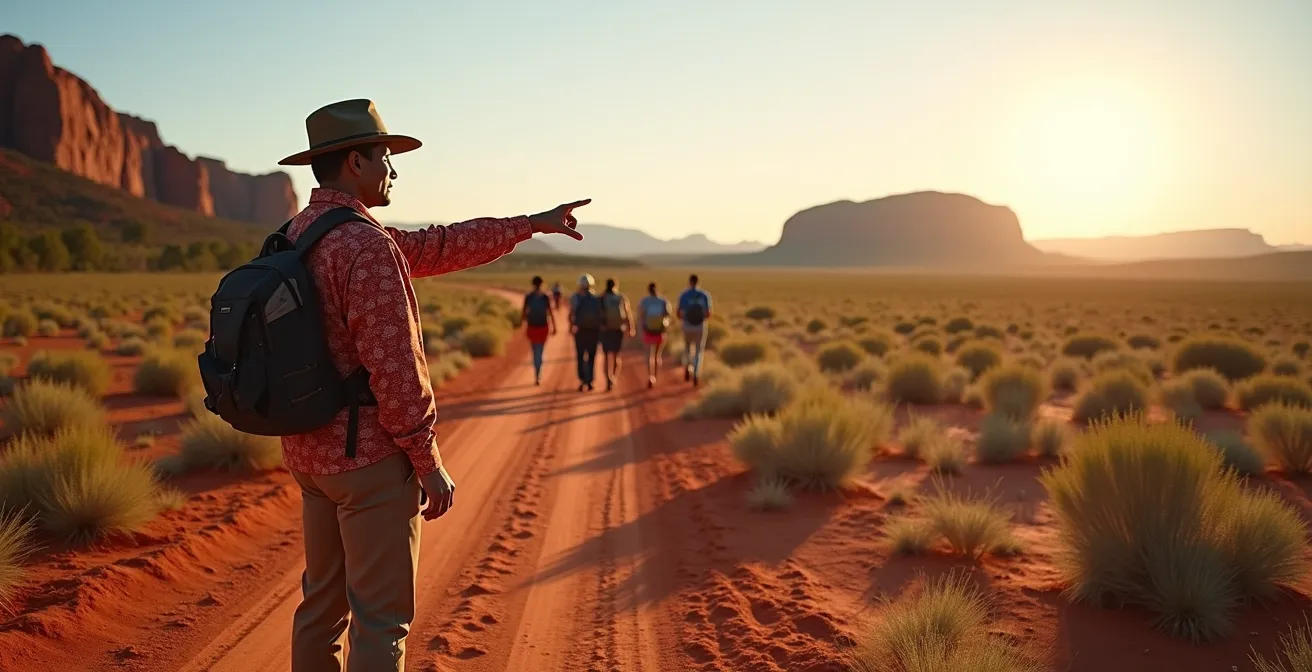
Choosing a self-guided walk shows you a landscape; an Indigenous-led tour lets you read a living library.
- A guide translates the invisible, revealing a world of medicine, history, and law hidden in plain sight.
- They provide cultural literacy, teaching you to see ancient signs like scar trees and understand protocols like smoking ceremonies.
Recommendation: To truly experience a Songline, invest in a guide. It’s the difference between looking at a book cover and having the author read you the story.
Standing at a trailhead, the modern hiker feels a familiar pull. The path ahead promises physical challenge, stunning vistas, and a quiet escape. For many, the choice between a free, self-guided trek and a paid, Indigenous-led tour seems simple—a matter of budget. Why pay for a guide when a GPS and a good map seem sufficient? This thinking, while practical, misses the fundamental nature of the Australian landscape. It treats the land as a beautiful but static backdrop, a museum to be observed from a distance.
But what if the landscape wasn’t a museum, but a library? What if every tree, rock, and creek bed was a page in an epic story, written in a language you couldn’t read? This is the core value proposition of an Indigenous guide. They are not merely navigators; they are translators. Their role is to unlock a profound layer of reality that is otherwise completely invisible, transforming your physical walk along a trail into a narrative journey along a Songline. An Indigenous-led walk is not about being shown more things; it’s about being taught to see the world differently.
This article will demonstrate the irreplaceable value a guide provides. We will explore how they reveal the hidden pharmacy in the bush and the subtle signs of ancient land use. We will cover the critical importance of cultural protocols, from verifying your tour operator to participating respectfully in a Welcome to Country. Finally, we will help you align your physical abilities with the right cultural experience and demystify the concept of ‘Dreamtime,’ showing why it is a living, breathing part of the landscape you walk through.
To help you navigate this deep topic, this guide breaks down the essential elements that distinguish a simple hike from a true cultural immersion. The following sections will explore the specific, tangible value that an Indigenous guide brings to your experience.
Summary: Unlocking the Layers of a Songline Walk
- More than weeds: how a guide reveals the pharmacy hidden in the scrub?
- Scar trees: spotting the subtle signs of ancient resource use
- Ownership verification: ensuring your tour operator is endorsed by the local mob
- Smoking ceremonies: what to expect and do when welcomed onto land?
- Walkabout Creek vs The Larapinta: matching your fitness to the cultural experience
- The difference between a standard tour and an indigenous-led walk
- Under the canopy: why satellite GPS struggles and how to read a topo map?
- Understanding ‘Dreamtime’: Why It Is Not Just Mythology?
More than weeds: how a guide reveals the pharmacy hidden in the scrub?
To an untrained eye, the Australian bush can appear as a monotonous expanse of hardy scrub and resilient trees. But with a guide, this perception shatters. The landscape transforms from mere scenery into a living pharmacy, a pantry, and a hardware store. Your guide acts as a translator, decoding the language of the land. That “unremarkable” bush is suddenly revealed as a source of medicine, its leaves crushed to create a poultice for aches, its sap used as an antiseptic. This isn’t folklore; it’s a sophisticated system of ecological and medicinal knowledge passed down through millennia.
The scale of this knowledge is staggering. Research has documented that over 1511 plant species have been recorded as having been used medicinally by Aboriginal communities in Queensland alone. This knowledge is not just historical; it has profound modern relevance. Consider the case of Dodonaea polyandra, a plant traditionally used by the Kuuku I’yų people for pain relief. Scientists, guided by this ancient wisdom, isolated compounds with potent anti-inflammatory properties. A formal commercialization agreement now exists between researchers and the Chuulangun Aboriginal Corporation, a tangible outcome of respecting and valuing traditional knowledge.
When you walk with a guide, you are not just learning plant names. You are witnessing a dynamic, reciprocal relationship with Country. You learn not only what to use but how and when, including the crucial protocols of seeking permission from the land itself and harvesting sustainably. This is the first, powerful layer of understanding you gain: the bush is not wilderness to be conquered, but a community to be engaged with.
Scar trees: spotting the subtle signs of ancient resource use
As you develop your “cultural literacy” with a guide, you’ll begin to notice marks on the landscape that tell a story of millennia. Among the most evocative of these are scar trees—living monuments to a sophisticated and sustainable way of life. These are trees, typically eucalypts, from which bark was carefully removed to create canoes, shields, coolamons (carrying vessels), or temporary shelters. Far from being random damage, these scars are the signature of a culture that lived in deep harmony with its environment, understanding precisely how much could be taken without killing the tree.
Spotting these can be difficult for the uninitiated. A guide will teach you to distinguish an Aboriginal scar from damage caused by fire, lightning, or farming machinery. They’ll point out the tell-tale signs: the regular, often oval or rectangular shape; the healed edges where the bark has curled over; and the axe-cut marks at the top and bottom. The tree was both a resource and a respected living entity. This is not just an interesting historical fact; it’s a lesson in sustainable resource management that predates modern environmentalism by tens of thousands of years. The presence of around 1000 culturally modified trees recorded in parts of NSW and Queensland alone demonstrates the sheer extent of this practice.
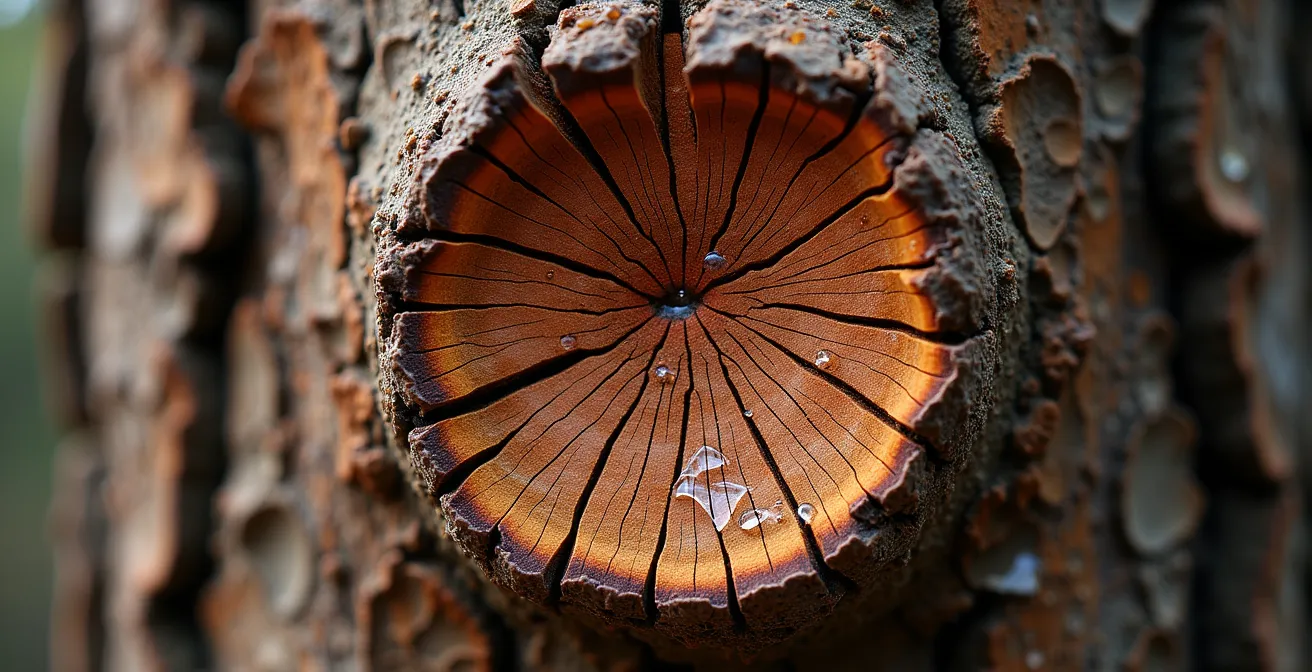
In some cases, modern science is now catching up to validate and protect this knowledge. A landmark collaboration between Wiradjuri Elders and La Trobe University used non-invasive ground-penetrating radar to study carved trees and burial sites. This approach not only confirmed cultural knowledge but also located the resting place of an ancestor, proving that science can serve as a powerful ally in the preservation of sacred sites without disturbing them. A guide doesn’t just show you a scar on a tree; they show you a chapter in a living book of history.
Ownership verification: ensuring your tour operator is endorsed by the local mob
Choosing an Indigenous-led walk is a powerful act of economic reconciliation, but its value is entirely dependent on authenticity. The most crucial step you can take before booking is to ensure your tour is operated or endorsed by the Traditional Owners of the specific Country you will be walking on. This is not just a matter of political correctness; it is a fundamental principle of respect and legitimacy. The stories, knowledge, and right to speak for a particular area belong to a specific group, often referred to as the “local mob.”
An authentic tour means the money you pay directly supports the community whose culture you are learning about. It ensures the knowledge shared is accurate, appropriate, and sanctioned by the Elders who are its custodians. A non-endorsed operator, even if they are of Aboriginal descent from a different region, may not have the right to share the stories of that land. This can be seen as a form of cultural theft and perpetuates a long history of exploitation. It’s akin to having someone from another country try to give you an “authentic” tour of your own hometown.
So how do you verify this? First, look for clear statements of endorsement on the operator’s website. They will often name the specific family groups or Aboriginal corporations they work with. Many legitimate operators are listed on official tourism websites or through organizations like Welcome to Country. Second, don’t be afraid to ask directly: “Are you a Traditional Owner of this land, or are you endorsed by them?” A legitimate operator will be proud to explain their connection and permissions. Choosing an endorsed tour ensures your presence is a respectful partnership, not a transactional intrusion. It’s the difference between being an invited guest and an unannounced visitor.
Smoking ceremonies: what to expect and do when welcomed onto land?
One of the most profound experiences you may have on an Indigenous-led tour is participating in a Welcome to Country, often involving a smoking ceremony. This is not a performance for tourists; it is a sincere and ancient ritual with deep spiritual significance. It is a formal welcome to the land by a Traditional Owner, a cleansing of your spirit, and a way of ensuring you travel safely on their Country. Understanding the etiquette and meaning behind this gift is vital for any respectful visitor.
During the ceremony, the Elder will light the leaves of specific plants—often Eucalypt or Eremophila—to create a thick, fragrant smoke. You will be invited to walk into the smoke and draw it over yourself with your hands. The purpose is twofold: it is believed to ward off bad spirits and it demonstrates your acceptance of being welcomed onto that Country. This is a moment for quiet reflection, not for taking photos. It is a sensory experience designed to shift your mindset from that of a passive observer to an active, respectful participant. The facilitator, like Ngambri and Ngunnawal custodian Paul Girrawah House, often speaks in language to the spirits and the land itself, asking for permission and showing honour.
Your role is one of quiet respect. Stand, listen, and follow the facilitator’s lead. The ceremony is a gift being offered to you. By participating with an open heart and a quiet mind, you acknowledge the deep, continuous connection the Traditional Owners have with their land. It is a powerful reminder that you are a guest in someone else’s home—a home that has been cared for for millennia.
Action plan: Etiquette during a smoking ceremony
- Stand quietly and respectfully during the ceremony
- Draw smoke over yourself with your hands as a gesture of acceptance
- Maintain silent reflection throughout the ceremony
- Understand this as a gift being offered, not a performance
- Allow the smoke’s sensory experience to shift your mindset from tourist to respectful listener
Walkabout Creek vs The Larapinta: matching your fitness to the cultural experience
The term “Songline walk” can encompass a vast range of experiences, from a gentle one-hour stroll around a sacred waterhole to a grueling multi-day trek through a remote desert. It is crucial to match your physical fitness and hiking expectations with the type of cultural immersion offered. A mismatch can lead to frustration, disappointment, or even physical risk. An experienced guide and a reputable tour operator are invaluable in helping you make the right choice, ensuring the physical challenge enhances, rather than detracts from, the cultural journey.
Generally, the shorter the walk, the higher the “cultural density.” A short walk around a single sacred site might involve stopping every few metres to hear a different story or learn about a plant, making it ideal for those who are primarily “Narrative Nomads” seeking stories. Conversely, a challenging multi-day trek like a section of the Larapinta Trail might cover vast distances between major sites. Here, the physical act of walking—the rhythm, the effort, the endurance—becomes part of the spiritual experience itself, echoing the epic journeys of the ancestral beings. This is better suited for “Spiritual Trekkers” seeking transformation through physical and mental challenge.
The following table provides a general guide to help you start thinking about what type of experience best suits you. Discuss your fitness level honestly with your tour operator. They can help you find the sweet spot where the physical journey and the cultural narrative are perfectly in sync, creating a truly memorable and meaningful experience.
| Walk Type | Physical Difficulty | Cultural Density | Best For |
|---|---|---|---|
| Short Sacred Site Walks | Easy (1-2 hours) | Very High – multiple stories per km | Narrative Nomads seeking stories |
| Half-Day Songline Sections | Moderate (4-6 hours) | High – major sites with deep narratives | Connected Observers wanting immersion |
| Multi-Day Desert Treks | Challenging (6+ hours daily) | Moderate – spiritual journey focus | Spiritual Trekkers seeking transformation |
| Seasonal Campsite Routes | Variable | High – following traditional patterns | Those wanting authentic pace |
The difference between a standard tour and an indigenous-led walk
A standard tour treats the landscape as a backdrop for facts. A guide might point to a mountain and state its geological age and height. An Indigenous-led walk, however, reveals the landscape as an active participant in a story. That same mountain is no longer just a geological feature; it’s a sleeping ancestor, a site of creation, or a place where cultural law was handed down. The focus shifts from a collection of isolated data points to an interconnected web of relationships. A standard tour gives you information; an Indigenous tour gives you understanding.
As Nyikina Warrwa Traditional Owner Dr Anne Poelina explains in the Marlaloo Songline Project:
When you look at those sorts of stories, you see the connectivity between all of the elements, between the sky, between the Earth, between the water, between magnificent sacred sites that are in the landscape that connect our people through this ancient wisdom
– Dr Anne Poelina, Nyikina Warrwa Traditional Owner, AIATSIS Marlaloo Songline Project
This “connectivity” is the key difference. The Balginjirr songline mapping project provides a powerful example. Elders had waited since 1976 for the “right moment” to share their knowledge. When they finally walked the Songline, they were not just remembering a story; they were “evoking the songline that has been anciently embedded in the cultural landscape,” bringing it to life through song. The landscape, which to an outsider might seem empty, was animated by their voices, transforming from a static view into a living, breathing entity. A standard tour guide stands outside the story, explaining it. An Indigenous guide stands inside the story, inviting you in.
Under the canopy: why satellite GPS struggles and how to read a topo map?
In modern hiking, we have become deeply reliant on technology. A GPS device feels like a lifeline, a guarantee against getting lost. However, in many parts of Australia, particularly under the dense canopy of a forest or deep within winding canyons, this reliance can become a liability. Satellite signals weaken, batteries die, and the digital screen offers no context for the world around you. A guide, in contrast, carries a mental map honed over a lifetime and inherited through generations—a navigation system far more robust and nuanced than any piece of technology.
This system, the Songline, is not based on abstract grid references but on a narrative woven into the landscape itself. Verses of a song correspond to specific landmarks—a uniquely shaped rock, a bend in a creek, a grove of trees. The rhythm of the song even dictates the pace of the walk. It is a method of navigation that has allowed Aboriginal people to traverse the entire continent for what is estimated to be up to 50,000 years, a period that dwarfs the entire history of satellite technology. It encodes thousands of sites, water sources, and safe routes in a way that is easily memorized and passed down.
While a topographic map is a more reliable tool than a GPS, showing the contours and features of the land, it is still a two-dimensional representation. It shows you the ‘what’ but not the ‘why’ or the ‘how’. A guide reads the land in 4D. They navigate not just by sight, but by story, by the flow of water, by the tracks of animals, and by the spiritual significance of place. They are not just following a path; they are re-enacting a creation journey. Relying solely on GPS is like trying to understand a city by only looking at its subway map; you see the stops, but you miss the life, the culture, and the stories that happen on the streets above.
Key takeaways
- A guide transforms the landscape from a static view into a living library of medicine, food, and history.
- Authenticity is paramount: ensure your tour operator is a Traditional Owner or is endorsed by them to guarantee a respectful and legitimate experience.
- The Dreaming is not a myth of the past but an active, ongoing creation process that a guide can reveal to you in the present landscape.
Understanding ‘Dreamtime’: Why It Is Not Just Mythology?
For many outsiders, the term ‘Dreamtime’ conjures images of ancient myths—creation stories from a long-vanished past, akin to Greek or Roman mythology. This is one of the most profound misunderstandings of Aboriginal culture. A guide’s most valuable role is to correct this misconception and reveal The Dreaming not as a collection of fables, but as an ongoing, living reality that shapes and defines the world right now.
The Dreaming refers to the era of creation by ancestral beings, but it is not confined to the past. It is a continuous process, an ever-present fabric of reality. The paths these beings traveled, their actions, and their transformations are not just stories; they are physically embedded in the landscape. A range of mountains is the sleeping body of an ancestor; a river is the path of the Rainbow Serpent; a waterhole is where a creation event took place. These are not metaphors. For Traditional Owners, these sites are the living embodiment of the ancestral beings, holding their power and their law.
Case Study: The Continuity of Creation
Research on totemic landscapes shows how cultural custodians can identify the transfer of an ancestral being’s essence from one feature to another. If a sacred tree, considered a locus of an ancestral spirit, is destroyed by a storm, the Elders can, through ceremony and observation, determine where that spirit has moved—perhaps into a nearby rock or a newly sprouted sapling. This demonstrates that The Dreaming is not a static story tied to a single object, but a dynamic, living system that adapts and persists, proving cultural continuity despite physical change.
A guide does not “tell you a Dreamtime story.” They show you where The Dreaming is happening right now. They can point to a tree and explain its connection to a specific ancestor, not as a historical footnote, but as a present-day kinship. This shifts your entire perception. The land is no longer a passive object but an active subject, a network of living, powerful entities. Understanding this is to move beyond tourism and begin to grasp a truly different worldview—one where myth, law, and geography are inextricably one.
Now that you’ve seen how an Indigenous guide can unlock these deep layers of meaning, the choice becomes clear. It’s not a choice between a free walk and a paid one. It’s a choice between seeing a landscape and truly experiencing a Country. To invest in an authentic, Indigenous-led tour is to invest in the deepest possible connection to the land you walk upon.