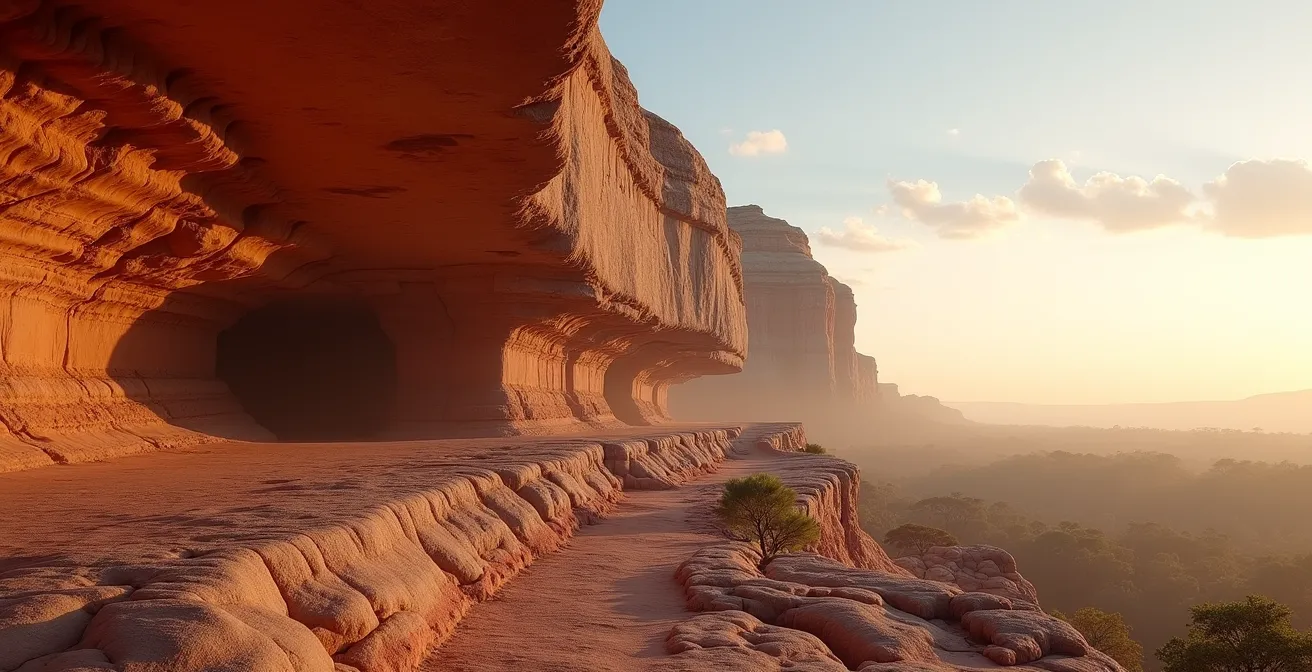
Your frustration at finding a rock art site closed is understandable, but these closures are not arbitrary. They are a critical part of a complex system of custodial management led by Traditional Owners. This system carefully balances the immense fragility of 20,000-year-old art, sacred cultural laws dictating who can view certain stories, and the practical realities of a harsh environment. This guide explains the specific scientific, cultural, and environmental reasons behind these necessary restrictions.
Standing before a gate or a sign telling you a world-renowned Kakadu rock art site is inaccessible can be deeply frustrating. You’ve travelled a long way, filled with anticipation to see this ancient gallery, only to be turned away. The immediate question is always “Why?” It’s easy to assume the reasons are purely bureaucratic or overly cautious. However, the reality is far more profound and complex. The access you are granted is not a given; it’s a carefully managed privilege, determined by a living culture, not a static museum administration.
The management of Kakadu’s rock art is not a simple open-or-closed binary. It is a dynamic system of custodial management led by the Bininj/Mungguy Traditional Owners. They are the custodians of a living library, where each painting is a chapter, and some chapters are not meant for all eyes. Their decisions are an intricate balance of three critical factors: the physical science of preserving millennia-old ochre, the immutable cultural laws governing sacred knowledge, and the practical challenges of a landscape shaped by dramatic seasonal shifts. Understanding this system is key to transforming frustration into a deeper appreciation for what you *are* able to witness.
This article will walk you through the specific reasons for these restrictions. We will explore the age and fragility of the art, the science of its decay, the layers of meaning within the stories, and the powerful impact of the wet season. By the end, you will not only understand why some sites are closed, but also how to be a more respectful and informed visitor, appreciating the profound responsibility shouldered by the park’s traditional custodians.
To navigate this complex topic, this guide breaks down the core issues you need to understand. We will cover the art’s physical nature, the cultural protocols that govern it, and the practical advice for planning your visit around these realities.
Summary: Understanding Access to Kakadu’s Cultural Heritage
- X-ray style vs Naturalistic: how to tell the age of a painting by its style?
- Why touching the rock destroys 20,000-year-old ochre within years?
- The sunset rush: how to secure a viewing spot without the crowds?
- The thin figures: interpreting the mythological stories painted on the walls
- Wet season closures: which art sites remain accessible when the waters rise?
- Sacred sites within Uluru: recognizing the areas where photos are banned
- Why visiting Darwin in the wet season limits your outdoor activities?
- How to Ask Cultural Questions Without Being Offensive?
X-ray style vs Naturalistic: how to tell the age of a painting by its style?
To understand why protection is so stringent, you must first grasp the immense timescale we are dealing with. The art in Kakadu is not from a single period; it is a layered chronicle of human existence. Some of this rock art spans from 20,000 years old to the present day. This incredible depth is visible in the different styles you can see. Early periods often feature naturalistic animals and dynamic human figures. Much later, the iconic X-ray style emerged, depicting the internal organs and bone structures of animals and people. This wasn’t a primitive artistic choice; it was a sophisticated expression of ecological and anatomical knowledge.
You may see newer paintings directly on top of older ones. This is not vandalism; it’s a fundamental aspect of the art’s cultural function. As Parks Australia explains, the art is a living tradition where renewal is key. This is why a single rock face can be a canvas with millennia of history layered upon itself. Distinguishing these styles helps archaeologists and custodians date the art, but more importantly, it reveals a continuous cultural practice. The presence of a naturalistic painting beneath an X-ray figure tells a story of cultural evolution and continuity that is profoundly important to protect.
The act of painting is generally more important than the painting itself, so older paintings are often covered by younger ones.
– Parks Australia, Kakadu National Park official information
This immense age and cultural practice of layering make the art an irreplaceable, living library. The closure of sites is the primary tool custodians have to ensure this library is not erased.
Why touching the rock destroys 20,000-year-old ochre within years?
The pigments used in this ancient art are remarkably durable yet incredibly fragile. The rich reds and yellows come from ochre, a natural earth pigment. Of all the materials used, haematite, a form of reddish iron oxide, lasts the longest. Its mineral composition allows it to bind to the sandstone and withstand millennia of exposure. However, this durability is contingent on it remaining undisturbed. When you touch the rock surface, the oils, salts, and acids from your skin initiate a chemical reaction. This contact can break down the delicate bond between the pigment and the rock, causing it to flake away. A single touch might seem harmless, but multiplied by thousands of visitors, it can erase a 20,000-year-old image in a few short decades.
The rock itself is also vulnerable. The sandstone is porous and susceptible to erosion. Dust and microscopic fungi, introduced by human presence, can accelerate this decay. This is why you will see boardwalks and barriers at sites like Ubirr and Burrungkuy (Nourlangie). They are not just for visitor convenience; they are a critical conservation tool designed to control dust, manage water runoff, and keep a crucial distance between visitors and the delicate rock surface.
Modern science plays a crucial role in this custodial management. Rather than relying on guesswork, conservationists use advanced, non-invasive techniques to monitor the art’s condition.
Case Study: Digital Preservation at Kakadu
To avoid any physical contact, Kakadu conservationists, in an Indigenous-led project, use 3D laser scanning and multispectral imaging. This technology creates high-resolution “digital twins” of the rock art sites. These models allow rangers to precisely assess pigment vulnerability and monitor degradation from tourism, water damage from cyclones, and other climate change impacts without ever touching the art itself. It is a powerful example of blending ancient custodial responsibility with cutting-edge science.
Therefore, when a site is closed, it is often a direct response to scientific assessments showing it has reached a critical threshold of fragility.
The sunset rush: how to secure a viewing spot without the crowds?
For the sites that are open, managing visitor impact is a constant challenge. The sunset view from Ubirr, for instance, is world-famous, leading to a “sunset rush” where crowds can diminish the experience and increase pressure on the site. However, with a little planning, you can experience the magic of these places in a more personal and less impactful way. The key is to think outside of the peak times and popular spots. A visit is not just about a single photo; it’s about connecting with the place.
The most common mistake visitors make is arriving mid-afternoon, when temperatures are highest and crowds are largest. An early start not only provides relief from the heat but also offers a completely different atmosphere. The soft morning light often reveals details in the rock art that are washed out by the harsh midday sun. Furthermore, exploring with a knowledgeable guide can unlock access to areas and stories that are simply unavailable to the independent traveller. These guides are accredited by Traditional Owners and are trained to share knowledge in a culturally appropriate way.
I cannot recommend highly enough a Kakadu tour or Arnhem Land adventure with an accredited guide. Traditional owners have allowed us to access these special areas.
– Holly, Venture North Safaris Guide
To make the most of your visit while minimizing your impact, a strategic approach is essential. Consider the following points to plan a more rewarding experience.
Your Action Plan: Experiencing Rock Art Responsibly
- Time Your Visit: Arrive when gates open (often around 7 AM) for cooler temperatures, softer light, and fewer people.
- Choose Strategic Sites: Prioritize year-round accessible sites like Burrungkuy (Nourlangie) or consider lesser-known galleries like Nanguluwurr, which often have smaller crowds than Ubirr.
- Book Accredited Tours: Invest in a tour with an Indigenous guide. They have the cultural authority to share stories and often have access to exclusive viewing areas not open to the general public.
- Consider the ‘Green Season’: Visiting during the wet season (November-April) means smaller crowds, though you must check road conditions as some sites will be closed due to flooding.
- Read the Signage: Interpretive signs are placed with the approval of Traditional Owners. They provide the “public story” of the art and often contain clues about why certain areas are restricted.
Ultimately, a good visit is a respectful one, and respect begins with planning and understanding the pressures on these sites.
The thin figures: interpreting the mythological stories painted on the walls
One of the most profound reasons for site closures is one that visitors cannot see: the sacred nature of the stories themselves. What may look like a simple painting to an outsider is, to a Traditional Owner, a complex legal document, a ceremonial text, or a dangerous power. Access to this knowledge is not universal; it is earned and restricted based on an individual’s status, initiation, and kinship. This concept of layered knowledge is fundamental to understanding access restrictions.
A painting has a “public” story, which guides and signage can share with visitors. But it also has deeper, restricted meanings accessible only to a few. Exposing these restricted stories to uninitiated people would be a profound breach of cultural law, akin to revealing state secrets or a sacred religious text. In some cases, the knowledge is considered so powerful that it can be dangerous to those who are not prepared for it. For this reason, entire sites containing this level of knowledge are permanently closed to the public. As Parks Australia notes, some art, such as sorcery paintings, could only be created by a person holding that specific, powerful knowledge.
Case Study: The Mimi Spirits and Restricted Knowledge
At Ubirr, you can see paintings of long, thin figures high up on the rock faces. These are the Mimi spirits. The public story is that these are ancient, shy spirits so thin they can slip through cracks in the rock to escape humans. The local Aboriginal explanation is that the spirits themselves brought the rock down to ground level to paint their own images, before returning it to its height. This story beautifully explains their inaccessible location. However, this is just the first layer. The deeper ceremonial meanings of the Mimi spirits, their role in creation stories, and their connection to certain families are restricted knowledge, not shared with the general public. This illustrates why you can look at the art, but cannot access the full story behind it.
Therefore, when you are denied access to a site, you are not being personally rejected; you are being asked to respect a legal and spiritual boundary that has existed for millennia.
Wet season closures: which art sites remain accessible when the waters rise?
Beyond the cultural and conservation reasons, there are powerful environmental forces at play. Kakadu’s climate is defined by two extreme seasons: the dry season (gudjewg) and the wet season (gurrung). During the wet season, from November to April, the park is transformed by monsoonal rains. Rivers and creeks overflow, inundating vast areas of the floodplains and turning access roads into impassable waterways. This isn’t just a bit of rain; it’s a deluge that fundamentally reshapes the landscape.
These floods are the most common reason for temporary or seasonal site closures. Ubirr, located on the edge of the Nadab floodplain, is particularly susceptible. Access roads are often cut off for months at a time, making it physically impossible to reach the site. This environmental triage is a practical necessity for park management. However, not all sites are equally affected. The main gallery at Burrungkuy (Nourlangie) is situated on higher ground and is designed with an elevated, wheelchair-accessible boardwalk. As a result, Burrungkuy (Nourlangie) maintains all-year access, making it a reliable destination when other sites are flooded.
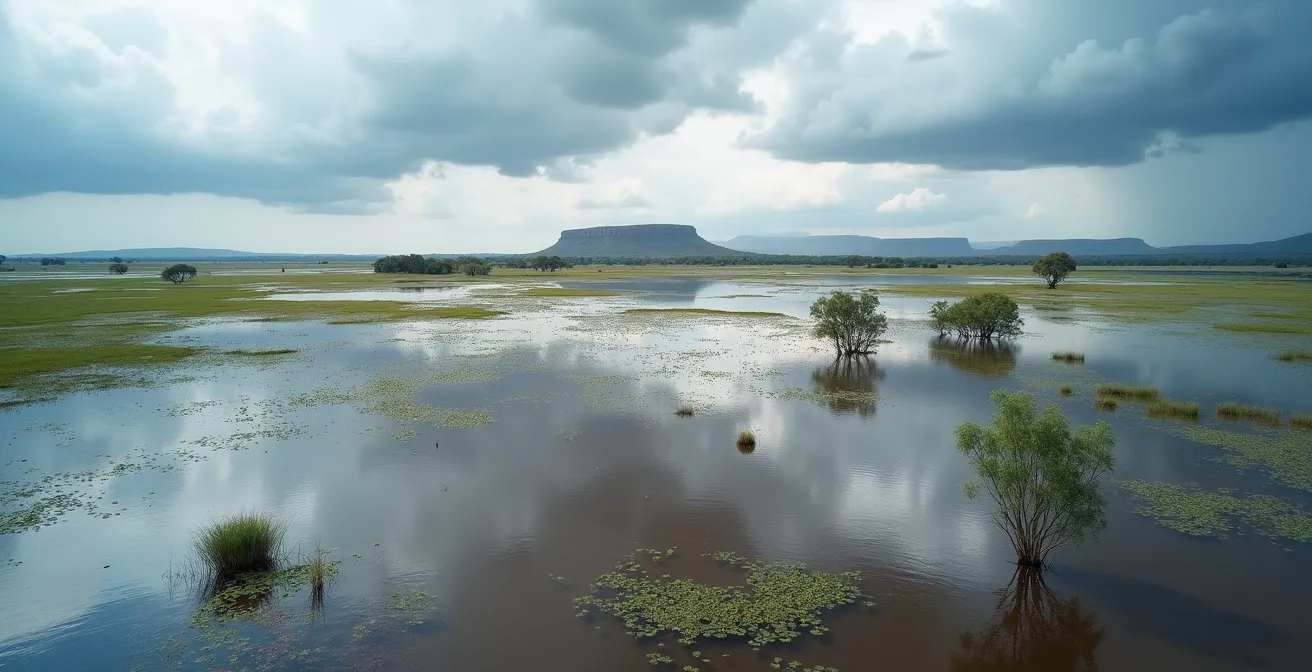
This reality offers a clear lesson for visitors frustrated by closures. It highlights the importance of checking conditions before you travel and having a flexible itinerary.
Case Study: A Visitor’s Experience in the 2023 Floods
In March 2023, at the height of the wet season, a visitor arrived in Kakadu hoping to see Ubirr, only to find the access road had closed that very day due to rising floodwaters. Disappointed, they consulted with local hotel staff who advised them that Burrungkuy (Nourlangie) was still open. The visitor was able to spend the evening at Nourlangie’s main gallery, experiencing the art in the dramatic light of the wet season. This demonstrates how the elevated position and resilient infrastructure of certain sites make them a crucial alternative during periods of heavy flooding.
A “closed” sign at Ubirr doesn’t mean Kakadu is closed; it means you need to adapt your plan to the park’s powerful natural rhythms.
Sacred sites within Uluru: recognizing the areas where photos are banned
To better understand the logic behind Kakadu’s restrictions, it is helpful to compare them with another of Australia’s iconic cultural landscapes: Uluru. While both are managed by Traditional Owners and hold deep spiritual significance, their protocols around visitor access and photography differ significantly. These differences are not arbitrary; they reflect the specific cultural laws (Tjukurpa for the Anangu at Uluru) of each place. At Uluru, visitors are asked not to photograph certain sections of the rock. These are sacred areas associated with sensitive ceremonies or gender-specific knowledge. The sites themselves remain visible as you walk the base, but capturing their image is forbidden.
In Kakadu, the approach is different. Photography is generally permitted at the public-access sites like Ubirr and Burrungkuy. The restriction is not on the act of photography, but on physical access to the site itself. As the UNESCO World Heritage listing for Kakadu notes, large areas of the park are virtually inaccessible to anyone other than Traditional Owners and park managers. This ensures that the most sensitive sites are “subject to little interference.” This strategy prioritizes complete protection of the physical site and its associated knowledge over allowing partial, restricted access.
The following table clarifies these distinct approaches to custodial management, showing that cultural protocols are tailored to the specific needs of each site and its custodians.
| Site | Traditional Owners | Photography Policy | Access Policy |
|---|---|---|---|
| Uluru Sacred Sites | Anangu | Photography banned at specific sacred locations | Physical access allowed with restrictions |
| Kakadu Rock Art Sites | Bininj/Mungguy | Photography generally allowed | Many sites completely closed to visitors |
| Rainbow Serpent Gallery (Ubirr) | Mirrar Erre clan | Photography permitted | Women-only site rule relaxed for tourists |
Each set of rules is a deliberate, culturally specific decision made by custodians to protect what is most important to them.
Why visiting Darwin in the wet season limits your outdoor activities?
The access issues within Kakadu are directly linked to the broader climate patterns of Australia’s Top End. Darwin, the gateway city to the park, experiences a dramatic transformation during the wet season. From November to March, the region is characterized by high humidity, heavy rainfall, and the potential for tropical cyclones. While this “green season” brings a stunning vibrancy to the landscape, it also brings practical limitations, particularly for outdoor activities. The same forces that close roads in Kakadu can cause localized flooding and disrupt plans across the entire region.
The intense rainfall, especially when cyclones from November through March inundate cultural sites, means that many hiking trails, swimming holes, and unsealed roads become unsafe or completely inaccessible. For visitors unprepared for these conditions, it can lead to disappointment. However, the wet season is also a fantastic time to engage with the region’s rich cultural life indoors. The heat and rain have historically been a time for storytelling and creating art, and many of these opportunities are available to visitors today.
Rather than seeing the wet season as a barrier, it can be viewed as an invitation to experience a different side of Top End culture. The region’s art galleries and cultural centres offer a cool, dry refuge and a chance to see incredible works of Aboriginal art.
Here are some excellent alternatives for a culturally rich experience during Darwin’s wet season:
- Visit the Museum and Art Gallery of the Northern Territory (MAGNT), which houses an extensive collection of Aboriginal art, including the prestigious Telstra National Aboriginal & Torres Strait Islander Art Awards.
- Explore community-owned art centres like Marrawuddi Gallery in Jabiru or galleries in Darwin, where you can buy authentic artwork directly from the artists and their communities.
- Attend indoor Indigenous artist workshops or cultural talks that are often scheduled during this period.
- Take a virtual tour of inaccessible sites using the 3D models created by conservation teams, offering a unique digital perspective.
A well-planned wet season visit leverages these indoor opportunities, turning potential weather-related limitations into a cultural advantage.
Key Takeaways
- Site closures are not arbitrary; they are a deliberate management strategy led by Traditional Owners.
- The art’s survival depends on a balance of scientific conservation, cultural law, and environmental management.
- Access restrictions protect both the fragile physical art and the sacred, restricted knowledge it contains.
How to Ask Cultural Questions Without Being Offensive?
Now that you understand the complex reasons behind site closures, you may have more questions. Engaging with Aboriginal culture is a key part of visiting Kakadu, but many visitors are hesitant, fearing they might cause offence. This fear is understandable, but it shouldn’t prevent you from learning. The key is to approach the situation with humility, respect, and an understanding of who is the right person to ask. The most important principle is recognizing that you are a guest in someone else’s home—a home that holds millennia of history.
The best people to direct your questions to are accredited Indigenous guides or park rangers delivering official talks. These individuals are trained to share cultural information in a way that is appropriate for the general public. They know what stories can be shared and how to explain complex ideas without breaking cultural protocols. Directly approaching a Traditional Owner you see in the park is not appropriate, as you would be putting them in the difficult position of having to refuse you or share knowledge they shouldn’t. Listening is often more powerful than asking. Pay close attention to the stories shared on tours and the information on interpretive signs; the answers to many of your questions are often embedded within them.
Remembering the deep, personal connection between people and this land is crucial. As Senior Traditional Owner Alfred Nayinggul states, this is not just a collection of paintings in a park.
Yes, [Ubirr] is a place with many rock paintings. And the tourists all go there to see them […] But long ago, our ancestors lived there. And so those paintings belong to us.
– Alfred Nayinggul, Senior Traditional Owner of the Mirrar Erre and Manilakarr clan
Ultimately, showing respect for the rules, the land, and the people is the most meaningful way to honour the privilege of being able to visit these sacred places.
Frequently Asked Questions about Kakadu Rock Art Access
Why can’t I access certain rock art sites?
Many sites contain sacred stories meant only for initiated individuals. Access depends on cultural protocols, ceremonial significance, and conservation needs determined by Traditional Owners.
Who should I ask about cultural significance?
Accredited Indigenous tour guides are trained to answer visitor questions appropriately. Park rangers enforce rules but may not share cultural knowledge. Traditional Owners should not be approached directly.
How can I learn without being intrusive?
Listen actively during ranger talks, read interpretive signage carefully, and pay attention to stories shared by guides which often contain implicit explanations about site restrictions.