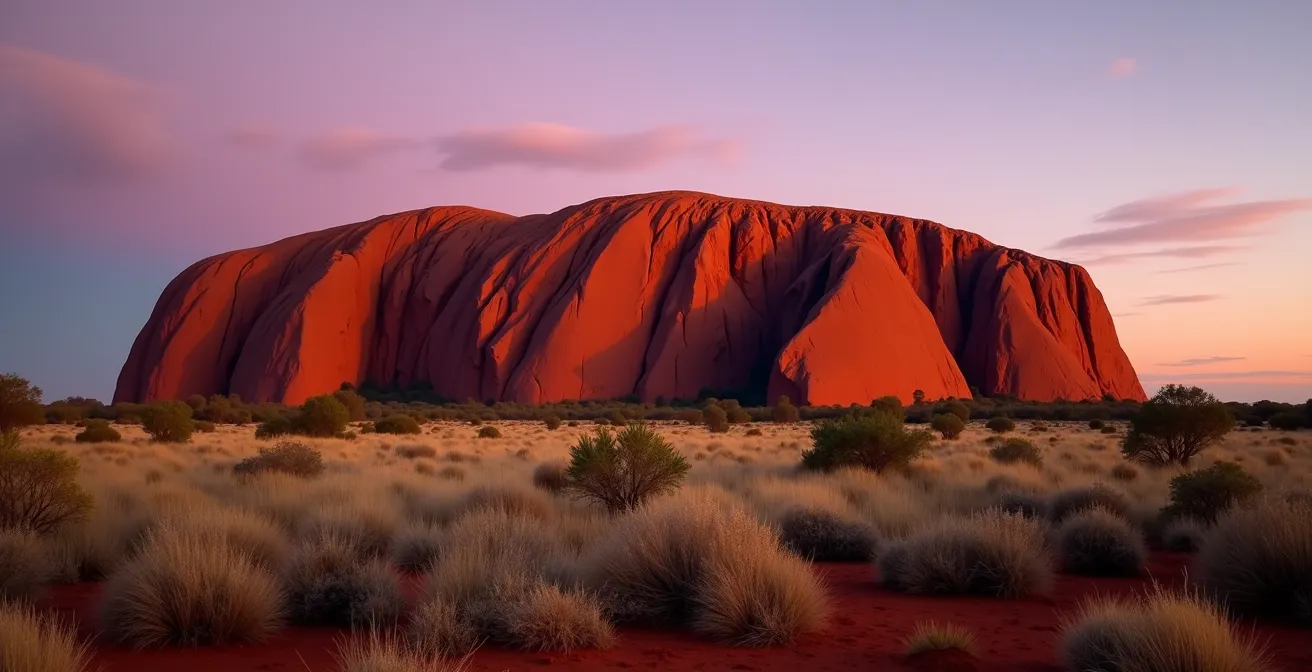
Visiting Uluru is not about following rules; it’s about understanding Tjukurpa, the living law that governs the land.
- The ban on climbing is a direct application of this law, which views the rock as a sacred, physical embodiment of ancestral beings.
- Respectful engagement goes beyond not climbing and includes understanding where to take photos and the deeper meaning behind the landscape’s features.
Recommendation: Shift your mindset from a tourist ticking a box to a guest invited to learn, by choosing Indigenous-led experiences and practicing ‘deep listening’ to the land.
For decades, the question for many visitors to Australia’s red centre was whether to climb Uluru. That question was settled in 2019 when the climb was permanently closed. But focusing on the prohibition itself misses the profound reason behind it. The closure wasn’t just a new rule; it was the rightful assertion of an ancient one, a law that has governed this landscape for tens of thousands of years. This law is called Tjukurpa, and understanding it is the true key to visiting Uluru with respect.
Many travel guides simply state that Uluru is a sacred site and that climbing is disrespectful to the Anangu, the traditional owners of the land. While true, this is a surface-level explanation. It frames respect as a list of things you cannot do. This guide takes a different approach. We will explore Uluru not as a monolithic tourist attraction with restrictions, but as a living cultural landscape. Your visit is an invitation to witness Tjukurpa in action—a complex system of law, spirituality, and ecological knowledge that is as present today as it was in the ancestral past.
This perspective transforms your experience. A walk around the base is no longer just a hike; it’s a journey through chapters of creation. The play of light at sunrise is not just a photo opportunity; it’s a connection to the daily cycle of life and spirit. By moving beyond the simple “don’t” of the climbing ban to the “why” of Anangu law, you cease to be a mere spectator and become a respectful participant in one of the world’s oldest living cultures.
To truly grasp the significance of this sacred place, this article will guide you through the core principles of Anangu culture and law. From the fundamental role of Tjukurpa in managing the park to the practical ways you can engage with the landscape, you will gain a deeper appreciation for why this is so much more than just a rock.
Summary: A Guide to Respecting Anangu Law and Tjukurpa at Uluru
- Why the creation stories of Tjukurpa dictate the management of the park?
- How to complete the 10km Uluru base walk before the midday heat hits?
- Sunrise or Sunset: which light creates the most dramatic color change on Uluru?
- The difference between a standard tour and an indigenous-led walk
- Sacred sites within Uluru: recognizing the areas where photos are banned
- How the Rainbow Serpent carved the gorges you are hiking through?
- Why the RFDS is the lifeline for remote communities in the outback?
- Understanding ‘Dreamtime’: Why It Is Not Just Mythology?
Why the creation stories of Tjukurpa dictate the management of the park?
To understand why you cannot climb Uluru, you must first understand that the site is governed not by modern park regulations alone, but by Tjukurpa. This is a foundational concept in Anangu life, often inadequately translated as ‘the Dreamtime’. It is far more than a collection of myths; it is a comprehensive, living system of law, philosophy, and religion that details the creation of the world by ancestral beings. These ancestors—Kuniya (the Woma Python), Liru (the Poisonous Snake), and Mala (the Rufous Hare-wallaby)—shaped the landscape as they traveled, and their actions created the physical features of Uluru and Kata Tjuta. Every cave, waterhole, and fissure in the rock is a physical record of their journey and the law they laid down.
This is not a historical footnote; it is the active legal and moral framework for the park’s governance today. Uluru-Kata Tjuta National Park is jointly managed by the Anangu and Parks Australia, a partnership where traditional law is paramount. As Parks Australia officially states, Tjukurpa guides the development and interpretation of park policy as set out in the Plan of Management. This means that decisions about conservation, tourism, and land care are made through the lens of Tjukurpa.
A powerful example is the integration of traditional patch burning into the park’s fire management strategy. This ancient practice, guided by Anangu ecological knowledge, helps prevent large-scale wildfires and promotes biodiversity. It’s a practical demonstration of how Tjukurpa is not just a spiritual belief but a sophisticated and effective system of environmental stewardship. The climb was closed because the path of the climb itself desecrates a sacred route tied to the Mala Tjukurpa, a violation of this living law.
How to complete the 10km Uluru base walk before the midday heat hits?
Experiencing Uluru respectfully means engaging with it on its own terms, and the 10-kilometre base walk is the most profound way to do so. It is not a race against the clock but an invitation to slow down and observe the details of the ‘spiritual geography’ around you. To do this safely and mindfully, timing and approach are everything. The desert heat is a serious factor, with temperatures often soaring above 30°C by mid-morning, making an early start non-negotiable.
Instead of a simple trek, consider the walk an exercise in what the local Ngangikurungkurr people call ‘Dadirri’—a practice of deep, respectful listening. This means pausing, being still, and attuning your senses to the environment: the sound of the wind moving through the desert oaks, the calls of the zebra finches, the texture of the ancient rock face. It is through this quiet observation that the stories of the land begin to reveal themselves. You start to notice the subtleties—the way a cave was formed, the path of a water stain from a rare rainfall, the placement of ancient rock art.
This paragraph introduces the illustration. To best capture this intimate connection with the land, notice the textures underfoot and the way light and shadow play across the rock’s surface. The path itself tells a story.

As you can see, the morning light creates long shadows, offering natural pockets of shade and highlighting the rich texture of the red earth. Following these shadows is a practical way to stay cool while connecting with the rhythm of the day as understood by Anangu. By walking in this contemplative manner, the journey becomes a form of communication with the landscape itself.
Your action plan: a mindful Uluru base walk
- Start at first light: Arrive at the Mala carpark 30 minutes before sunrise to watch the rock transform from deep purple to fiery red.
- Practice ‘Dadirri’: Every 20 minutes, pause for a moment of deep listening. Notice the wind, the bird calls, and the silence.
- Follow the shadows: Walk the circuit clockwise, using the rock’s natural morning shade as your guide for cooler rest breaks.
- Listen with your heart: Absorb the knowledge you encounter not just as information, but as a story that settles in your mind and heart.
- Finish before the heat: Aim to complete the 3-4 hour walk by 10:30 AM, before the desert sun becomes dangerously intense.
Sunrise or Sunset: which light creates the most dramatic color change on Uluru?
The “magic” of Uluru’s changing colors at sunrise and sunset is a world-renowned spectacle. But for Anangu, this daily event is more than just a beautiful display; it is a deeply significant part of the land’s spiritual rhythm. Choosing between sunrise and sunset is not just about photography; it’s about selecting which part of the Tjukurpa daily cycle you wish to connect with. Both offer a dramatic transformation, but they carry different feelings and cultural meanings.
Sunrise is associated with new beginnings. It marks the start of life’s journey, a time of awakening and clarity. The air is cool and still, and the silence of the pre-dawn is a powerful moment for quiet contemplation. In contrast, sunset represents the end of the daily cycle and a connection to the spirit world. The warmth of the day lingers in the air as the rock glows with a final, intense burst of energy before settling into the deep purples of twilight. It is a time for reflection on the day’s journey.
The following comparison breaks down the practical and cultural differences, helping you decide which experience aligns best with your intentions for visiting. This data, drawn from official park information, highlights how every aspect of the visit can be viewed through a cultural lens.
| Aspect | Sunrise | Sunset |
|---|---|---|
| Cultural Significance | New beginnings, start of life’s journey in Tjukurpa | Connection to spirit world, end of daily cycle |
| Color Progression | Purple → Pink → Red → Orange | Yellow → Orange → Deep Red → Purple |
| Best Viewing Time | 30 min before to 45 min after sunrise | 45 min before to 30 min after sunset |
| Temperature | Cool (10-15°C in winter, 20-25°C summer) | Warm (25-30°C winter, 35-40°C summer) |
| Blue Hour Experience | Pre-dawn silence, spiritual awakening | Post-sunset contemplation, deeper connection |
The difference between a standard tour and an indigenous-led walk
A standard bus tour of Uluru will likely tell you that the rock is a 600-million-year-old sandstone monolith. While geologically accurate, this fact completely misses the point. It describes the “what” but reveals nothing of the “who” or “why.” This is the fundamental difference between a conventional tour and a walk led by an Anangu guide: one speaks about the rock, while the other helps you listen to the stories the rock itself tells. Choosing an Indigenous-led experience is the single most important decision you can make to visit Uluru respectfully.
On an Anangu-led tour, you are not a passive tourist but a student. You learn directly from the traditional custodians of the law. You might watch a local artist demonstrate dot painting, not as a performance, but as a form of storytelling and knowledge-keeping. The guide will point to a feature on the rock and not explain its mineral composition, but share the part of the Kuniya or Liru Tjukurpa that it represents. This approach provides a direct and lasting insight into the culture, shifting your perspective from the geological to the spiritual.
This is an act of cultural exchange, where knowledge is transmitted through gesture, story, and presence. Supporting these tours also provides direct economic and social benefits to the community, with many guides being graduates of specialized training programs.
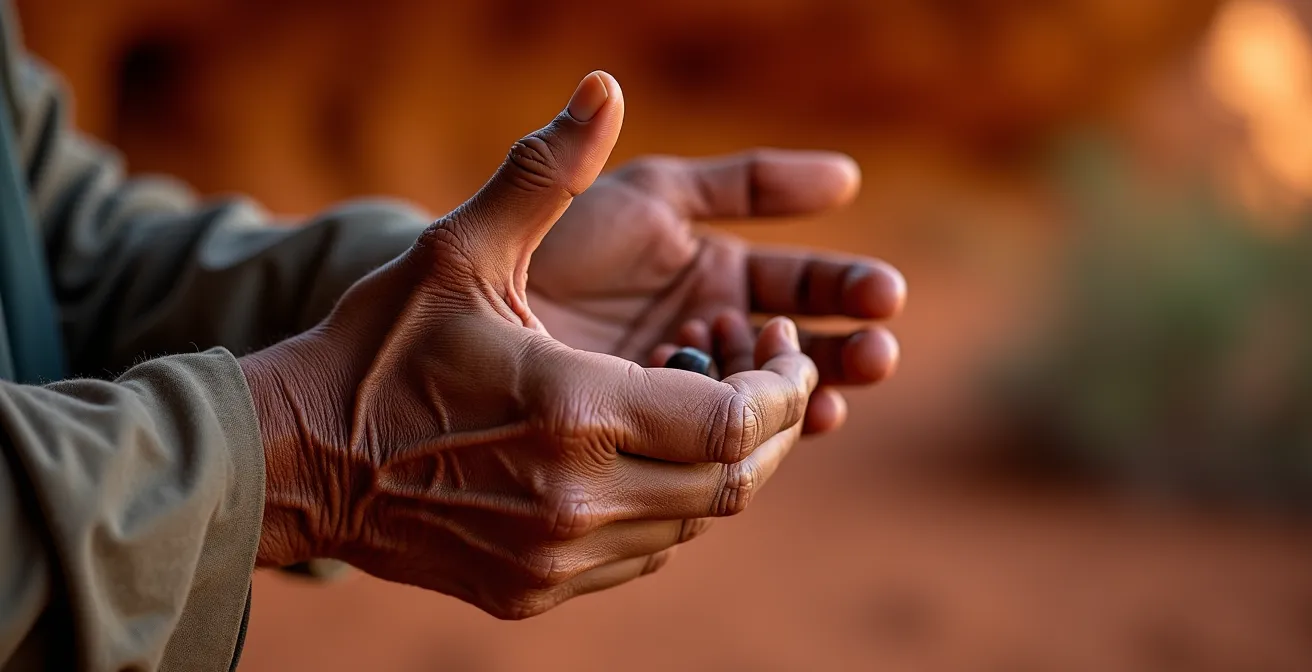
As you can see in this depiction of cultural sharing, the focus is on the human connection and the act of passing down knowledge. This is not something that can be replicated from a guidebook. According to Ayers Rock Resort, many of their Indigenous staff are graduates of the National Indigenous Training Academy, ensuring that cultural interpretation is both authentic and professionally delivered. The experience is about direct storytelling from traditional custodians, a connection that no other tour can provide.
Sacred sites within Uluru: recognizing the areas where photos are banned
A crucial aspect of respecting Tjukurpa involves understanding that not all parts of Uluru are meant for all eyes, and certainly not for the camera lens. While the rock as a whole is sacred, specific areas hold a level of significance akin to the most holy texts of other world religions. These are active ceremonial sites and places of deep spiritual power. In these locations, photography is strictly forbidden by Anangu law. A sign with a camera crossed out is not a suggestion; it is a legal and moral directive.
As the World History Encyclopedia notes, photography of a large portion of these ancient rock paintings and petroglyphs is forbidden. This is because these markings are not simply “art”; they are a physical manifestation of Tjukurpa. They are religious texts, teaching tools, and records of law. For example, certain sites are sacred men’s sites (like Warayuki) while others are sacred women’s sites (like Mala Puta and Pulari). To photograph them would be a profound violation of cultural privacy and religious law, equivalent to broadcasting a secret and sacred ceremony to the world.
This restriction is not meant to deprive visitors of an experience. On the contrary, it is an invitation to have a more profound one. It encourages you to put down the camera and be fully present. It asks you to form a deep, personal memory that is not mediated by a screen or intended for social media. This is a rare gift in the modern world—an opportunity to connect with a place purely through your own senses and consciousness, just as Anangu have for millennia. Taking a rock or sand from the park is also a deep violation, leading to the well-documented phenomenon of “sorry rocks” being mailed back to the park by tourists who experience bad luck after the theft.
How the Rainbow Serpent carved the gorges you are hiking through?
The stories of Tjukurpa are not confined to Uluru alone. The entire landscape, including the soaring domes of nearby Kata Tjuta, is a narrative map of ancestral journeys. One of the most significant of these ancestors is the Rainbow Serpent, a powerful being present in creation stories across Aboriginal Australia. At Kata Tjuta, the dramatic gorges and wind-swept valleys are understood to have been shaped by the movement of these great serpents.
As you hike through Walpa Gorge, for example, you are literally walking through a chapter of Tjukurpa. Anangu tell stories of Wanambi, great snakes who reside in the waterholes of these gorges. It is said that when they exhale, you can feel the cool breeze that offers respite from the desert heat. This belief is not a quaint piece of folklore; it is an intimate observation of nature intertwined with spiritual law. It reflects a sophisticated understanding of how the landscape’s topography influences microclimates, explained through the living presence of an ancestral being.
Similarly, the forms on Uluru itself are tied to serpent battles. A key part of the Tjukurpa for Uluru’s southern face describes the epic war between Kuniya, the Woma Python, and Liru, the Poisonous Snake. The physical indentations, boulders, and marks on the rock are the direct results of this battle. For example, a large concave form is where Kuniya danced across the rock. You are not just looking at erosion; you are seeing the physical evidence of a battle between creator beings. This is the essence of ‘spiritual geography’—the land is the storybook, and its features are the words.
Key takeaways
- Tjukurpa is not mythology; it is the living legal and spiritual framework that actively governs Uluru-Kata Tjuta National Park.
- Respectful visitation involves more than not climbing; it means engaging with the land’s stories through Indigenous-led tours and mindful observation.
- Photography restrictions at sacred sites are a fundamental law, offering visitors a chance for a deeper, unmediated connection with the place.
Why the RFDS is the lifeline for remote communities in the outback?
Respect for Uluru and its people extends to understanding the context of life in the remote Australian Outback. In this vast and often unforgiving environment, access to healthcare is a critical challenge. This is where the Royal Flying Doctor Service (RFDS) plays an indispensable role. The RFDS is not just an emergency service; it is the primary healthcare provider for millions of Australians living in remote and rural areas, including the communities around Uluru.
The sheer scale of their operation is staggering. The Royal Flying Doctor Service provides medical coverage to 7.69 million square kilometres of Australia, an area larger than Western Europe. They operate a fleet of specially-equipped aircraft that function as intensive care units in the sky, bringing critical care to people who may be hundreds of kilometres from the nearest hospital. For the Anangu community and other residents of the Outback, the RFDS is a vital lifeline, responding to everything from serious accidents to chronic health issues.
Their work, however, goes far beyond emergency evacuations. The RFDS provides comprehensive primary health services, including dental clinics, mental health support, and telehealth consultations. For travelers, understanding the role of the RFDS adds another layer of appreciation for the realities of Outback life. It is a reminder that living in this beautiful but isolated landscape requires incredible resilience and a robust support network. Acknowledging and, where possible, supporting their work is another facet of being a responsible and respectful visitor to the region.
Understanding ‘Dreamtime’: Why It Is Not Just Mythology?
The term ‘Dreamtime’ is widely used but often misunderstood, and it is a crucial concept to clarify for any respectful visitor. As the Ayers Rock Resort’s cultural team explains, Anangu life revolves around the Tjukurpa, which is sometimes wrongly referred to as the Dreamtime. While it refers to the ancestral period of creation, calling it “Dreamtime” can imply it is a dream, a myth, or something that is not real. For Anangu, Tjukurpa is the absolute opposite: it is the ultimate reality and the foundation of all life and society.
Tjukurpa is not a collection of stories from the past. It is a living law that continues to guide everything in the present, from social relationships to land management. It is a ‘see-able’ law, written into the very fabric of the landscape. When an Anangu guide tells you the story of Kuniya and Liru, they are not recounting a myth; they are explaining a legal and physical reality that is as true and present today as it was when it occurred.
This understanding is the final piece of the puzzle. The climbing ban, the photo restrictions, the prescribed burning practices—all are direct applications of this living, breathing law. Tjukurpa dictates that Anangu are obligated to protect the land and the sacred stories it holds. Allowing visitors to climb Uluru was a violation of that profound responsibility. By choosing to visit on the ground, listen to the stories, and respect the sacred sites, you are not just following rules. You are actively participating in the honoring of Tjukurpa, and in doing so, you experience Uluru not as an object to be conquered, but as a teacher to be respected.
Frequently asked questions on Why Climbing Uluru Is Forbidden and How to Respect Anangu Law?
Why are certain areas of Uluru off-limits for photography?
The rock carvings and features in these areas are extremely culturally sensitive. For the Anangu, particularly women, they are the equivalent of sacred religious texts in other cultures, and photographing them is a profound violation of their law and privacy.
Which specific sites have photography bans?
Photography is banned at several signed locations around the base of Uluru. These include Taputji, a culturally sensitive site for all Anangu, as well as Tjukatjapi, Pulari, and Mala Puta, which are sacred women’s sites. Warayuki is a cave-like sacred men’s site where photos are also forbidden.
How should visitors respond to photography restrictions?
View the ban not as a restriction, but as a rare gift. It is an invitation to be fully present in the moment and to form a deep, personal memory that cannot be commodified or shared online. It allows for a more authentic and respectful connection to the site.