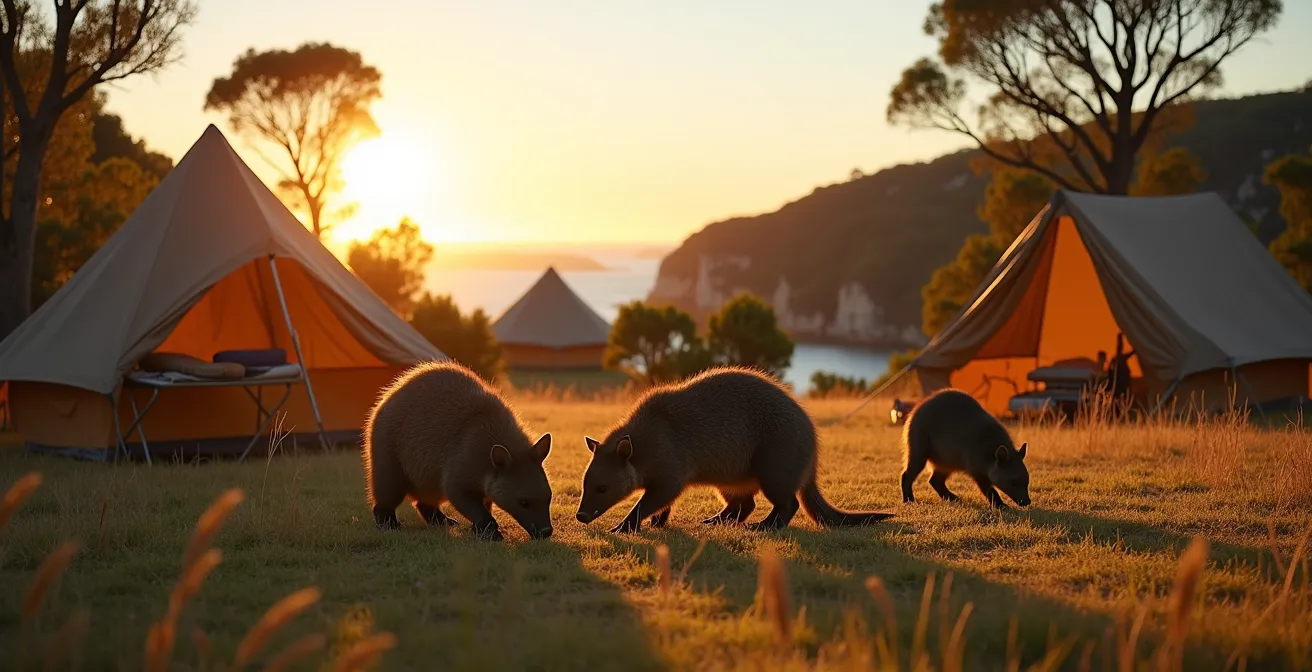
Securing a campsite near wombats at Wilsons Prom is less about luck and more about a dedicated strategy for managing their behaviour.
- Success depends on navigating the competitive ballot system and having solid backup plans.
- True wombat-proofing goes beyond just hiding food; it involves securing your entire campsite from their powerful, scent-driven curiosity.
Recommendation: Shift your mindset from passive observation to active preparation. Audit your gear and your booking plan before you even think about packing the car.
The dream for many campers visiting Wilsons Promontory is that magical, heart-stopping moment: a furry, barrel-shaped wombat munching on grass just metres from your tent as dusk settles. It’s an iconic Australian experience. Many guides will offer the usual advice: book your site at Tidal River far in advance, keep your food locked away, and hope for the best. This approach often leads to disappointment, either from failing to secure a spot or from a stressful encounter with a surprisingly determined marsupial.
But what if the key wasn’t just about being lucky? What if getting that perfect, peaceful wombat encounter was a predictable outcome of the right strategy? The secret lies in moving beyond generic tips and adopting an insider’s mindset. It’s about understanding wombat behaviour to anticipate their movements, mastering the booking system like a game of chess, and equipping yourself not just to see them, but to coexist with them safely and ethically. This isn’t just about preventing a wombat from stealing your bread; it’s about creating an environment where both you and the wildlife can feel secure.
This guide will break down that strategy step-by-step. We will cover everything from mastering the elusive booking process to the specific gear modifications that make your campsite genuinely wombat-proof. We’ll explore how to capture stunning photos without disturbing the animals and even touch on what to do if you encounter wildlife in distress, transforming you from a hopeful tourist into a knowledgeable and responsible visitor.
Summary: Wilsons Promontory Camping: A Strategic Guide to Wombat Encounters
- The ‘wombat walk’: how to store your cooler so wombats don’t break in at night?
- The lottery system: when to apply for a peak summer camping permit?
- Settings for twilight: capturing fur details without using a flash that scares them
- Healthy vs sick: what to do if you see a wombat with skin issues?
- Kangaroo Valley or Maria Island: where else are wombats guaranteed to be seen?
- The only diurnal marsupial: where in Western Australia can you see a numbat?
- Zippers and mesh: ensuring your luxury tent is actually mosquito-proof
- Interacting with Australian Wildlife: 5 Safety Rules to Prevent Injury
The ‘wombat walk’: how to store your cooler so wombats don’t break in at night?
Experienced Prom campers know about the “wombat walk”—the well-trodden, invisible highways these animals use every night to navigate the campgrounds. They are creatures of habit, and your campsite might be directly on their route. Their goal is simple: follow any interesting scent to its source. A standard cooler or a canvas bag is no match for a creature that can dig extensive burrows through compacted soil. Their powerful claws and jaws can make short work of plastic and fabric, driven by a sense of smell that is remarkably acute. This isn’t just an inconvenience; it can be destructive.
Case Study: The Viral Tent Invasion
The risk is very real. A viral TikTok video from October 2024 showed the aftermath of a wombat encounter where the animal had torn straight through a tent wall in its search for food. The incident, which gained over 3.3 million views, serves as a stark reminder that even a fabric wall offers no protection. As the camper noted, it highlights how you’re “never really safe from anything” without proper precautions.
Therefore, wombat-proofing your food storage is non-negotiable. The number one rule is that all food, toiletries, and scented items must be stored in the boot of your locked vehicle overnight. Never leave an esky (cooler) outside your tent, no matter how robust you think it is. For temporary daytime storage, using heavy-duty straps and wildlife-specific locks can add a layer of security. After every meal, a thorough cleanup is essential. Wipe down tables, pack away all scraps, and ensure your site is as scent-free as possible before dusk descends and the wombat walk begins.
The lottery system: when to apply for a peak summer camping permit?
One of the biggest hurdles for camping at Wilsons Promontory, especially at the popular Tidal River campground, is securing a spot during peak season. Many first-timers assume it’s a simple first-come, first-served online booking race. This is a critical mistake. For the peak summer holiday period (typically from Christmas to late January), Parks Victoria runs a ballot system. This is essentially a lottery. You enter during a specific application window, usually around June, and find out weeks or months later if you were successful. Missing this window means you have zero chance of camping at Tidal River in summer.
The competition is fierce. The park’s stunning coastal scenery and abundant wildlife make it a prime destination for the 15.2 million camping trips taken in Australia annually. Visitor reports frequently confirm that accommodations are fully booked up to a year in advance for school holidays and long weekends. Your strategy must be to know the ballot dates (check the Parks Victoria website religiously) and apply the moment it opens. Have multiple date options and site types in mind to increase your chances.
But what if you lose the lottery or are planning a last-minute trip? Don’t despair. Several excellent campgrounds are located just outside the park’s entrance, offering a fantastic alternative with their own abundant wildlife—often without the crowds or complex booking systems.
This table outlines some of the best alternatives for those who miss out on the main ballot.
| Campground | Distance from Prom | Wildlife Present | Booking System |
|---|---|---|---|
| Stockyard Campsite | 2 minutes from entrance | Kangaroos, wallabies, wombats | Free, first-come basis |
| Fish Creek Area | 7 minutes south | Wombats, wallabies, koalas | Direct booking |
| Yanakie | At park entrance | Dog-friendly, various wildlife nearby | Standard booking |
Settings for twilight: capturing fur details without using a flash that scares them
Photographing wombats at dusk is a delicate art. The golden hour and ensuing twilight are when they are most active, but it’s also the most challenging lighting condition. The number one rule of ethical wildlife photography is to never use a flash. A sudden burst of white light can startle a wombat, causing it to flee, become aggressive, or even be temporarily blinded, making it vulnerable. It ruins the moment for you, stresses the animal, and teaches it to be wary of humans. The goal is to be a ghost—present but unnoticed.
To capture the beautiful detail of their coarse fur without a flash, you need to master low-light settings on your camera. This means opening up your aperture as wide as possible (e.g., f/2.8 or lower) to let in maximum light and create a soft, blurred background. You’ll need to increase your ISO (the sensor’s sensitivity to light) to a range between 1600 and 6400. This will introduce some grain, but it’s far better than a blurry, underexposed shot. Enable your camera’s image stabilization and shoot in burst mode to increase your chances of getting a sharp image. A tripod can be a game-changer, but if you’re on the move, brace yourself against a tree or the ground for stability.
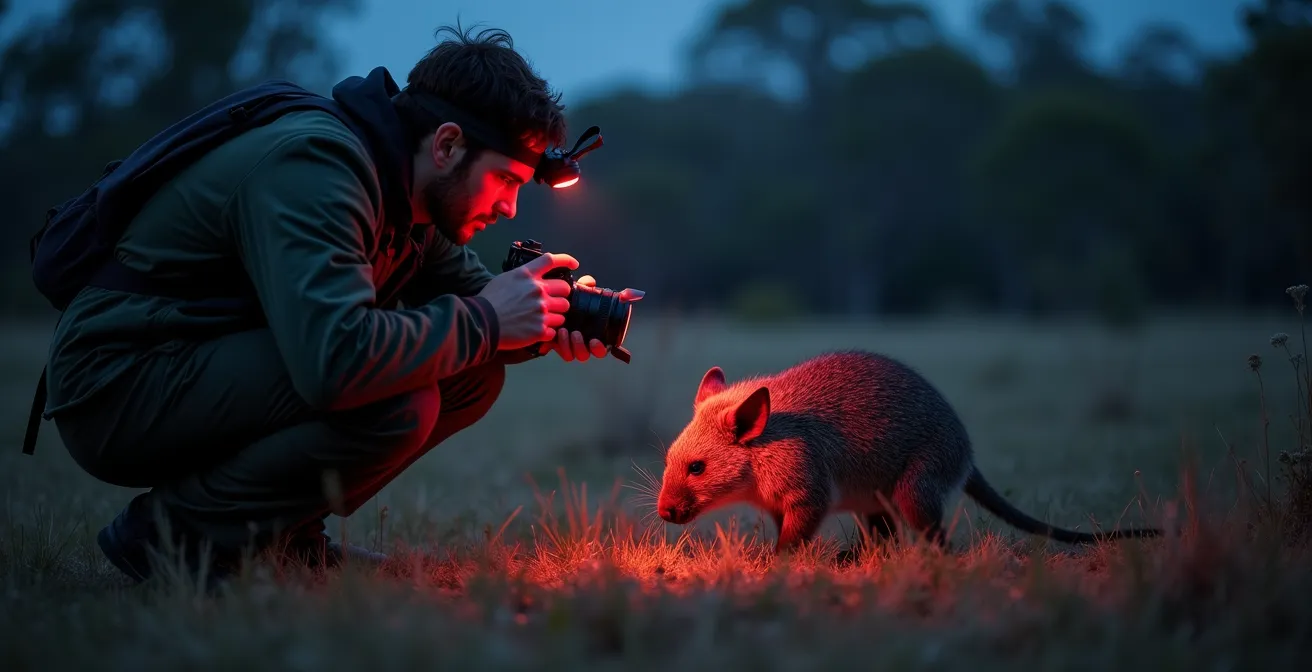
Perhaps the most advanced “insider” technique is using a red light. Wombats, like many nocturnal animals, have poor red-light vision. A headlamp with a red-light mode allows you to observe and set up your shot without startling them. Position yourself downwind so your scent doesn’t give you away, and be patient. Let the wombat come to you, and you’ll be rewarded with natural, intimate photographs that truly capture its character.
Healthy vs sick: what to do if you see a wombat with skin issues?
Part of being a responsible visitor is knowing how to recognize an animal in distress. While most wombats at Wilsons Prom are healthy, they are susceptible to sarcoptic mange, a debilitating disease caused by parasitic mites. It’s a significant animal welfare issue across Australia. Knowing the signs is crucial. A healthy wombat has a thick, coarse coat of fur and is generally robust and energetic at night. A wombat suffering from mange will show obvious signs: significant hair loss, thick and crusty skin (especially around the eyes and on the back), and often appears disoriented or unusually lethargic, sometimes even venturing out during the day.
If you see a wombat you suspect has mange, the most important rule is to do not approach it. The animal is already under immense stress and may react defensively. It’s also a zoonotic disease, meaning it can potentially transfer to humans, although this is rare. Do not attempt to treat it or feed it. Your role is to observe and report. Take a photo from a safe distance if you can, note your exact location (e.g., campsite number, trail marker), and report it to the Parks Victoria staff at the Tidal River Visitor Centre or by calling their information line. Your report provides valuable data for park ecologists managing the health of the population.
This concern for their welfare exists within a complex landscape for the species. Beyond disease, wombats face other threats. For instance, research from Humane World for Animals revealed that 3,558 wombats were legally killed under licence in 2023 in some parts of Australia where they are considered agricultural pests. This context underscores the importance of protecting the healthy populations within national parks like Wilsons Prom. Your vigilance as a visitor plays a small but vital part in that conservation effort.
Kangaroo Valley or Maria Island: where else are wombats guaranteed to be seen?
While Wilsons Promontory is arguably the most famous place to camp with wombats, its popularity can be a double-edged sword. If you miss out on the ballot or simply prefer a quieter experience, it’s worth knowing that other locations in Australia offer “guaranteed” wombat sightings, each with a unique character. Expanding your horizons can lead to an equally magical, and sometimes more intimate, encounter. Two of the best alternatives are Bendeela Recreation Area in New South Wales’ Kangaroo Valley and Maria Island in Tasmania.
Field Report: The Bendeela Wombat Experience
One of the most accessible options is Bendeela, a free camping area just two hours from Sydney. As a report from Dirty Drifters explains, it offers a truly immersive experience: “We had the privilege of camping right next to wombats… In Kangaroo Valley, the wombats don’t give a care about you being there – they just keep munching grass near your campsite.” This proximity, with wombats emerging from under cars and grazing by tents all night, makes it a top contender for a hassle-free encounter.
Maria Island offers a completely different vibe. A short ferry ride off Tasmania’s east coast, this national park is a car-free sanctuary. Here, wombats are so abundant and unafraid that they are a ubiquitous part of the landscape, often seen grazing on the historic Darlington settlement’s lawns in broad daylight. The effort to get there is rewarded with a pristine environment and an almost prehistoric sense of tranquility. Each location provides a different flavour of wombat-watching, from the riverside freedom of Bendeela to the island isolation of Maria Island.
To help you decide which alternative might be right for your next trip, here is a comparison of the top wombat-viewing locations.
This comparative analysis from a dedicated Australian camping guide provides a clear overview of the options.
| Location | Distance from Sydney/Melbourne | Best Feature | Access Difficulty |
|---|---|---|---|
| Wilsons Promontory | 3 hours from Melbourne | Most wombats, coastal scenery | Moderate – car required |
| Bendeela Recreation Area | 2 hours from Sydney | Free camping with wombats | Easy – direct drive |
| Maria Island | Ferry from Tasmania | No cars, pristine environment | Complex – ferry required |
The only diurnal marsupial: where in Western Australia can you see a numbat?
Once you’ve had your incredible wombat encounter, the natural next question for a wildlife enthusiast is: what’s next? Australia’s fauna is famously unique, and moving from the nocturnal world of wombats to the daytime realm of other marsupials offers a whole new challenge. Enter the numbat, one of Australia’s most beautiful and endangered animals. Unlike most marsupials, the numbat is almost exclusively diurnal, meaning it’s active during the day. This unique behaviour is dictated by its diet.
Echidnas are diurnal. They are one of only two Australian mammals which are active only during the day (the other is the numbat). Both eat ants, which is why they are daytime foragers.
– Wildlife expert on TripAdvisor forum, Wilsons Promontory National Park Forum
The numbat feeds almost exclusively on termites, consuming up to 20,000 per day. Since termites are most active in the warmth of the day, so is the numbat. With its elegant, reddish-brown coat, striking white stripes, and bushy tail, it’s a breathtaking sight. However, being small and diurnal also makes it highly vulnerable to predators like eagles and foxes. This, combined with habitat loss, has made it critically endangered, with its wild population now almost entirely restricted to small pockets of Western Australia.
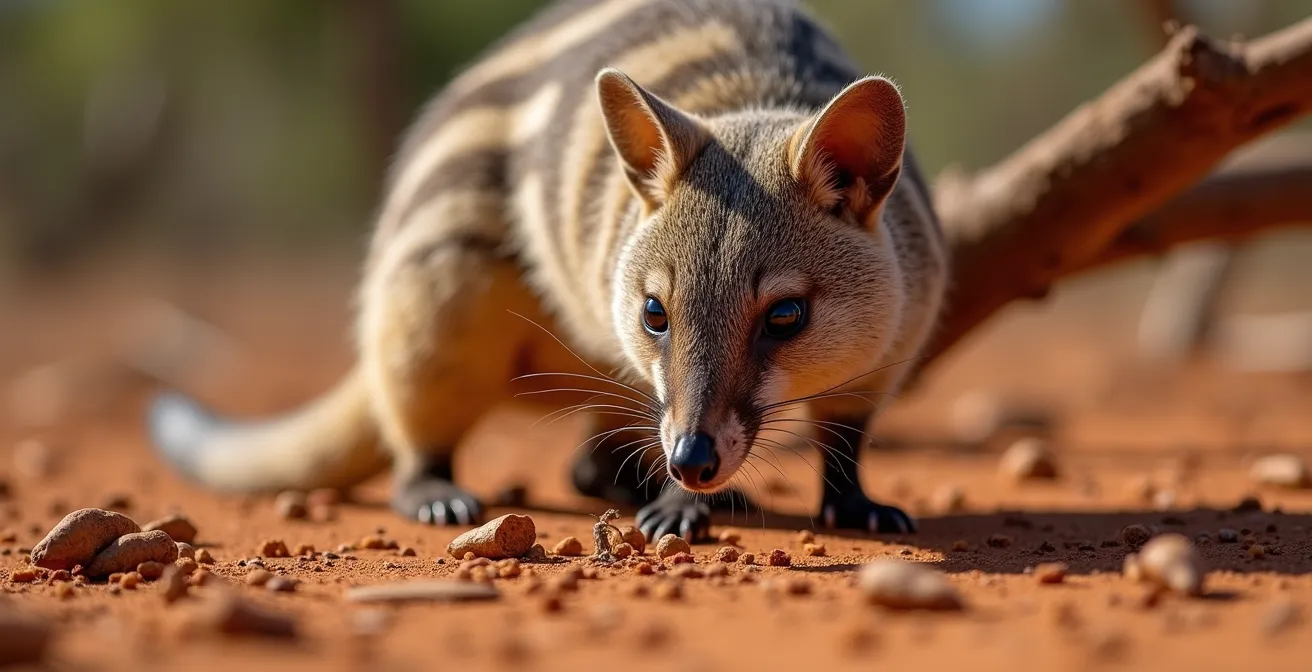
The absolute best place in the world to see a numbat in the wild is Dryandra Woodland, about two hours southeast of Perth. This area of wandoo and mallee forest is one of the last remaining strongholds for the species. To see one, you need to drive slowly along the park’s roads in the mid-morning or mid-afternoon, scanning the ground near fallen logs and termite mounds. It requires immense patience and a bit of luck, but spotting this rare and beautiful creature is a pinnacle experience for any Australian wildlife lover.
Zippers and mesh: ensuring your luxury tent is actually mosquito-proof
A wombat encounter is the goal, but your trip can be quickly ruined by smaller, more persistent intruders: insects. A high-quality tent is an investment in comfort and safety, but not all “luxury” tents are created equal when it comes to being truly wildlife-proof, from the largest marsupial down to the tiniest mosquito. It’s the small details that matter, and auditing your tent’s features is a critical part of your pre-trip preparation. True “wombat-proofing” extends to your shelter, as their curiosity can lead them to investigate tent vestibules if a scent catches their interest.
Your first line of defence against insects is the mesh. Standard fly screens are not enough to stop the notoriously small midges found in many coastal areas. You need to ensure your tent has no-see-um mesh, which typically has a density of at least 1200 holes per square inch. This fine weave is impenetrable to even the smallest bugs. The second critical element is the zippers. Loud, catchy zippers can be a major disturbance when you need to exit the tent at night, potentially spooking nearby wildlife. Opt for tents with high-quality, silent-gliding zippers like those made by YKK.
Finally, consider the tent’s overall design. A full-zipper closure on the vestibule is a must. This creates an “airlock” system, allowing you to enter or exit the outer door without immediately exposing the inner tent to insects or the curious nose of a passing wombat. Positioning your tent door to face away from the prevailing wind can also significantly reduce the number of insects that fly in when you open it. A truly wildlife-proof tent is a complete system, and checking these features will ensure your nights are peaceful.
Your Checklist for a Wildlife-Safe Tent
- Zipper Quality: Choose YKK or similar silent zippers to avoid spooking wildlife when exiting your tent at night.
- Mesh Density: Install or confirm your tent has no-see-um mesh (minimum 1200 holes per square inch) for complete protection against midges and mosquitoes.
- Vestibule Security: Ensure the vestibule has a full zipper closure, creating an “airlock” against both insects and curious animals like wombats.
- Food Proximity Rule: Always store your food in an esky or, even better, in the car. Wombats have an extremely keen sense of smell and will investigate your tent if food is inside.
- Door Orientation: Position the tent door facing away from the prevailing wind to minimize the number of insects that get blown inside when you open it.
Key Takeaways
- Strategic Booking is Everything: Success at Wilsons Prom hinges on mastering the peak season ballot system and having alternative, non-ballot campgrounds as a solid Plan B.
- Comprehensive “Wombat-Proofing”: True security goes beyond locking your esky. It means managing all scents, securing your tent, and understanding their nightly behaviour to prevent any unwanted intrusions.
- Ethical Observation is Active, Not Passive: Getting great photos and close encounters requires specific low-light techniques (like red light) and a commitment to never disturbing the wildlife with flashes or sudden movements.
Interacting with Australian Wildlife: 5 Safety Rules to Prevent Injury
The ultimate goal is a close encounter, but “close” does not mean “contact.” Australian wildlife is just that—wild. Misinterpreting their placid grazing as an invitation for a pat can lead to serious injury. Wombats are incredibly strong, with powerful jaws and sharp claws. When they feel threatened or cornered, they can be surprisingly fast and aggressive. Enjoying their presence requires respecting their space and adhering to a strict set of safety rules. These rules aren’t meant to diminish the magic of the experience; they are designed to preserve it for you, the animals, and future visitors.
The first rule is the simplest: keep a respectful distance. Use the zoom on your camera; there is no reason to be within arm’s reach. The second rule is absolute: never, ever feed them. Feeding wildlife habituates them to humans, makes them aggressive, and the food can make them sick. Third, always be aware of your surroundings, especially after dark. Wombats are solid, low-to-the-ground obstacles that can be hard to see.
Be careful where you walk – it’s easy to trip over the wombats
– TripAdvisor Forum Contributor, Wilsons Promontory Wildlife Discussion
Fourth, drive slowly and cautiously within the park from dusk until dawn. This is when many animals are most active and likely to be on or near the roads. Finally, ensure your campsite is secure not just for your own sake, but for the animals’ too. A site free of food scraps and accessible rubbish is a safe site. Following these five rules ensures that your memorable encounter remains a positive one for everyone involved.
Now that you have the complete strategy, from booking and preparation to ethical interaction, you are ready to plan your trip and turn that dream of a wombat at your tent into a reality.
Frequently Asked Questions About Wilsons Promontory Wildlife
What should I do if a wombat approaches my campsite?
Don’t tempt them closer with food as they can become a danger to you and the human food a danger to their health. Stay calm, make no sudden movements, and ensure all food and scented items are securely stored away. They will usually move on if there is nothing of interest.
When are wombats most active and dangerous to encounter?
You will see animals during the day, but many more at night. They are most active from dusk through to dawn. The danger isn’t from their inherent aggression, but from accidental encounters. Always drive carefully after dark and use a torch when walking around the campground at night.
Can wombats actually damage camping equipment?
Yes, absolutely. Although wombats may look harmless to some, they can attack humans when they feel threatened and will fiercely and aggressively defend their burrows. More commonly, their strength and determination in seeking food can lead them to easily tear through tents, bags, and non-secured coolers.